Updated: 20.08.2026 · A practical guide for businesses
de minimis, eligible costs, aid intensity, EDIC, TRL, capital rebate... If you are reading LIAA or ALTUM programme conditions for the first time, it can sometimes feel as though you need to learn a new language before you can even apply.
Most of the terminology is actually quite straightforward. What matters is understanding not only what a term means, but what it means for your project and your money. That is why Juice Digital Agency created this practical funding glossary for businesses in Latvia.
- what it means;
- why it matters;
- a simple example;
- what not to confuse it with.
This article is part of the Juice Digital Agency funding knowledge series: Funds & Financing →
Programme conditions differ. This glossary helps with terminology, but for a specific project you must always check the current conditions of the chosen programme.
Start with these 10 terms
5 things businesses most often misread in funding conditions
If the programme maximum is €25,000, it does not mean every approved project receives €25,000. The actual amount may depend on project costs, aid intensity, eligible costs and the conditions of the specific programme.
A project may have €30,000 in total costs while the programme recognises only part of them as eligible. Support is calculated from eligible costs under the rules of the specific programme.
Aid intensity applies to eligible costs, not automatically to the company's entire project budget.
In ALTUM capital rebate programmes the company first receives a loan. If the programme conditions are met, part of the loan principal can be written off.
The fact that a project is digital does not mean it automatically qualifies for a given support programme. Always check the programme's objective and supported activities.
Can LIAA funding cover website development? →
Funding glossary from A to Z
1.Loan
A loan is financing the company must repay according to the schedule and conditions set by the lender.
ALTUM offers several programmes where state support is combined with a loan. So the word “support” does not always mean a free grant.
Before applying, check whether the programme offers a grant, a loan, a guarantee, a capital rebate or a combination of these instruments.
2.Aid intensity
Aid intensity shows what share of a project's eligible costs the support may cover.
A simple example: eligible costs €20,000, aid intensity 50%, calculated support €10,000. The actual amount always has to be assessed against the conditions and limits of the specific programme.
Important: 50% aid intensity does not mean 50% of any expense the company has.
3.Eligible costs
Eligible costs are the project costs a specific programme accepts as fundable. Depending on the programme these may include:
- external service costs;
- software;
- equipment;
- research;
- testing;
- design;
- specialist costs.
The list differs from programme to programme, so check the rules of the specific programme before planning the budget.
4.Aid beneficiary
A natural or legal person, company or other organisation meeting the requirements of the specific programme that has been granted state or EU support.
Not every company automatically qualifies as a beneficiary of every programme. You need to check:
- company size;
- industry;
- legal status;
- project location;
- linked enterprises;
- other programme criteria.
5.Business incubation
Business incubation is a support mechanism for the early stage of company development.
Depending on the programme it may include financial and non-financial support, consultations, mentoring, contacts and other development instruments. LIAA company stories show that technology and digital product companies have also used incubation support.
6.Price survey
A price survey is the process of comparing potential suppliers' quotations to justify the price of a service or product and the choice of supplier.
In some LIAA programmes a preliminary price survey is mandatory. For example, in the earlier process digitalisation programme LIAA required quotations from at least three candidates plus retained documentation.
Important: a price survey is not simply “I found three prices online”. You must follow the requirements of the specific programme and keep evidence of the procedure.
7.Digital development roadmap
A digital development roadmap is an assessment of a company's digital transformation needs and the investment required.
In the LIAA process digitalisation programmes, EDIC was involved in preparing the roadmap.
8.De minimis
De minimis is the state aid framework defining how much support of a certain type one company or a group of linked enterprises may receive within a given period.
Under European Commission Regulation 2023/2831 the general de minimis ceiling is €300,000 over any three-year period. Different rules may apply to certain sectors and aid schemes.
A simple example: if a company has already received de minimis aid, the amount already used must be taken into account in a new application.
Important: de minimis is not a specific LIAA programme. It is a state aid framework under which support can be granted across different programmes.
9.Digitalisation
In a funding context, digitalisation can mean improving company processes with digital solutions. Depending on the programme this may include:
- process automation;
- software;
- data solutions;
- AI;
- e-commerce;
- system integrations;
- manufacturing digitalisation;
- customer service systems.
This does not mean that any digital purchase is automatically an eligible cost.
10.Digital maturity assessment
A digital maturity assessment evaluates a company's current digital and innovation maturity.
In the LIAA process digitalisation programme, an initial assessment was made before the project and a repeat assessment afterwards to measure the change.
11.EDIC
EDIC stands for European Digital Innovation Hub. EDIC helps companies assess their digital maturity and digitalisation needs.
In the LIAA process digitalisation programmes, EDIC was involved in the digital maturity assessment and the digital development roadmap.
Important: EDIC is not the same as LIAA.
12.Experimental development
Experimental development is work that uses existing knowledge and experience to create new or significantly improved products, processes or services.
In the LIAA innovation voucher programme, experimental development is one of the supported activities.
13.Funding recipient
See: Aid beneficiary.
14.Grant
A grant is financial support that, provided the programme conditions are met, does not have to be repaid like an ordinary loan.
A grant recipient must meet the programme requirements, justify the costs and follow the project implementation rules.
15.Innovation
In a funding context, innovation is not simply something “more modern”.
Specific programmes assess novelty, technological content, product or process development and other criteria set by the programme. An ordinary update of an existing system therefore does not automatically become an innovation project.
16.Innovation voucher
The LIAA innovation voucher is a support instrument for developing new products and technologies with the aim of bringing them to market.
As of August 2026, LIAA states support of up to €25,000 for the development of one new product and an aid intensity of 45-100% depending on the activity and conditions. Supported activities include, for example:
- technical and economic feasibility study;
- industrial research;
- experimental development;
- industrial design of the product;
- certification and testing;
- designer services.
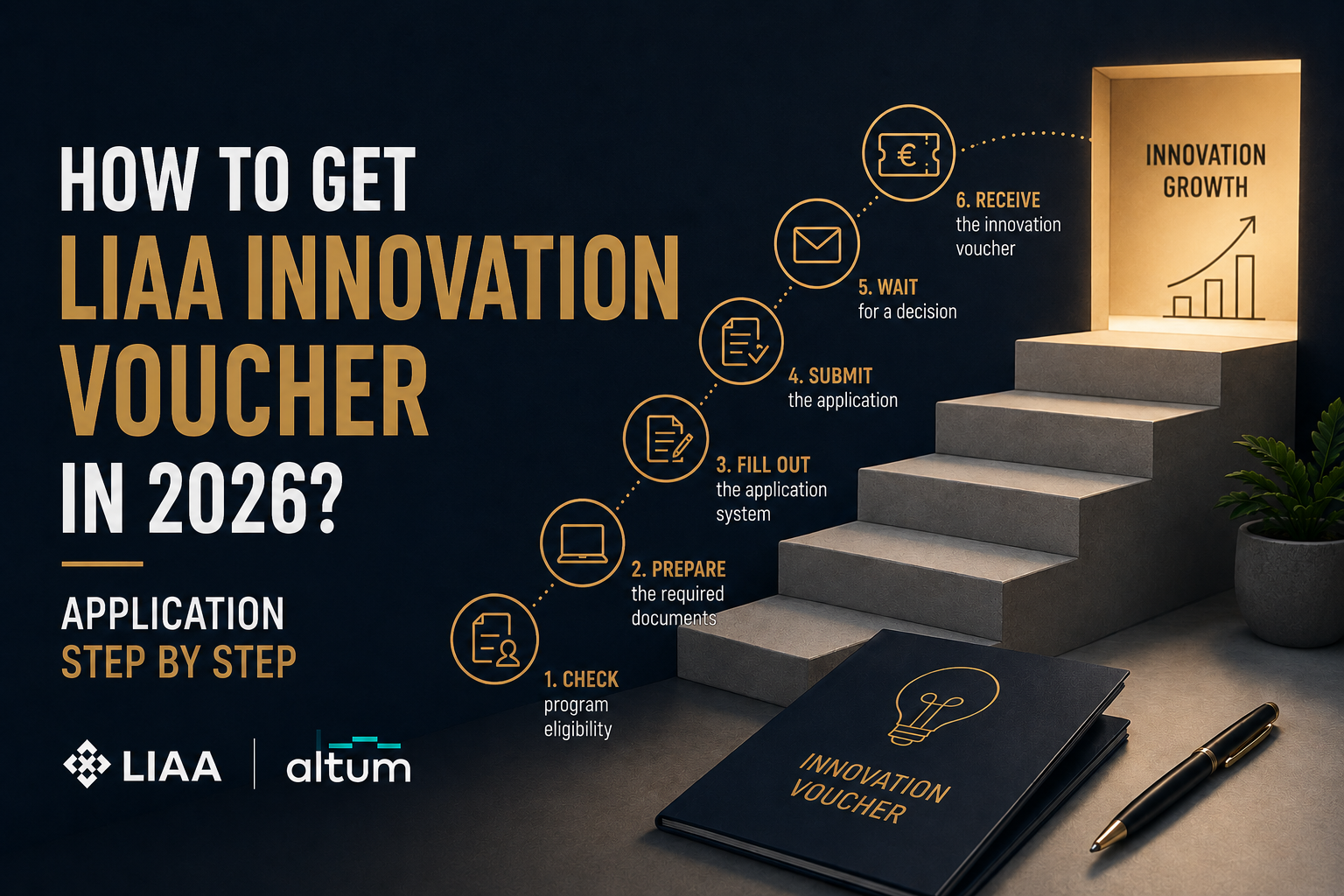
€25,000 is the programme maximum for one new product, not an amount automatically granted to every company. More: How to get the LIAA innovation voucher in 2026 →
17.Capital rebate
A capital rebate is a mechanism that can reduce the principal of an ALTUM loan after the project has been implemented successfully and the programme conditions have been met.
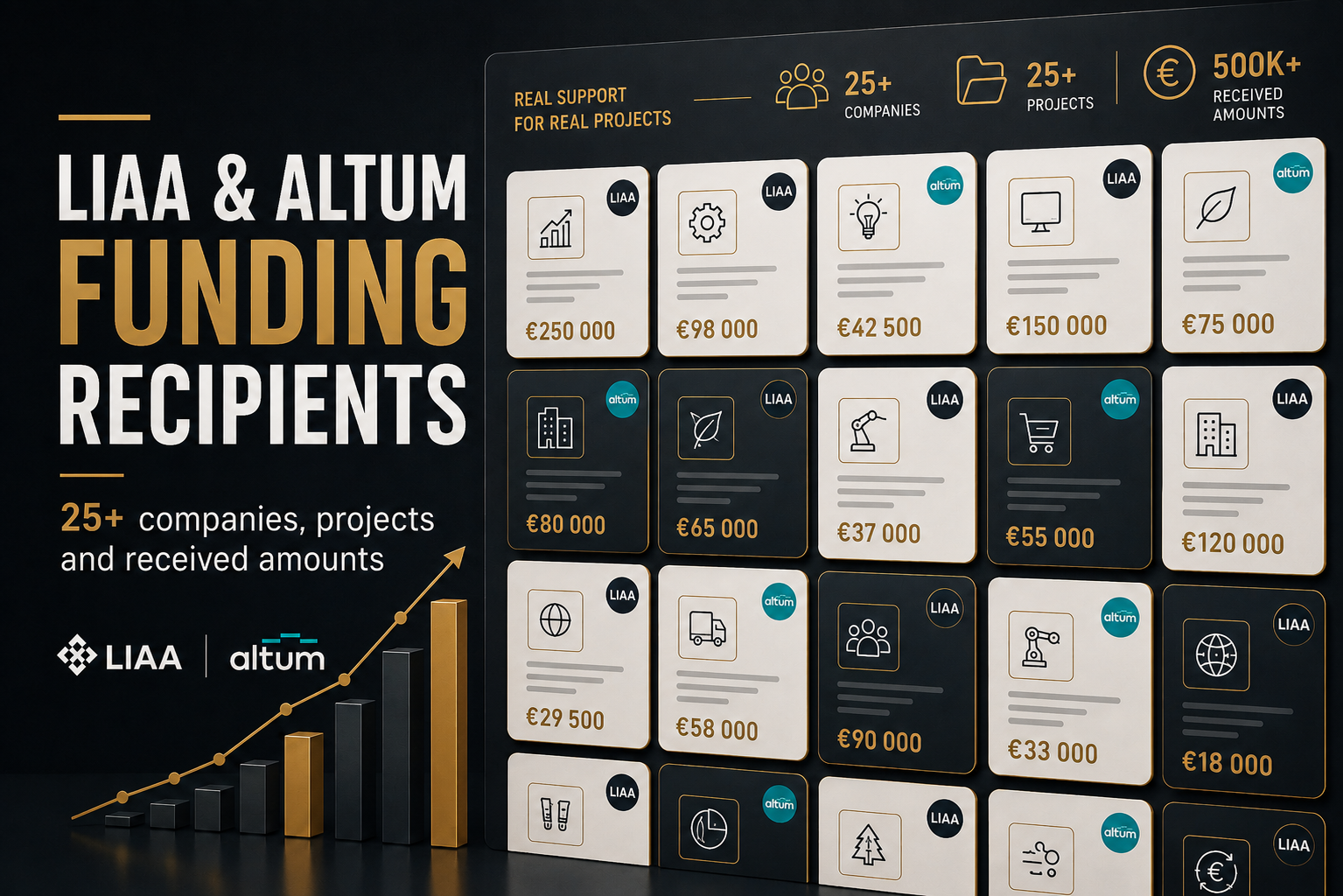
A capital rebate is not the same as a standard grant received at the start of a project. Real examples: LIAA and ALTUM funding recipients →
18.Co-financing
Co-financing is the share of project costs covered by the company itself or another financier.
If the aid intensity does not cover 100% of eligible costs, the company must be able to fund the remainder. Ineligible costs must also be taken into account.
19.Payment claim
A payment claim is the set of documents or the application through which a beneficiary requests disbursement after completing certain project activities. Depending on the programme this may require:
- invoices;
- proof of payment;
- contracts;
- project deliverables;
- other cost-supporting documents.
The exact requirements are set by the specific programme, so plan the documentation from the start of the project.
20.MVP
MVP - Minimum Viable Product. A version of the product with the minimum functionality needed to test the core idea with real users or the market.
MVP is not a universal legal term in LIAA or ALTUM funding. It is a product development term that often appears in startup and innovation project contexts.
21.Ineligible costs
Costs a specific programme does not fund. They may be entirely necessary for the project, but the company covers them itself.
For example, in some programmes VAT is not eligible. Always check the rules of the specific programme.
22.Project budget
The project budget is the total of all planned project costs. It is not automatically equal to the amount of support.
Support is calculated according to the rules of the specific programme, not from the total budget.
23.Project implementation period
The period within which the project activities approved by the programme must be carried out.
It is important to check from which moment the project may start. In some programmes starting work too early can affect the eligibility of costs.
24.Prototype
A prototype is an early version of a product or technology used to test an idea, technical solution or functionality before full development or production. A prototype can be:
- physical;
- digital;
- software-based;
- technological.
25.RIS3
RIS3 is Latvia's Smart Specialisation Strategy. It defines the priority knowledge and innovation areas in which Latvia concentrates research, innovation and development resources.
In some innovation and investment programmes, alignment with a RIS3 area can be a material condition.
26.Industrial design
In a funding context, industrial design can mean developing the form, functionality, usability and production-ready solution of a new product.
In the LIAA innovation voucher programme, industrial design of a product is one of the supported activities.
This does not mean ordinary branding or logo design automatically qualifies as industrial design - check the conditions of the specific programme.
27.Industrial research
Industrial research is planned research to acquire new knowledge and skills for developing new, or significantly improving existing, products, processes or services.
It is one of the terms used in innovation support programmes.
28.Linked enterprises
In state aid calculations it is sometimes not enough to look at a single legal entity. Relationships and control between companies must also be assessed.
This matters particularly for de minimis and for determining company size. Check the exact legal definition in the rules of the specific programme and the relevant regulation.
29.TRL
TRL - Technology Readiness Level. It helps assess how far a technology has developed: from an initial scientific idea to a validated technology and a solution ready for use in a real environment.
- TRL 1 - basic principles / early research
- TRL 3 - experimental proof of concept
- TRL 4 - validation in a laboratory environment
- TRL 6 - prototype demonstration in a relevant environment
- TRL 7 - prototype demonstration in an operational environment
- TRL 9 - system proven in real conditions
This is a simplified explanation. Different programmes may require different TRL levels.
30.Voucher
In a funding context, a voucher is a support instrument for acquiring specific project activities or external competences.
In the LIAA innovation voucher programme, the voucher is intended for developing new products and technologies. It is not a “coupon” in the everyday sense.
How these terms connect in one project
- Idea↓
- Programme↓
- Eligible costs↓
- Price survey / supplier (if the programme requires it)↓
- Aid intensity↓
- Co-financing↓
- Project approval↓
- Project implementation↓
- Payment claim / conditions met↓
- Support / capital rebate (depending on the instrument)
Not every programme follows exactly this sequence, but the scheme helps you see how the main funding terms relate to each other.
A practical example
A company wants to develop a new digital product. Total project budget: €30,000. Of this, the specific programme recognises €20,000 as eligible. Assume the applicable aid intensity is 50%. Theoretically calculated support: €20,000 × 50% = €10,000.
- the remaining share of eligible costs;
- all ineligible costs;
- other payments the specific programme does not cover.
This is only an illustrative example to explain terminology, not a funding calculation for a specific LIAA or ALTUM programme.
Which programme should you choose?
Now that the terminology is clearer, the next question is: which programme actually fits your project? If you are planning a new product, SaaS, an AI solution, a website, e-commerce, process digitalisation, a prototype, automation or manufacturing technology, first define the project outcome and only then look for the most suitable funding instrument.
You know the terms. Now assess the project itself.
If you are planning a website, e-commerce, SaaS, UX/UI, AI, automation or another digital project and want to understand how to structure it for a funding application, tell us about your idea. Juice Digital Agency can help:
- define the scope of the digital project;
- develop the technical solution;
- prepare a price quotation;
- implement the project within our area of competence.
Juice Digital Agency does not make decisions on granting state support and does not guarantee that funding will be received. Programme conditions, deadlines and available funding may change. Always check the current conditions with the programme administrator before applying.
Frequently asked questions
What is de minimis?
De minimis is a state aid framework. Under European Commission Regulation 2023/2831 the general ceiling for a single undertaking is €300,000 over any three-year period. Different conditions may apply to certain sectors and aid types.
What are eligible costs?
These are the project costs a specific funding programme accepts as fundable. The rules of the specific programme must be applied when calculating support.
What does 50% aid intensity mean?
Simplified, it means support may cover up to 50% of the costs the programme recognises as eligible, subject to the programme's other limits and conditions.
What is a capital rebate?
In ALTUM programmes, a capital rebate is a mechanism that reduces the loan principal after the project is completed and the set conditions are met.
What is EDIC?
EDIC is a European Digital Innovation Hub. In digitalisation programmes, EDIC can help a company assess digital maturity and prepare a digital development roadmap.
What is TRL?
TRL, or Technology Readiness Level, is a scale that helps assess the development stage of a technology from early research to a solution proven in real conditions.
Does a grant have to be repaid?
A grant normally does not have to be repaid like a loan if all programme conditions are met. However, improper project implementation can trigger an obligation to repay the support received.