Introduction
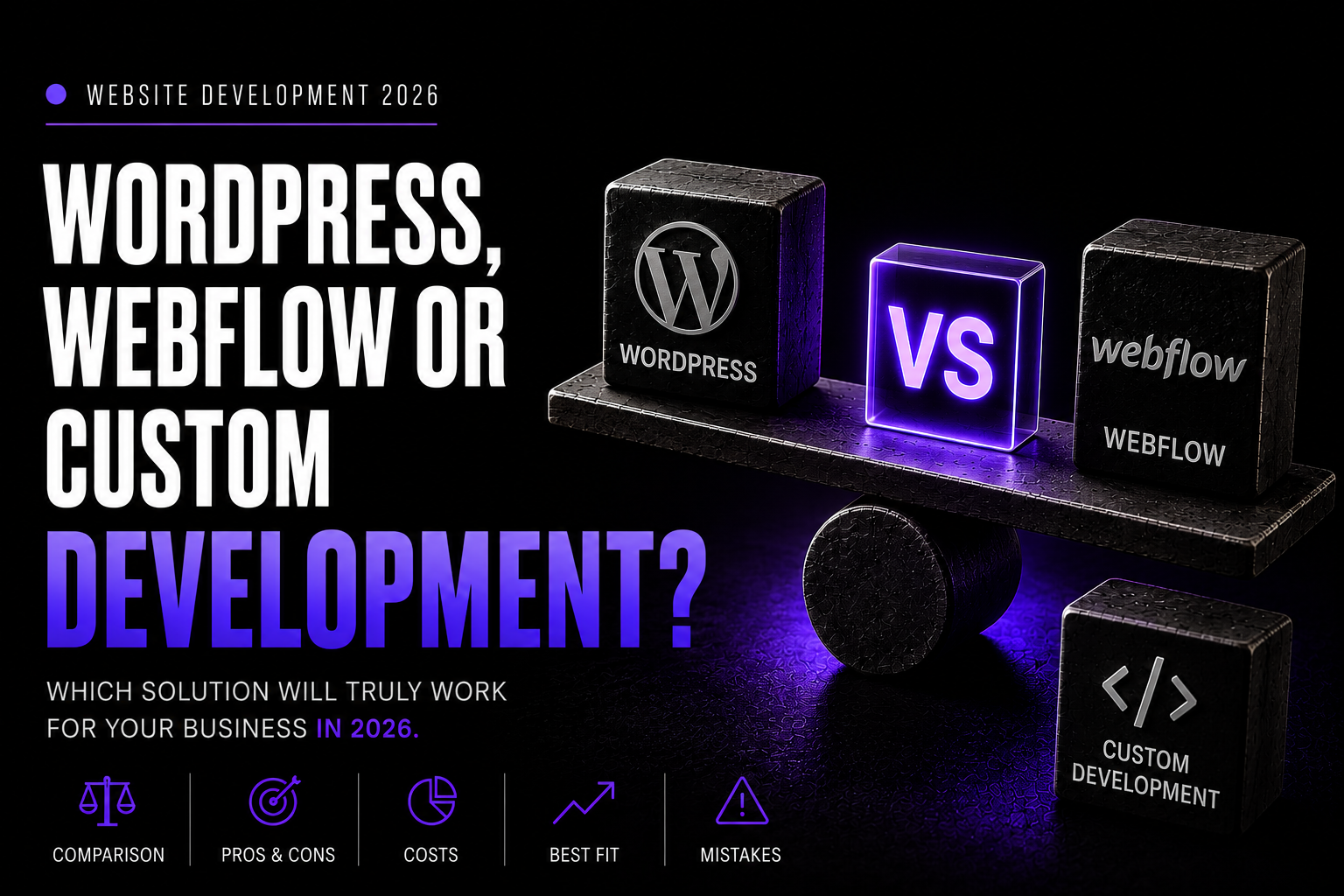
One of the most common questions we hear at the start of a conversation is - should the site be built on WordPress, Webflow, or with custom development from scratch. Each approach has its place, and the honest answer is - it depends on your goals, budget and how much the site needs to grow together with the business.
In this article we compare all three approaches practically - without ideology about which is "best" in general, but with a clear picture of when each approach actually fits.
The short answer
WordPress fits simple projects with a limited budget, where fast launch matters more than custom performance. Webflow fits design teams that want visual control without code. Custom development (for example, on a modern stack like React/Next.js) fits when maximum performance, an SEO foundation and a site that can grow with the business without technical limits are what matter.
WordPress: pros and cons
Pros: low initial cost, a huge library of available plugins, a broad developer base - which means almost anyone can maintain it after you.
Cons: performance often suffers, especially with functionality built from many plugins - each plugin adds extra code the browser has to load. Security vulnerabilities are more common because a popular platform attracts more attack attempts. Technical SEO optimisation often requires additional plugins, which in turn can slow the site down even more - a vicious circle.
Webflow: pros and cons
Pros: a visually clean design editor without writing code, cleaner output code than WordPress by default, a good solution for design teams that want full visual control.
Cons: limited functionality for more complex business processes (for example, custom user systems, complex integrations), the monthly fee grows with traffic and functionality, and migrating to another platform in the future can be harder than expected.
Custom development: pros and cons
Pros: maximum performance, because the code is written specifically for the project rather than for a universal solution with unnecessary features. Server-side rendering (SSR) provides a stronger SEO foundation and a faster initial load. No limits on functionality - the system is built around the business process rather than fitted into a ready-made framework. Lower long-term maintenance costs, because there's no dependency on third-party plugin updates and compatibility issues.
Cons: higher initial cost compared to WordPress or Webflow, and the need for a custom CMS solution for content editing (which is no longer an issue today - we include this in every project so the client can edit content themselves without involving a developer).
How to choose the right approach
In practice we work with all three approaches, depending on the client's needs - but most often we recommend custom development specifically when the site needs to be a business growth tool rather than just a digital business card:
- If you need a simple site with a limited budget and don't plan rapid growth - **WordPress** may be enough.
- If visual design control without code matters to your team and the functionality is relatively simple - **Webflow** is a good solution.
- If you're planning to invest in SEO, expect high traffic, or the site needs to become a long-term business platform rather than a one-off project - **custom development** usually pays off faster than it seems at first, precisely through better performance and a stronger SEO foundation.
FAQ
Can a WordPress site be as fast as a custom-built one?
Theoretically yes, with careful optimisation and a minimal number of plugins, but in practice it requires more ongoing attention and technical maintenance than a custom-built system designed for speed from the start.
Is Webflow suitable for e-commerce?
For simpler e-commerce projects - yes. For more complex solutions with custom logic, integrations or a large product catalogue, more flexibility is often needed than Webflow can offer.
Is custom development always more expensive?
The initial investment is usually higher, but over the long term - counting maintenance, plugin updates and fixing performance problems - the gap often narrows or even flips the other way.
Can I later migrate from WordPress or Webflow to custom development?
Yes, it is possible, but it requires a full rebuild of the site rather than a simple migration - so if you already know from the start that the business will need serious growth, it's often more cost-effective to start with the right approach right away.
*Regardless of the approach you choose, our website development team will help pick the right solution for your specific project. A detailed price comparison can be found in the article How much website development costs in Latvia.*