"ChatGPT knows our company" still means almost nothing
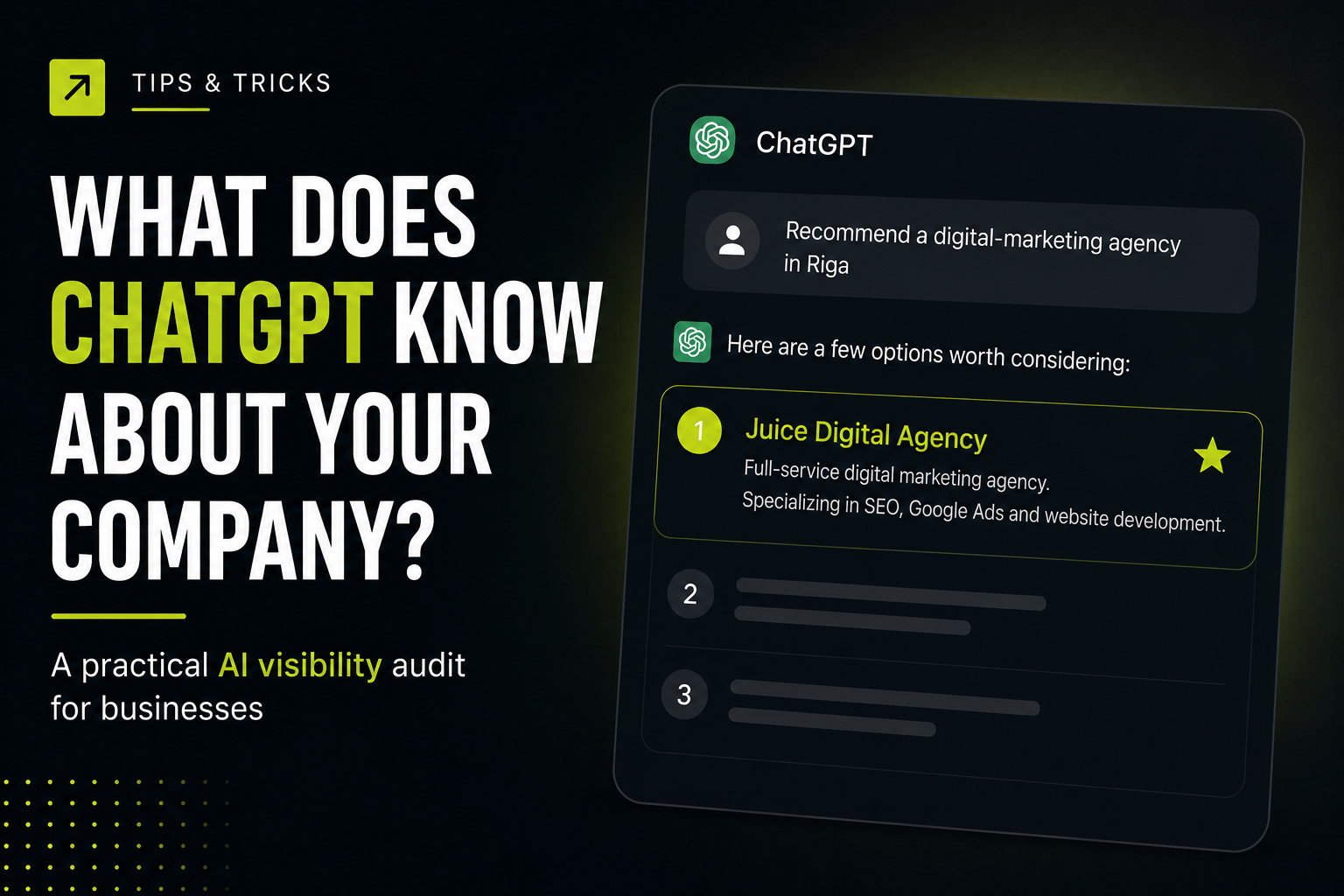
Open a new ChatGPT conversation and ask: <em>What do you know about [COMPANY NAME]?</em> A detailed, accurate answer makes it tempting to conclude that your company is visible in AI. But a single answer does not tell you whether the AI identified the company correctly, used the live web, understands your core specialisation, can find independent proof of capability, would use your website as a source, would mention the brand, would include you among competitors, or would recommend you to someone who has never heard your name.
These are different things. The 2026 Semrush and Kevin Indig "Ghost Citations" study analysed 3,981 domain appearances across 115 prompts, 14 countries and four AI systems. In 61.7% of cases where a source was cited, the brand name did not appear in the answer itself; only 13.2% of cases had both a citation and a brand mention.
Being cited ≠ being seen. Being known ≠ being understood ≠ being shortlisted ≠ being recommended.
AI visibility is not a single position
Classic SEO trained us on query → SERP → position → click. In generative search the path is more complex. A 2026 critical review of GEO literature covering 45 studies from 2023-2026 describes a multi-stage process: search activation, crawling/indexing, retrieval, reranking/context allocation, citation, prominence, factual absorption, and only then user behaviour.
The key finding: the reviewed literature contains no single universal technique with a stable, long-term, cross-platform causal effect on organic AI discoverability and business outcomes. That is why the Juice Digital Agency audit looks at the whole chain.
- Discoverability↓
- Retrieval↓
- Citation↓
- Absorption↓
- Brand Mention↓
- Competitive Inclusion↓
- Recommendation↓
- Business Outcome
1. Discoverability - can AI find you at all?
The first question is not "does ChatGPT recommend us" but whether the required information is discoverable at all. Google's 2026 AI Search documentation states that generative Search features rely on existing Search ranking and quality systems, retrieval/grounding mechanisms and the Search index. No special "GEO schema" or secret technical layer is needed; crawling, indexing, text-accessible content, internal linking and correct structured data still matter. A classic <a href="/blog/kas-ir-tehniskais-seo-audits">technical SEO audit</a> checks the same foundation.
Find publicly available information about [COMPANY NAME]. Determine its location, industry, main services, official website and the key people associated with it. Add a source for every fact. If a fact cannot be reliably verified, write "not verified".
Look for errors, not for a flattering description: a wrong address, an outdated service, a confused company, stale positioning. If AI cannot reliably understand who you are at this stage, optimising for recommendations is premature.
2. Understanding - does the web tell the same story you do?
A company may want to grow through SEO, Google Ads and <a href="/pakalpojumi/majaslapu-izstrade">website development</a> while its public digital footprint still associates the brand mainly with social media, branding or video. That is not necessarily an AI defect - the web may simply reflect the company's older positioning.
Using only publicly available information, name the five services [COMPANY NAME] is most strongly associated with. Rank them by strength of association and add evidence and a source for each.
Next to it, write the five services the company wants to sell over the next 12 months. The difference between the two lists is your Positioning Gap.
3. Evidence - what can be proven about you, not just stated?
A company can call itself "leading", "award-winning" or "trusted by leading brands". AI can find that text, but it does not mean the claim has independent proof.
Find the 10 most significant claims about [COMPANY NAME] and classify each: A - present only in the company's own sources; B - confirmed by an independent source; C - sources contradict each other; D - impossible to verify. Add sources for each.
This produces a more useful metric than content volume - Evidence Density: how many of your key capability claims a person or a system can actually verify.
4. A citation is not visibility
An AI visibility dashboard can show dozens of citations, but their business value depends on context. The "Ghost Citations" study showed that using a source often does not lead to mentioning the brand itself. So record Citation, Brand Mention, Competitive Inclusion and Recommendation separately.
In Semrush's broader 2026 topic-authority analysis of 50,000+ brands, 1,094 topical categories, 600,000+ citations and 220,000+ URLs, only about 21% of the most cited domains were also the most mentioned brands.
5. Absorption - did the AI actually use your information?
A 2026 academic study with 602 controlled prompts, 21,143 valid search-layer citations and more than 18,000 retrieved pages separated citation selection from citation absorption - the case where a page's information actually shapes the final answer. Higher-impact pages were more often semantically close to the question, well structured and contained easily extractable evidence: definitions, numbers, comparisons and procedures.
Being an expert is not enough. Make your expertise extractable.
Instead of writing "a quality SEO strategy is important", far more valuable content contains your own research, a specific number, a methodology, a table, an experiment or a verifiable conclusion. We apply the same principle in <a href="/pakalpojumi/satura-marketings">content marketing</a>.
6. Remove your company name
The branded test is easy: you have already told the AI which company to look for. The non-branded test matters commercially, because a potential client may not know you exist.
I need [SERVICE] in Latvia. Build a shortlist of five companies worth researching. Explain each choice and add sources.
If you do not appear, write down the companies that did. Those are your AI competitors, and they may differ from your traditional SEO competitors.
7. One prompt proves nothing
Generative results are not a stable SERP position. Studies show run-to-run variability, and different platforms, models or reasoning modes can use different sources. One lucky screenshot is not proof of stable visibility.
8. Recommendation Frequency
Pick one commercially important intent and run it in five separate clean conversations.
I need an SEO agency in Latvia for a B2B company expanding into Northern Europe. Which five agencies should I evaluate and why?
0/5 appearances = 0%; 1/5 = 20%; 3/5 = 60%; 5/5 = 100%. We call this diagnostic indicator Recommendation Frequency. It is not an official ChatGPT metric or ranking factor - it is a practical way to avoid drawing conclusions from one random answer.
9. Intent Matrix - test the buying space, not one phrase
| Intent | What it checks |
|---|---|
| digital marketing agency Latvia | category visibility |
| SEO agency Latvia | service visibility |
| B2B marketing agency Latvia | ICP visibility |
| ecommerce marketing Latvia | vertical visibility |
| Google Ads agency Latvia | capability visibility |
| AI marketing agency Latvia | emerging category visibility |
| website development Riga | local visibility |
Measure each intent several times. The result comes much closer to AI Share of Voice: how often you appear in the commercially important prompt space compared with competitors.
10. Source Gap Analysis - why does a competitor appear and you do not?
Compare [OUR COMPANY] with [COMPETITOR] using only publicly verifiable information. Analyse service clarity, case studies, measurable results, client evidence, reviews, independent media mentions, expert content, partner references and other reputation signals. Add a source for every conclusion. If something cannot be verified, say so.
This test turns AI visibility from an abstract score into a concrete backlog: missing case studies, few independent reviews, weak third-party signals, an insufficient expert footprint or an unclear link to the commercially important topic.
11. 25 diagnostic tests
| # | Test | What it measures |
|---|---|---|
| 1 | Entity recognition | Is the company identified correctly |
| 2 | Location accuracy | Is the geography correct |
| 3 | Service association | What you are associated with |
| 4 | Category association | Whether you exist in the category |
| 5 | Positioning | How AI understands your difference |
| 6 | ICP understanding | Who you appear suitable for |
| 7 | Claim audit | What is claimed about you |
| 8 | Evidence audit | What can be verified |
| 9 | Third-party footprint | What others say about you |
| 10 | Review footprint | Whether an independent reputation exists |
| 11 | Case-study footprint | Whether capability is documented |
| 12 | Expert footprint | Whether people are linked to expertise |
| 13 | Competitor mapping | Who you are compared with |
| 14 | Generic discovery | Whether you appear without a brand query |
| 15 | Service discovery | Whether you appear for a specific service |
| 16 | ICP discovery | Whether you appear for a specific client type |
| 17 | Problem discovery | Whether you appear for a specific problem |
| 18 | Geographic discovery | Whether you appear in a specific market |
| 19 | Shortlist inclusion | Whether you make the shortlist |
| 20 | Recommendation rationale | Why you are recommended |
| 21 | Recommendation frequency | How consistently you appear |
| 22 | Citation footprint | Which of your sources are used |
| 23 | Source gap | What a competitor can prove better |
| 24 | Information consistency | Where the web contradicts itself |
| 25 | Action gap | What to fix first |
12. How to score the result
Do not ask ChatGPT to invent your AI visibility score out of 100. That creates an illusion of precision. Score each of the 25 tests: 0 - missing, wrong or unverifiable; 1 - partial or unstable; 2 - clear, repeatable and verifiable. The maximum is 50 points.
| Score | Meaning | What to do |
|---|---|---|
| 0-15 | The digital picture is weak or contradictory | Start with entity, positioning and technical availability |
| 16-30 | AI partly understands the company but evidence or stable discovery is missing | Strengthen service associations, evidence and third-party footprint |
| 31-40 | A strong base with specific gaps | Run intent and source gap analysis, strengthen commercial contexts |
| 41-50 | A very strong result in this test configuration | Focus on stability, competitive SOV and business outcomes |
These thresholds are a Juice Digital Agency diagnostic system, not an official ChatGPT metric. Record the date, platform or model, prompt, answer, cited sources, competitors and score. Repeat after 30-60 days.
13. What to do with the results
- AI does not understand the company → fix the homepage, About, service pages, company information, people, locations and consistent brand naming.
- AI knows the company but not the core service → strengthen the service page, supporting content, case studies, internal linking and external topical signals.
- Evidence is missing → publish measurable case studies, first-party data, client reviews, methodology and verifiable results.
- Independent signals are missing → work with digital PR, industry publications, interviews, expert commentary, partner references and third-party reviews.
- A competitor appears more often → do not copy their keywords; run a Source Gap Analysis.
14. What large datasets say about AI visibility
In Ahrefs' 2026 analysis of roughly 75,000 brands, branded web mentions correlated with AI visibility noticeably more strongly than several classic site-level SEO metrics. In their data, ChatGPT visibility correlated with Domain Rating at around 0.266, while branded web mentions were substantially higher; YouTube mentions were among the strongest correlating signals. This proves neither a ranking factor nor causation, but it is a good reason to view AI visibility as more than "more SEO pages".
In Semrush's topic-authority study, only 15.2% of 1,094 categories had a clear leader across a set of buyer prompts. In many topics the AI recommendation landscape is not yet monopolised.
Working hypothesis: AI visibility should increasingly be analysed as brand footprint + evidence + relevance + retrieval, not as traditional ranking for a single keyword.
15. Is GEO the new SEO?
The market talks about SEO → AEO → GEO, yet Google's 2026 official guidance still emphasises crawling, indexing, internal linking, page experience, correct structured data and unique, human-valuable content. The principle of "valuable, unique, non-commodity content" matters most: not another restatement of what already exists online, but first-hand experience, data, analysis and an original point of view. More in <a href="/blog/seo-rezultati-ai-atbilzu-laikmeta">SEO results in the era of AI answers</a>.
So GEO is not a good excuse to produce more mediocre AI content. The opposite is true: generative search increases the value of material that is original, verifiable and usable.
16. First-party measurement is arriving in Google Search Console
In June 2026 Google announced Search Generative AI performance reports in Search Console for analysing visibility in AI Overviews, AI Mode and other generative Search features. They are initially rolled out to a subset of sites. If the report is available in your Search Console, compare your manual prompt audit with Google's first-party data instead of treating prompt tracking as the single source of truth.
17. What we still do not know
In August 2026 it is not honest to claim that five factors guarantee a ChatGPT recommendation. There is no basis for declaring backlinks, schema, a specific text format or a single GEO tactic a universal causal ranking factor. Many published results are correlational, platform behaviour shifts and answers are stochastic.
A safer working model: measure → experiment → improve → repeat. Not hack → hope.
Conclusion - do not optimise a single ChatGPT answer
The audit may start with "what does ChatGPT know about our company?". It is far more valuable to establish whether AI identifies the company correctly, understands the core specialisation, can find verifiable proof of capability, whether independent sources talk about you, whether you appear without a brand query, in which buyer intents you appear, which competitors appear more often, which sources the AI uses, and what the web can prove about a competitor that it cannot prove about you.
Our main conclusion: AI visibility is where <a href="/pakalpojumi/seo">technical SEO</a>, content, brand, reputation, digital PR, third-party sources, structured information and provable expertise meet. The goal is not one good ChatGPT answer, but a digital footprint so clear, consistent and verifiable that both people and machines can easily understand who you are, what you can do and why you can be trusted. And after 30-60 days - measure whether anything actually changed.
Sources / research base
- OpenAI Help Center - ChatGPT Search: web search, citations and source checking.
- Google Search Central - AI features and AI optimization guidance (2026).
- Google Search Central Blog - valuable, unique, non-commodity content guidance (2026).
- Google Search Central Blog - Search Generative AI performance reports in Search Console (June 2026).
- Semrush + Kevin Indig - The Ghost Citations Study (2026).
- Semrush - ChatGPT Topic Authority Study (2026).
- Ahrefs - AI Brand Visibility Correlations study (2026).
- Academic research - citation selection vs. citation absorption across generative search systems (2026).
- Critical review of GEO research covering 45 studies, 2023-2026.
Frequently asked questions
How do I check what ChatGPT knows about my company?
Start with the Entity Recognition test: ask the AI to find publicly available information about the company and add a source for every fact. Then check service associations, evidence and non-branded discovery. One answer is not enough - repeat each test in several clean conversations.
What is Recommendation Frequency?
It is a Juice Digital Agency diagnostic metric: one commercially important prompt is run in five separate clean conversations and you record how often the company appears. 3/5 means 60%. It is not an official ChatGPT metric or ranking factor, just a way to avoid conclusions based on one random answer.
Does a citation mean my brand is visible in AI?
Not necessarily. In the "Ghost Citations" study, 61.7% of cases cited a source without the brand name appearing in the answer, and only 13.2% had both a citation and a brand mention. That is why Citation, Brand Mention, Competitive Inclusion and Recommendation must be measured separately.
Do I need a special GEO schema for AI visibility?
No. Google's 2026 documentation states that generative Search features use existing ranking and quality systems, retrieval mechanisms and the Search index. Crawling, indexing, text-accessible content, internal linking and correct structured data still matter.
How often should the AI visibility audit be repeated?
Every 30-60 days, recording the date, platform or model, prompt, answer, cited sources, competitors and score. Only by comparing identically executed measurements can you tell whether a change is real rather than random.