Introduction
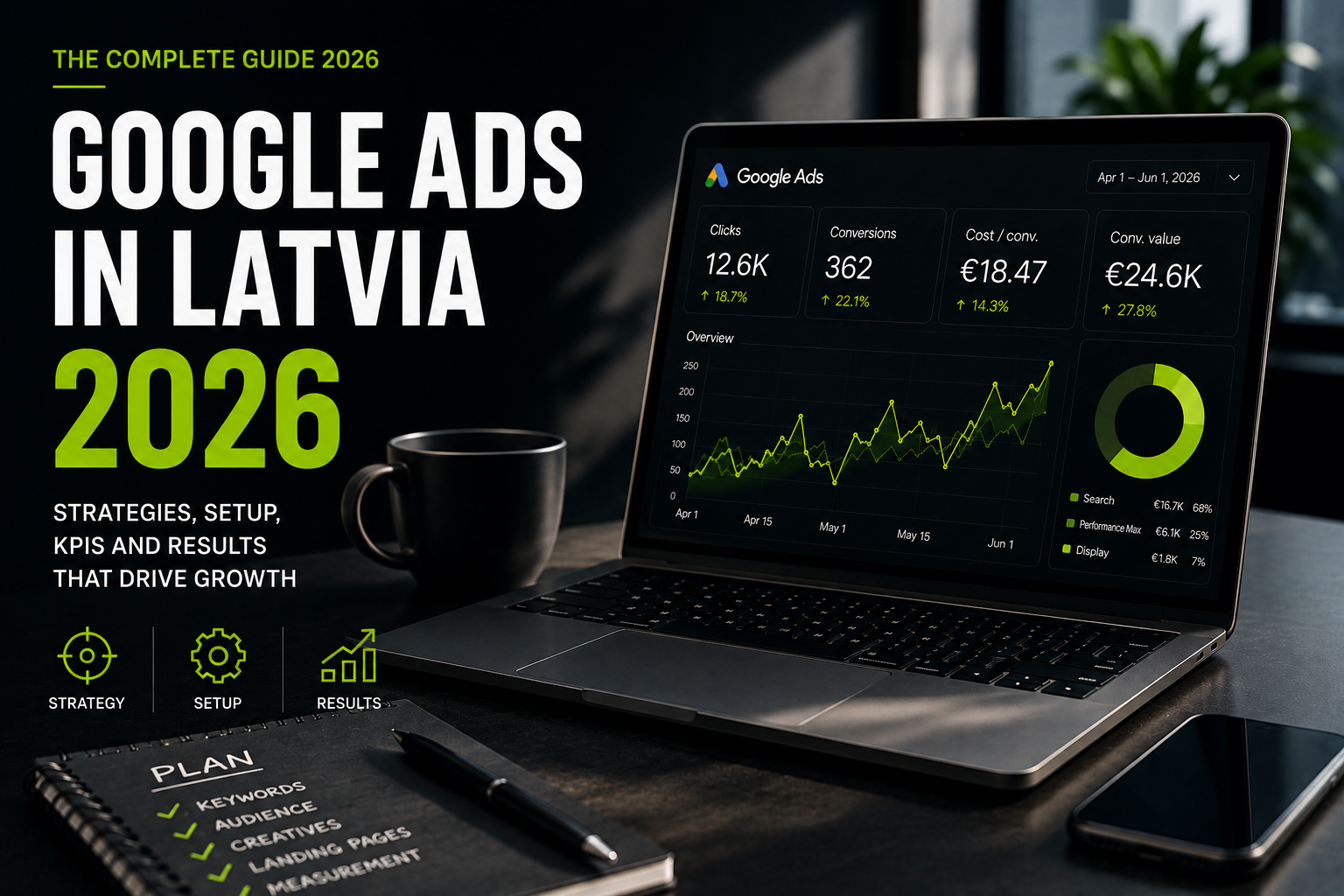
Every time a company considers Google Ads, the question is usually the same: does it still work at all, or will the money simply go to the platform with nothing to show for it?
The answer is - yes, it works, but only if the ads are built as a system with a clear goal, proper tracking, and a landing page that actually converts. Without these three elements, even the biggest budget will not deliver results.
In this guide we cover how Google Ads works in the Latvian market, when it is a better fit than SEO, what campaign types exist, and which mistakes most often ruin the result - based on what recurs in practice when working with Latvian companies across industries, including logistics and HoReCa (Else Logistics, O'Sole Mio).
If you specifically want to know how much Google Ads costs in Latvia and how to calculate a budget - we've dedicated a separate detailed article to that: Google Ads pricing in Latvia.
Contents
- What Google Ads is and how it works
- Google Ads or SEO - which to choose first
- Campaign types: Search, Performance Max, Shopping, Display, YouTube
- Google Ads or Meta Ads - how to choose
- Common mistakes that ruin the result
- How to tell if your ads are really working
- FAQ
1. What Google Ads is and how it works
Google Ads is a paid advertising platform where businesses pay for visibility in Google Search, YouTube, partner sites and Shopping results. Unlike SEO, where visibility is earned organically, Google Ads works on an auction principle - you pay per click or impression, and the price is shaped by competition for the specific keyword, the ad's quality and how precise your targeting is.
The main advantage of Google Ads is speed. Unlike SEO, where results build up over months, a Google Ads campaign can start bringing in visitors and leads on the very day it launches.
2. Google Ads or SEO - which to choose first
This is one of the most common questions, and the honest answer is - they are not competitors, they work together.
Google Ads is a good fit when you need a fast result, have a seasonal offer, or need to validate a new product in the market before a larger investment.
SEO is a good fit for long-term, steady organic customer flow without paying per click - but it takes months to start delivering results.
A common situation: a company invests only in Google Ads, with no SEO foundation, and pays for traffic that in the long run could come in for free. Or the opposite - it relies only on SEO and waits months for results, while competitors running Google Ads are already collecting leads today. The optimal solution for most businesses is a combination of both channels.
3. Campaign types: Search, Performance Max, Shopping, Display, YouTube
Search campaigns appear when a person is already actively looking for a solution - the highest purchase intent and usually the highest conversion rate.
Performance Max is an automated campaign format that uses Google's AI to run ads across all Google channels simultaneously from a single campaign setup.
Shopping campaigns display product images, prices and store name directly in the search results - essential for e-commerce with a product catalogue.
Display ads appear as banners on partner sites - useful for brand awareness and remarketing, less so for direct conversion.
YouTube ads are a good fit for brand storytelling and reaching a wider audience, especially combined with remarketing to people who have already visited your website.
4. Google Ads or Meta Ads - how to choose
Google Ads works when someone is already looking for a solution - active demand. Meta Ads works when demand still has to be created - a visual product, an impulse buy, a new brand.
B2B with a long sales cycle, services and local businesses usually start with Google. E-commerce, fashion, beauty, HoReCa and FMCG often perform better on Meta. In practice, for most clients it makes sense to test both channels in parallel and, after a few weeks, shift the budget toward whichever delivers a lower cost per real lead.
5. Common mistakes that ruin the result
The assumption that a bigger budget automatically means better results. It doesn't - budget without the right campaign structure and landing page simply means larger spend, not better results.
Missing conversion tracking. Without proper analytics in place (GA4, conversion goals), the campaign is optimised "blind" - without real data about what actually brings in customers.
The website, not the ads, is the problem. Often when ads "don't work", the reason isn't the campaign itself - it's slow load time, an unclear landing page, or a complicated contact form that turns people away right before they convert.
Too broad an audience with no segmentation and launching a campaign without a clear goal (leads? sales? brand awareness?) are two more common mistakes that make the result hard to measure.
6. How to tell if your ads are really working
The right approach is to look not at click volume or spend, but at business metrics - how many enquiries came in, what their quality is, and what the cost of one real customer is, not just one click. Regular reporting with up-to-date metrics and clear communication about what is and isn't working is the minimum to expect from any agency or in-house team running the campaign.
FAQ
Google Ads or SEO - where to start?
If you need a fast result or want to test a new product in the market - Google Ads. For long-term, steady organic traffic - SEO. The optimal solution for most businesses is a combination of both.
How quickly do Google Ads start delivering results?
The first clicks and conversions appear in the first week. Statistically reliable data for decision-making usually builds up over 3-4 weeks, while a stable, predictable campaign takes 2-3 months.
Does the ad account stay in my ownership?
The honest practice is to work inside the client's own Google Ads account - all data, history and access stay with the client even after the engagement ends.
What is the difference between Search and Performance Max campaigns?
Search campaigns appear directly in the search results for a specific query. Performance Max automatically uses all Google channels at once, driven by AI - less manual control, but broader reach potential.
Is Google Ads suitable for small businesses with a limited budget?
Yes, but with a small budget the data becomes noisier and optimisation slows down. For smaller budgets it often makes sense to start with a single, tightly focused campaign rather than trying to cover everything at once.
Search campaign automation keeps evolving: from September 2026 some settings gradually move to AI Max capabilities. What that means and what to check before switching is covered in Google Ads AI Max 2026.
*If you'd like us to build or audit your Google Ads campaign, our Google & Meta ads team works with a transparent model - your account, your data. You can see concrete examples in the Else Logistics and O'Sole Mio projects.*