AI can be your most effective marketing assistant - but only if you know how to talk to it.
Research shows 71.7% of marketers fail to get the best results from AI precisely because they don't know how to craft effective prompts. The difference between mediocre and outstanding AI output is almost always in the prompt, not the tool.
This prompt pack is also part of our practical marketing resources, where you will find checklists, templates and other materials for everyday work.
If you want to use prompts inside an automated daily process rather than only in a chat, see the guide on building a personal AI morning assistant with n8n.
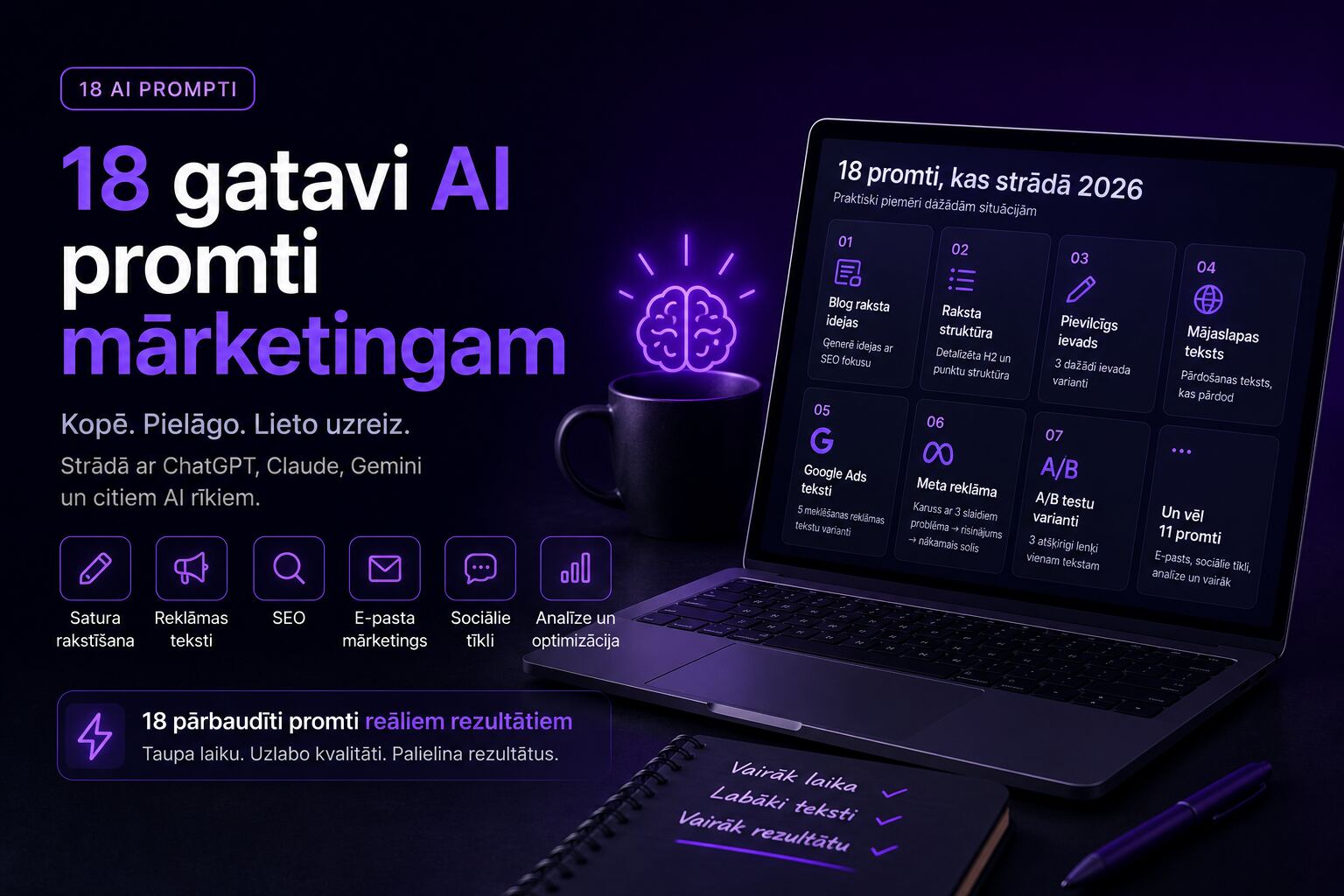
In this collection - 18 proven prompts used by real marketing teams around the world, adapted for companies in Latvia and across Europe. Works with ChatGPT, Claude, Gemini and other AI tools.
How to use: copy the prompt → replace the [bracketed] parts with your data → send it to the AI.
If the output still misses the mark, the problem is usually the brief itself - we break that down step by step in Why ChatGPT Misunderstands Your Tasks: 15 Prompts.
✍️ Content writing and blogs
Generate 10 blog post ideas about [your topic] that would be relevant for
[target audience - e.g. "B2B company leaders in Latvia"].
For each idea include:
- A compelling headline
- One sentence about the angle
- The primary SEO keyword

Focus on topics that solve specific pain points,
not generic informational ones.
Build a detailed blog post outline for "[article topic]"
for the audience: [audience].

Include:
- An intro with a hook that starts from the problem
- 5-7 H2 headings phrased as questions
- 3-4 sub-points under each heading
- A closing with a concrete call to action

Target length: 1500-2000 words.
Write 3 different intro paragraphs (100-150 words each)
for a blog post about "[topic]".

Each intro must start with an engaging problem, include
a surprising fact or stat, and state what the reader will
learn. No generic openings - each must take
a different angle.
Write sales copy for a website homepage
for a company that [short company description].

Target audience: [audience]
Tone: [e.g. "professional but friendly, no corporate jargon"]

Structure:
1. Headline (max 10 words) - what you do + for whom + the benefit
2. Sub-headline (1-2 sentences) - expands the headline
3. 3 main benefits (bullet points) - from the customer's perspective
4. Call to action

Avoid phrases like: "innovative", "comprehensive",
"premium", "trusted partner".
📣 Ad copy
Write 5 Google Ads search ad variants
for the product/service: [description]

Target audience: [audience]
Main benefit: [benefit]

For each variant:
- Headline 1 (max 30 characters): include the main keyword
- Headline 2 (max 30 characters): concrete benefit or offer
- Description (max 90 characters): problem → solution → call to action

Focus on specifics - no abstract promises.
Write a Meta ad for the service: [service]

Format: 3-slide carousel
Audience: [age, interests, lifestyle]
Goal: [e.g. "get consultation requests"]

For each slide:
- Headline (max 40 characters)
- Text (max 125 characters)
- Image description

Slide 1 starts with the problem, slide 2 offers
the solution, slide 3 gives a concrete next step.
Here's my ad copy: "[paste existing copy]"

Create 3 A/B test variants, each with a different angle:
- Variant A: pain-point focus (problem)
- Variant B: outcome focus (benefit)
- Variant C: social-proof focus (others' experience)

Keep the same length and format.
🔍 SEO and content for search engines
I am [company description]. My target audience is [audience].

Generate 20 potential SEO keywords this audience
might search on Google. Split into categories:
- Informational queries (how, why, what is...)
- Commercial queries (best, comparison, price...)
- Transactional queries (order, sign up, buy...)

Include long-tail queries too (longer phrases with
lower competition).
Write SEO-optimised meta tags for this website page:

Page topic: [topic]
Primary keyword: [keyword]
Target audience: [audience]

I need:
- Meta title (max 60 characters): include the keyword,
  brand name, concrete benefit
- Meta description (max 155 characters): keyword,
  concrete benefit, call to action

Give 3 variants of each.
Write an FAQ section for a website about [topic].

Audience: [audience]

Include 8 questions this audience really asks on Google.
For each:
- Question (phrased the way a person would type it into search)
- Answer (3-5 sentences, concrete and useful)

Goal: optimise this section for both Google Featured Snippets
and AI Overviews citations.
📧 Email marketing
Write a welcome email for new subscribers who
just signed up to [company name]'s list.

Context: [what they'll get, why they subscribed]
Tone: [e.g. "friendly, human, informal"]

Structure:
- Subject line (max 50 characters): personalised, no "Welcome!"
- Intro: confirm what they'll get
- 3 concrete things they can do right now
- CTA: one specific next step
- Signature: from a real person, not "The Team"
Write a re-engagement email for subscribers who haven't
opened your emails in the last [time period].

Company: [company]
Service: [service]

Create 2 variants:
- Variant A: honest and direct ("We noticed you haven't been active...")
- Variant B: value-focused (offer something new or useful)

Both: subject line, short body (max 150 words), one CTA.
🎨 Brand and communication
Help define a brand's tone of voice:

Company: [company]
What you do: [service/product]
Target audience: [audience]
3 words that describe the brand: [words]

Produce:
1. Tone of Voice description (1 paragraph)
2. "We are / We are not" list (5 contrasts)
3. 3 examples - how to say the same thing "right" and "wrong" in your brand voice
4. Words and phrases to avoid
Write 5 LinkedIn posts for [company/expert] on the topic: [topic]

Audience: [e.g. "company leaders and marketers"]
Goal: [e.g. "demonstrate expertise, attract followers"]

For each post:
- A different format (story, stat, contrarian take, "how-to", question to the audience)
- Length: 150-300 words
- 3-5 relevant hashtags
- Ends with a question or a call to comment
📊 Strategy and analysis
Help me analyse competitors for marketing purposes.

My company: [description]
Competitor: [name and URL]

Analyse:
1. What messages they use (what they promise customers)
2. Their obvious communication strengths
3. What they DON'T say and where the "white space" in the market is
4. How I can differentiate through my communication

Base it on publicly available information.
Build a detailed buyer persona
for the company: [company]

Service: [service]
What's known about customers: [what you know about current customers]

The persona must include:
- Demographics (age, role, company size)
- Main pain points (what worries them)
- Goals (what they want to achieve)
- Where they look for information
- The words and phrases they use to describe their problem
- Main objections before a purchase decision
Build a 4-week content calendar for the company: [company]

Channels: [e.g. "LinkedIn, blog posts, email newsletter"]
Goal: [e.g. "grow organic traffic, generate leads"]
Resources: [e.g. "1 person, 5 hours per week"]

For each week:
- 2 LinkedIn posts (topic + format)
- 1 blog post (topic + main keyword)
- 1 email newsletter (topic)

Content topics should alternate between: educational,
social proof, company perspective, practical advice.
Help me build a simple 90-day marketing strategy
for a company:

Company: [description]
Goal: [e.g. "get 20 new B2B customers in 3 months"]
Budget: [approximate budget]
Team: [how many people, how much time]

Produce:
1. 3 priority channels (with reasoning)
2. Concrete steps per channel (week by week)
3. KPIs - how to measure success
4. The biggest risk and how to mitigate it
How to get better results from AI
Before sending a prompt, check that you've included:
- Audience - who is it for?
- Format - blog post, email, social post?
- Length - how many words or characters?
- Tone - professional, friendly, humorous?
- Goal - what should this content achieve?
The more specific the prompt, the better the result. And don't forget - the first AI response is rarely the best. Iterate: "Make it shorter", "Change to a friendlier tone", "Add a concrete example".
Want us to do it for you?
These prompts are a good starting point. But professional marketing takes more than good prompts - it takes strategy, context and experience. Juice Digital Agency helps companies in Latvia, Europe and around the world build digital marketing that delivers real results - with or without AI.
To decide which tool should run these prompts, use the comparison ChatGPT vs Claude for marketing: 25 practical tests.