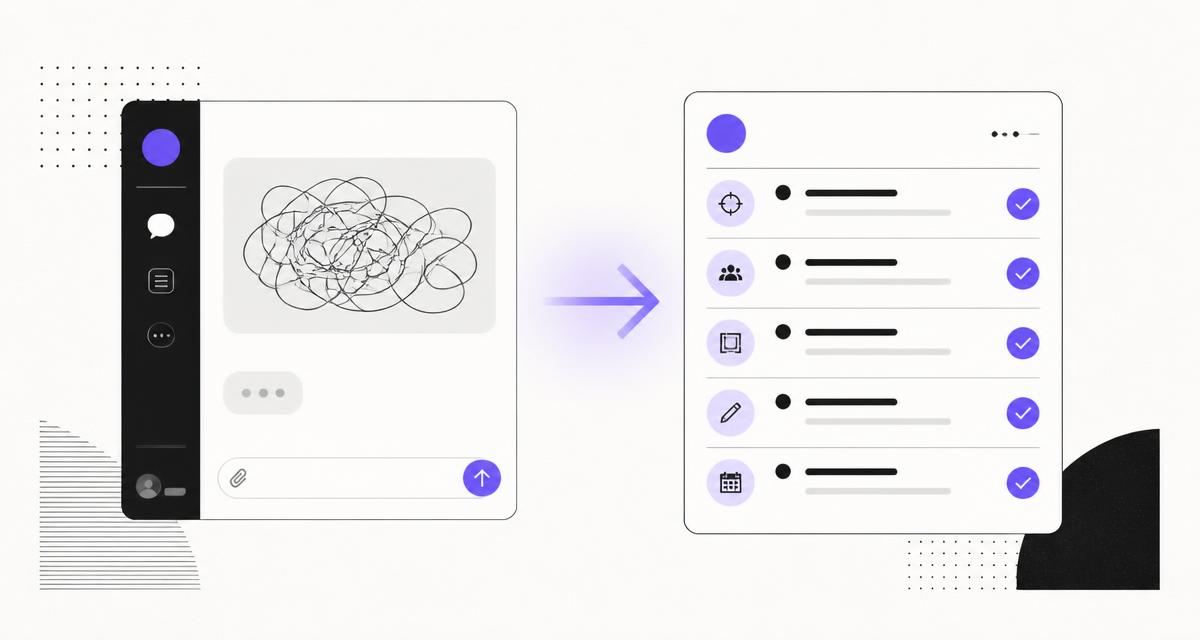
ChatGPT can produce polished writing while failing to solve the problem you actually had. The response may be grammatically correct, logically structured and still unusable.
The issue is often not that AI “does not understand people”. A model fills missing information with plausible assumptions. If you do not define the goal, audience, source material, constraints and success criteria, it selects the most likely interpretation on your behalf.
A good prompt is therefore not a magic phrase. It is a concise brief.
The 15 prompts below can help you:
- turn a vague idea into a defined task;
- make the model ask instead of guess;
- specify the audience, tone and output format;
- uncover missing information and hidden assumptions;
- critique the first draft;
- save a successful workflow as a reusable template.
For ready-made prompts covering specific marketing tasks, see 18 of the Best AI Prompts for Marketing in 2026. This guide addresses a different problem: how to define the task itself.
Why short prompts often produce weak work
“Write professional sales copy” does not explain what is being sold, who the buyer is, where the copy will appear, what action it should encourage or which claims are prohibited.
The model will still answer, but it will invent a large part of the brief. This is how generic language, unsupported promises and interchangeable brand copy are produced.
A useful prompt normally contains seven elements:
- 1.Goal — what the work should achieve.
- 2.Context — what matters about the situation.
- 3.Inputs — facts, sources and materials that may be used.
- 4.Audience — who the result is for.
- 5.Constraints — what must not be assumed or changed.
- 6.Format — how the answer should be structured.
- 7.Success criteria — how quality will be judged.
Not every prompt needs to be long. Include the information that can materially change the result.
1. Ask clarifying questions before answering
I want to [briefly describe the task].

Before answering, ask no more than five clarifying questions that would have the greatest effect on the quality of the result. Do not ask for information I have already provided. After I reply, briefly summarise your understanding of the task and only then produce the result.
2. Turn a vague idea into a structured brief
My initial idea is: [insert idea].

Turn it into a precise brief with these sections:
1. objective;
2. target audience;
3. required inputs;
4. expected deliverable;
5. constraints;
6. quality criteria;
7. unresolved questions.

Do not invent missing facts. Present them as questions.
3. Define an expert role and its boundaries
Work as a [specific specialism] whose objective is to [goal].

Focus on: [2–4 areas of expertise].
Do not make conclusions about: [boundaries].
If the available information is insufficient, state that clearly and identify what is missing.

Task: [task].
“B2B SaaS positioning consultant” provides a clearer direction than “experienced marketing expert”.
4. Identify the context that actually matters
I need to complete this task: [task].

Before proposing a solution, create a context checklist and divide the information into:
- essential;
- useful but optional;
- unlikely to affect the result.

Explain in one sentence why each essential item matters.
5. Define the audience precisely
The result is intended for this audience:
- role or job title: [..];
- level of expertise: [..];
- primary problem: [..];
- what they already know: [..];
- what they may misunderstand or question: [..];
- desired action after reading: [..].

Adapt the arguments, terminology and depth to this audience. Avoid generic statements that could be addressed to anyone.
6. Connect the deliverable to a business objective
Task: [task].
Business objective: [for example, help a qualified buyer compare solutions].

Before completing the task, explain:
1. how the deliverable should support this objective;
2. which information or arguments must be included;
3. what might look polished but remain commercially useless.

Then complete the task.
7. Specify a strict output format
Return the result in this format:
- executive summary: no more than 60 words;
- five key points;
- detailed reasoning in three sections;
- a separate risks and unknowns block;
- numbered next steps.

Do not repeat the same idea across sections. If there is insufficient evidence for a section, write “Insufficient information” instead of inventing content.

Task: [task].
8. Define testable quality criteria
Complete this task: [task].

The result is acceptable only if it:
- [criterion 1];
- [criterion 2];
- [criterion 3];
- does not contain [undesirable feature];
- can be used in [specific situation].

Before returning the final answer, check it against every criterion and correct any failure. Show only the final result and a brief verification summary.
9. Separate facts from assumptions
Analyse this task or plan: [content].

List separately:
1. facts explicitly provided;
2. assumptions you are making;
3. information that cannot be verified from the inputs;
4. the three riskiest conclusions;
5. data that should be obtained before a decision is made.

Do not present assumptions as facts.
10. Follow an example without copying it
Below is an example whose structure and level of detail I like:
[example]

Create a new piece about [topic]. Preserve only:
- the structural logic;
- information density;
- approximate paragraph length;
- sequence of reasoning.

Do not copy wording, metaphors, facts or conclusions. If the example's style conflicts with the new objective, prioritise the objective.
11. Generate meaningfully different options
Produce three approaches to this task: [task].

They must differ in strategy, not merely wording:
- A: safest and easiest to implement;
- B: balanced risk and potential benefit;
- C: boldest, with explicit risks.

For each option, give the best-use situation, advantages, disadvantages and primary trade-off. Recommend one based on this priority: [priority].
12. Critique and improve the first draft
Review the material below as a demanding editor, not a polite assistant:
[material]

Criteria: [criteria].

Identify:
- vague or generic passages;
- unsupported claims;
- repetition;
- missing arguments;
- sections that do not support the objective.

Then produce an improved version. Do not preserve wording merely because it already exists.
13. Identify missing inputs
I want this outcome: [outcome].
I currently have these inputs: [inputs].

Determine:
1. what is sufficient to begin;
2. what is missing for a high-quality result;
3. what can safely be assumed;
4. what must not be assumed;
5. the single most important missing input to obtain first.

Do not start the final solution until this analysis is complete.
14. Work in controlled stages
Complete the task in stages:
1. summarise your understanding;
2. identify missing information and assumptions;
3. propose an outline or plan;
4. stop and wait for my approval;
5. after approval, produce the final deliverable;
6. check it against the quality criteria.

Do not skip the approval stage.

Task: [task].
Quality criteria: [criteria].
15. Turn a successful conversation into a reusable template
Analyse our conversation and create a reusable prompt template for tasks of the same type.

In the template:
- replace case-specific variables with [fields in square brackets];
- preserve important constraints and quality criteria;
- remove incidental details relevant only to this case;
- add brief completion instructions;
- include one completed example.

Finally, explain when this template should not be used without adaptation.
A universal prompt template
Goal:
[What should be achieved]

Context:
[Relevant information about the company, situation and previous decisions]

Audience:
[Who the result is for and what they already know]

Inputs and sources:
[Facts and materials that may be used]

Task:
[Exactly what must be done]

Constraints:
[What must not be invented, claimed, changed or omitted]

Output format:
[Structure, length, language and depth]

Quality criteria:
[How we will determine that the result is usable]

If information that could materially change the result is missing, ask up to five clarifying questions first. If information cannot be verified, state that explicitly.
Five mistakes that weaken even detailed prompts
Irrelevant context
Longer is not automatically better. Include information that affects the decision, not the entire company history.
Conflicting instructions
“Extremely detailed but as short as possible” forces the model to decide which requirement to ignore unless you establish a priority.
Vague quality labels
“Professional”, “creative” and “persuasive” are interpreted differently. Describe observable characteristics instead.
Too many jobs in one step
Strategy, drafting, fact-checking and publication planning are usually more reliable when separated into stages.
Treating an AI response as verified evidence
A precise prompt reduces misunderstandings but does not guarantee factual accuracy. Verify figures, quotations, legal claims, product capabilities and other changing facts using primary sources.
Conclusion
The quality of AI output rarely depends on one secret phrase. The largest gains come from a clearly defined task, relevant context and explicit criteria for a usable result.
Start with one of the 15 prompts and save templates that work consistently. If your company needs a deliberate content system rather than simply more generated copy, explore Juice Digital Agency's content marketing services.
Frequently asked questions
Does a longer prompt always produce a better result?
No. Quality depends on task-relevant information: the goal, context, inputs, constraints, format and success criteria. Excessive irrelevant context can make the task less clear.
Must every prompt contain all seven elements?
No. A simple task may need only a goal, inputs and output format. As the cost of error and scope increase, the audience, constraints and quality criteria become more important.
Why does ChatGPT still miss the task after receiving detailed instructions?
The instructions may conflict, contain too many simultaneous tasks or lack essential inputs. Ask the model to summarise its understanding and identify ambiguity before producing the final answer.
Can these prompts be used with Claude, Gemini and other AI tools?
Yes. Model behaviour varies, but a clear goal, context, constraints and success criteria improve the brief regardless of the selected tool.
Does a good prompt prevent fabricated facts?
No. It can reduce unsupported assumptions, especially when the model must separate facts from unknowns, but important information should still be verified through reliable primary sources.
How can a company standardise its use of AI?
Begin with a small set of tested templates for recurring tasks. Define mandatory inputs, approval stages, human ownership and fact-checking rules. Update the templates based on actual outcomes.