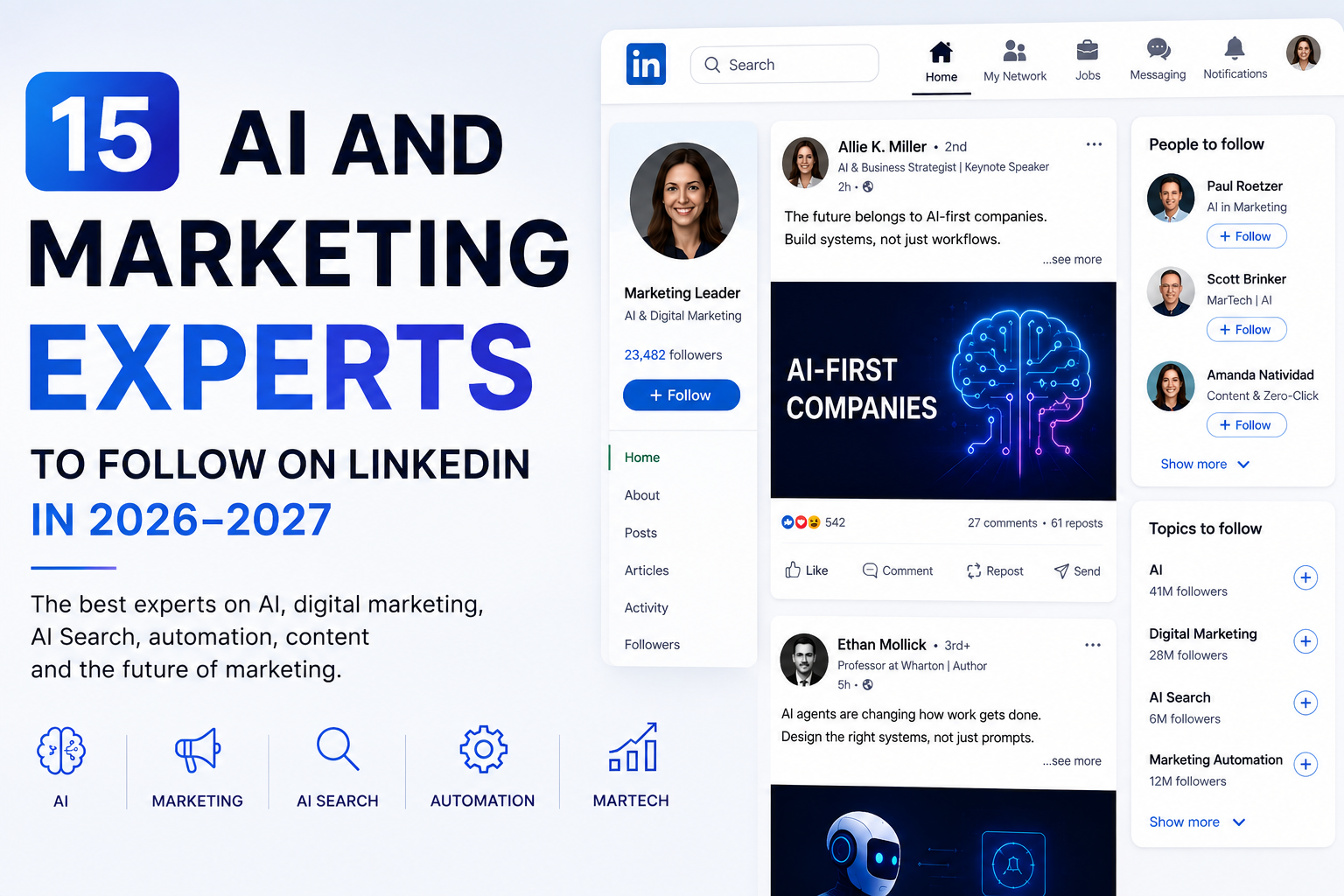
Which AI and marketing experts are worth following on LinkedIn in 2026-2027?
LinkedIn is now one of the most useful places to follow developments in AI, digital marketing, SEO, AI Search, GEO, MarTech and automation. The problem is no longer a lack of information - it is an excess of it. Every week brings new AI models, agents, marketing tools and dramatic claims that SEO is dead, Google is losing relevance or marketers will soon be replaced by artificial intelligence.
Juice Digital Agency therefore selected 15 AI and marketing experts on LinkedIn whose work is worth following in 2026-2027. This is not a popularity ranking: original thinking, practical value and relevance to the forces already reshaping marketing mattered more.
15 AI & marketing experts - the shortlist
| Expert | Primary focus |
|---|---|
| Ethan Mollick | AI and the future of work |
| Allie K. Miller | AI in business and AI agents |
| Paul Roetzer | AI in marketing |
| Christopher S. Penn | AI, analytics and digital marketing |
| Scott Brinker | MarTech and AI |
| Michael King | AI Search, SEO and GEO |
| Rand Fishkin | zero-click marketing and audience research |
| Amanda Natividad | content marketing and zero-click |
| Lily Ray | SEO, E-E-A-T and AI Search |
| Ann Smarty | GEO, SEO and AI visibility |
| Andy Crestodina | content marketing and conversion |
| Mike Rizzo | Marketing Operations and AI automation |
| Aleyda Solis | SEO and AI Search |
| Wil Reynolds | SEO, analytics and revenue |
| Andrew Ng | AI technology development |
If you follow only five: Ethan Mollick, Paul Roetzer, Scott Brinker, Michael King, Rand Fishkin.
How we selected the experts
Follower count was not the main criterion. We looked for original content, practical experience, evidence-based reasoning and consistent work across enterprise AI, AI Search/GEO, SEO, MarTech, automation, content marketing and measurement.
1. Ethan Mollick - AI and the future of work
LinkedIn: Ethan Mollick
Wharton professor Ethan Mollick is one of the most useful sources for understanding AI without the technology industry's promotional noise. He regularly tests new models and examines how AI changes work, organisations and human judgement.
What to learn from them: how to divide work intelligently between people and AI, rather than merely writing better prompts.
2. Allie K. Miller - AI in business and AI agents
LinkedIn: Allie K. Miller
Allie K. Miller focuses on enterprise AI adoption, AI-first organisations and agentic workflows. Her work is useful because AI is treated as an operating system for work rather than as another standalone tool.
What to learn from them: how to redesign a process instead of simply accelerating the old process with AI.
3. Paul Roetzer - AI in marketing
LinkedIn: Paul Roetzer
Marketing AI Institute founder Paul Roetzer is one of the most consistent voices at the intersection of AI and marketing. He focuses on AI literacy, leadership responsibility and systematic adoption.
What to learn from them: how to move from scattered AI experiments to an organisation-wide marketing system.
4. Christopher S. Penn - AI, analytics and digital marketing
LinkedIn: Christopher S. Penn
Christopher S. Penn connects generative AI with analytics, data, measurement and automation. His work is more technical than the average LinkedIn feed and often starts with the right question: how do we know this actually works?
What to learn from them: how to measure AI as a business instrument and avoid vanity metrics.
5. Scott Brinker - MarTech and AI
LinkedIn: Scott Brinker
Scott Brinker has mapped the MarTech industry for years. State of Martech 2026 continues to show a huge but fluid ecosystem in which traditional SaaS, AI-native products and companies' own solutions are converging.
What to learn from them: how the entire marketing technology infrastructure is changing, not just individual AI tools.
6. Michael King - AI Search, SEO and GEO
LinkedIn: Michael King
iPullRank founder Michael King is one of the most interesting sources on the technical side of AI Search. His work around Relevance Engineering helps move the discussion beyond the simplistic question of how to appear in a ChatGPT answer.
What to learn from them: how retrieval, relevance and information structure are changing SEO and GEO.
7. Rand Fishkin - zero-click marketing and audience research
LinkedIn: Rand Fishkin
Moz co-founder and SparkToro CEO Rand Fishkin focuses on audience research and zero-click marketing. That matters in a world where a buyer can encounter a brand across several platforms before ever visiting its website.
What to learn from them: why the click is no longer the only unit of marketing value.
8. Amanda Natividad - content marketing and zero-click
LinkedIn: Amanda Natividad
Amanda Natividad is one of the most practical voices in zero-click content. Her approach is a useful reminder that on LinkedIn, social platforms and in AI Search, content should create value before the click.
What to learn from them: how to create content that is useful on its own while also building brand demand.
9. Lily Ray - SEO, E-E-A-T and AI Search
LinkedIn: Lily Ray
Lily Ray is known for her work on Google algorithms, E-E-A-T, content quality and SEO. In the AI Search era, that perspective matters even more because trust and authority signals do not disappear.
What to learn from them: why technical SEO, quality and reputation remain foundations of AI visibility.
10. Ann Smarty - GEO, SEO and AI visibility
LinkedIn: Ann Smarty
Ann Smarty actively connects traditional SEO with GEO, AI visibility, Reddit and brand presence beyond the company's own domain. This encourages a broader view of optimisation as a digital reputation system.
What to learn from them: how to think about what the internet as a whole knows about a brand, not only what is published on its website.
11. Andy Crestodina - content marketing and conversion
LinkedIn: Andy Crestodina
Andy Crestodina has focused for years on content strategy, analytics and conversion. In the AI era, his perspective helps keep attention on business outcomes when content can be produced at near-infinite scale.
What to learn from them: how to connect content with user intent, conversion and real business value.
12. Mike Rizzo - Marketing Operations and AI automation
LinkedIn: Mike Rizzo
Mike Rizzo and the MarketingOps community track the growing importance of systems, integrations and automation in marketing. The boundary between marketer, automation specialist and marketing engineer is becoming thinner.
What to learn from them: how marketing teams move from using tools to building systems.
13. Aleyda Solis - SEO and AI Search
LinkedIn: Aleyda Solis
Aleyda Solis is a strong technical and international SEO practitioner with a disciplined experimental mindset. That is especially valuable in AI Search, where the market is full of conclusions drawn from one test or one screenshot.
What to learn from them: how to test, document and compare before declaring a new AI Search tactic universally true.
14. Wil Reynolds - SEO, analytics and revenue
LinkedIn: Wil Reynolds
Wil Reynolds has long connected SEO, data and business outcomes. That matters as the market adopts new metrics such as AI citations, mentions, share of answer and AI referral traffic.
What to learn from them: always connect visibility metrics with pipeline, customers and revenue.
15. Andrew Ng - AI technology development
LinkedIn: Andrew Ng
Andrew Ng is not a marketing expert, which is precisely why he belongs here. His work helps readers understand developments in AI technology, agents and models before those developments are repackaged as marketing hype.
What to learn from them: understand the technology one level deeper than its marketing interpretation.
If you only have time to follow five
For a minimal AI & Marketing radar, we would choose Ethan Mollick, Paul Roetzer, Scott Brinker, Michael King and Rand Fishkin. Together they provide five different lenses: AI and work, AI marketing, MarTech, AI Search/SEO/GEO, and audience/zero-click.
5 trends already visible in their work
1. AI is moving from tool to infrastructure
The first AI wave helped people write, summarise and generate. The next embeds AI into processes, data and multi-step workflows. The important question becomes not which AI tool you use, but where AI is built into the way your company operates.
2. Search is becoming bigger than Google
Discovery is distributed across Google, AI answers, ChatGPT, social platforms, Reddit, YouTube and other sources. SEO does not disappear; it expands into Search & AI visibility. Our guide to AI SEO, GEO and AEO explains this in more detail.
3. The click is losing its monopoly on value
A buyer may encounter a brand on LinkedIn, ask an AI assistant later, search the brand on Google and only then visit the website. Visibility, citations, branded search, qualified traffic and revenue therefore need to be evaluated together.
4. Mediocre AI content is losing value
If anyone can generate articles quickly, advantage comes from what is difficult to copy: proprietary data, experiments, real cases, opinions, experience, reputation and a distinctive brand voice.
5. The marketer's role is changing
The more valuable marketer increasingly combines marketing, data, AI, automation and business judgement: defining the problem, selecting the metric, testing the hypothesis and making the decision.
How to use this list in practice
Do not mechanically follow all 15 and keep scrolling. Pick one person for each key area: AI, AI Marketing, AI Search, MarTech and Content/Audience. Once a week, save only 2-3 ideas and ask: what changed, does it matter to our business, and what can we test in the next 30 days?
What does this mean for companies in Latvia?
Smaller organisations may have an advantage: shorter decision chains can make it easier to test AI workflows than in large corporations. But the sequence should be problem → process → data → AI → tool, not the other way around. For local market context, see our article on AI marketing in Latvia in 2026.
What will matter most in marketing in 2027?
AI is no longer a separate marketing topic. It is becoming a layer beneath SEO, content, analytics, advertising, CRM, research and Marketing Operations. The advantage will not belong to the person who knows 100 AI tools, but to the team that understands where AI produces a measurable business outcome. We explore this further in our article on marketing trends in 2027.
Conclusion: follow the people who help you think
In 2026, information advantage no longer means access to information. Everyone has Google, LinkedIn and AI. The advantage is the ability to filter the right signals. This list is therefore not an influencer popularity ranking, but a practical information filter.
If you want to turn these principles into a concrete plan, see our digital marketing services.
Frequently asked questions
Who are the best AI experts to follow on LinkedIn in 2026?
A strong starting set is Ethan Mollick, Allie K. Miller, Paul Roetzer, Scott Brinker and Andrew Ng, depending on whether your focus is work, business, marketing, MarTech or technology.
Which marketing experts should I follow on LinkedIn?
Paul Roetzer, Christopher S. Penn, Scott Brinker, Rand Fishkin, Amanda Natividad and Andy Crestodina cover AI marketing, analytics, MarTech, audience research, content and conversion.
Who should I follow for AI Search, GEO and SEO?
Michael King, Lily Ray, Ann Smarty and Aleyda Solis provide different and complementary perspectives on AI Search, GEO, technical SEO, quality and experimentation.
Who should I follow for AI in marketing?
Paul Roetzer and Christopher S. Penn are especially useful for practical AI adoption in marketing, while Allie K. Miller broadens the perspective to company-wide workflows and agents.
Will GEO replace SEO?
No. AI Search expands the visibility environment, but crawlability, indexing, useful content, authority, reputation and clear information architecture remain foundational. GEO extends SEO rather than replacing it.