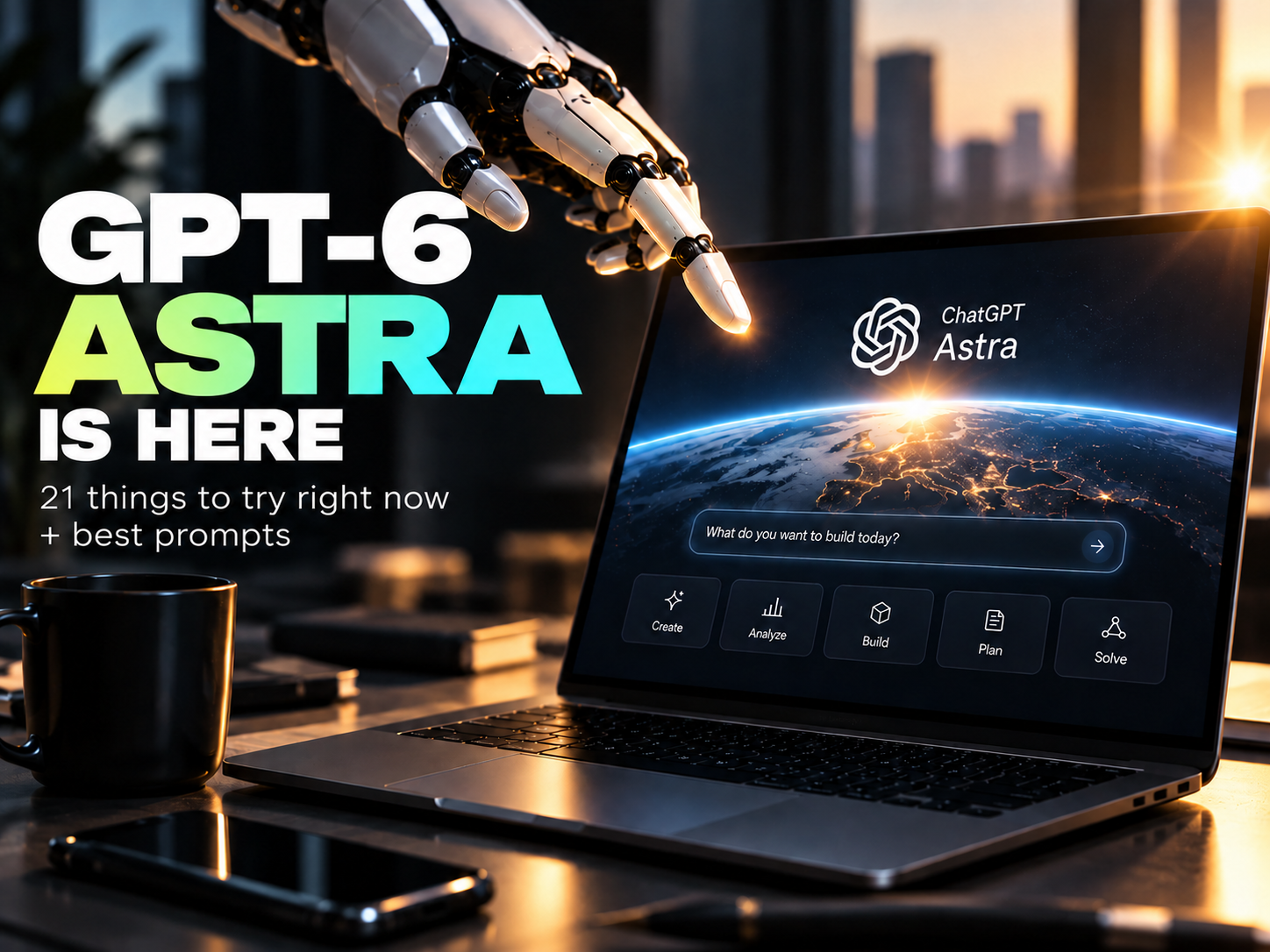
OpenAI has released GPT-6 Astra. If the news is reduced to "ChatGPT got smarter again", the most important part is missed. Astra's biggest leap is not writing text. It is the ability to hold a goal for longer, work with a computer and a browser, use professional tools and carry a multi-step task through to a finished result.
This article is not a context-free list of benchmarks. It covers what is worth knowing and trying now: what changed, where Astra is genuinely stronger, how to phrase tasks, and 21 practical prompts you can copy and use immediately.
What Is GPT-6 Astra and Who Gets Access?
GPT-6 Astra is OpenAI's new frontier model generation. OpenAI positions it as its most capable model for computer and browser use, software development, professional work, science and complex multi-step processes.
The rollout started on 6 September 2026 for a limited set of organisations. OpenAI says Astra will become available to ChatGPT Plus, Pro, Business and Enterprise users in the coming days. Pro, Business and Enterprise plans also get GPT-6 Astra Pro access. The API model will be available as gpt-6-astra, as well as through Microsoft Azure and AWS Bedrock.
OpenAI's standard API price at launch is $10 per million input tokens and $50 per million output tokens. Fast mode offers up to 2x speed at 2x the standard price.
Where Is the Real Leap?
| Test | GPT-5.6 Sol | GPT-6 Astra |
|---|---|---|
| AutomationBench | 18.1% | 41.4% |
| OSWorld 2.0 | 65.7% | 72.6% |
| ScreenSpot-Pro | 76.9% | 92.7% |
| Terminal-Bench 4.0 | 37.3% | 57.9% |
| BenchCAD | 83.3% | 95.9% |
In OSWorld 2.0 simulations, Astra reached a higher score roughly 47% faster per task than GPT-5.6 Sol. In practice, this means the biggest change is not only answer quality, but the ability to complete real work faster.
From "Answer Me" to "Do It for Me"
OpenAI demonstrates Astra working with CRMs, calendars, browsers, spreadsheets, presentations, professional software, website building and frontend QA. The model is trained to better follow company templates and style, and to preserve the original goal when a task changes mid-process.
So the most interesting question is: which stage of work can I hand over to AI - from start to a verified result?
21 Practical Prompts
Analyse my website as a sceptical potential customer. Find 10 specific reasons why I might not trust the company, fail to understand the offer, or not submit an enquiry. For each: evidence, impact on conversion, a concrete fix. Sort by priority.
Compare my company with the 5 main competitors. Assess positioning, offer, proof, pricing transparency, UX, SEO, content, case studies and conversion friction. Finish with 3 things where competitors are objectively stronger and 3 priorities for the next 30 days.
You are an interim CMO. First, establish the business model, margin, average deal size, sales cycle, channels, CAC and growth constraints. Then create a 90-day plan with priorities, KPIs, risks and what we deliberately will NOT do.
Analyse the marketing and sales data as a CFO. Calculate or estimate CPL, cost per qualified lead, lead-to-customer conversion, CAC and revenue per acquisition source. Flag where data is insufficient.
Do not build a summary. Find anomalies, contradictions, unexpected correlations and rows that may indicate an error or lost money. For each finding, state the business impact and what to investigate next.
Analyse reviews and support messages. Find recurring problems, what customers praise, what they misunderstand and what they expect but do not receive. Finish with 10 testable product/marketing hypotheses.
Research the company, business model, products, markets, leadership and recent public events. Prepare 10 questions, 5 possible objections, our leverage, their leverage and 3 conversation scenarios.
Assume that in 12 months the project has failed. Name the 10 most likely reasons. For each, give an early warning signal and a preventive action.
Extract only the decisions made, owners, deadlines, unresolved questions, risks and commitments. If anything is unclear, mark it UNKNOWN.
Split the findings into 4 groups: commercial risk, legal ambiguity, missing information, negotiation points. Quote the exact wording. Finish with 10 questions to ask before signing.
From several documents, create a single source of truth. Structure: goal, assumptions, decisions, priorities, roadmap, owners, risks, open questions. Do not resolve contradictions by guessing.
Look for contradictions in dates, amounts, definitions, responsibilities, requirements and statuses. Table: topic, source A, source B, conflict, possible version, confidence, what needs confirming.
First define the audience, problem, desired outcome, proof and main objection. Then create the hero, value proposition, proof, process, FAQ and CTA. Do not use empty superlatives without evidence.
Test navigation, forms, mobile layout, broken links, CTAs, error states and the main conversion flows. For each defect, add reproduction steps, severity and expected behaviour.
From the data, create an 8-slide executive presentation. Each slide must answer one business question. Structure: situation, changes, drivers, risks, opportunities, 3 decisions.
Look for evidence that the idea might be bad. Build a competitor map, alternatives, switching costs, willingness-to-pay signals and critical assumptions. For each, name the cheapest test.
Analyse the funnel from impressions to revenue. Find the 3 stages with the biggest value loss. For each: evidence, business impact, one experiment.
Find the 10 issues with the highest potential impact on organic growth. For each: evidence, affected URLs, impact, effort, priority. Also name 5 things that are NOT worth fixing right now.
Compare how the company is described across public sources: name, category, services, location, leadership, proof. Find entity inconsistencies and information gaps.
Use primary and trusted sources. Separate facts from interpretation. Prepare one page: 5 facts, 3 conclusions, 3 risks, 3 opportunities, 5 key sources.
Goal: [result]. Context: [what to know]. Constraints: [budget, deadline, what is not allowed]. Evidence: [data/files/sources]. Success criteria: [what a good result looks like]. Output format: [table/plan/document]. Ask questions only if a missing answer would materially change the final result.
7 Mistakes That Will Make Astra Seem Worse Than It Is
- Writing a novel when a clear goal and constraints are enough.
- Repeating the same instruction several times.
- Demanding facts without providing sources or access to evidence.
- Describing 47 micro-steps instead of defining the final result.
- Not stating what the model may do on its own and what needs approval.
- Not giving success criteria. The model cannot know what you consider a good result.
- Using maximum reasoning for every trivial task. A heavier mode only pays off when the extra quality changes the outcome.
A Longer Prompt Is Not Always Better
OpenAI's latest model guidance recommends leaner prompts: state each instruction once, avoid repeating examples unnecessarily and provide only the tools the task needs. In internal coding-agent tests, simpler system prompts improved results by roughly 10-15% while cutting total token usage by 41-66% and costs by 33-67%. OpenAI stresses these figures are indicative and should be validated in your specific workflow.
A practical formula:
- Goal↓
- Context↓
- Constraints↓
- Evidence↓
- Success criteria↓
- Output format
When Is Astra Overkill?
Not every email or text rewrite needs the most powerful mode. The simpler and more frequent the task, the more speed and cost matter. Heavier reasoning or Pro mode pays off where the cost of an error is high: complex analysis, significant code, professional review, optimisation or multi-step work with clear quality criteria.
What Does GPT-6 Astra Mean for Business?
The biggest change is not that ChatGPT will write a better LinkedIn post. The line between "AI gives advice" and "AI does the work" is getting thinner.
For companies, this means looking not for another 100 prompts, but for processes where AI can reduce manual human work while keeping clear verification and approval boundaries.
From Juice Digital Agency's perspective, the most interesting question of autumn 2026 is simple: which company processes are still done manually only because, until now, AI was not reliable enough to finish them end to end?
Related Juice Digital Agency Resources
- [AI prompti mārketingam](/tips-and-tricks/ai-promti-marketingam)
- [Kāpēc AI nepiemin jūsu uzņēmumu](/blog/kapec-ai-nepiemin-jusu-uznemumu)
- [AI aģenti un jaunais klienta interfeiss](/blog/ai-agenti-jaunais-klienta-interfeiss)
- [Mārketinga tendences 2027](/blog/marketinga-tendences-2027)
Sources
- OpenAI: GPT-6 Astra - A new generation of intelligence (6 September 2026)
- OpenAI Developers: Model guidance / prompting best practices
Frequently asked questions
What is GPT-6 Astra?
GPT-6 Astra is OpenAI's new frontier model generation, positioned as its most capable model for computer and browser use, software development, professional work and complex multi-step processes.
Who has access to GPT-6 Astra?
The rollout started on 6 September 2026 for a limited set of organisations. In the coming days Astra becomes available to ChatGPT Plus, Pro, Business and Enterprise users, as well as via the API (gpt-6-astra), Microsoft Azure and AWS Bedrock.
How much does the GPT-6 Astra API cost?
At launch, the standard price is $10 per million input tokens and $50 per million output tokens. Fast mode offers up to 2x speed at 2x the standard price.
How should you phrase a task for GPT-6 Astra?
A practical formula: Goal -> Context -> Constraints -> Evidence -> Success criteria -> Output format. State each instruction once and provide only the tools the task needs - a longer prompt is not always a better one.
When is GPT-6 Astra overkill?
For simple emails and text rewrites, speed and cost matter more. Heavier reasoning or Pro mode pays off where the cost of an error is high: analysis, code, professional review or multi-step work.