Two proposals labelled “marketing support” can cover very different work. One might include advertising management alone; another might also cover content, analytics and website improvements. Before choosing a partner, establish what each team will do and what your own team will need to handle.
This guide focuses on ongoing agency support. A standalone website or branding project will need different stages and acceptance criteria.
1. Define a qualified enquiry
“More customers” describes a business goal, but it is not enough for a working plan. Write down your priority service, market, customer type and the criteria that make an enquiry relevant.
For a B2B business, that might mean an enquiry from a company in a suitable industry with a specific need. This is an illustration, not a universal definition. Give every agency the same brief.
2. Separate the first month from ongoing work
The initial work might involve checking analytics, auditing accounts or setting priorities. Later work could focus on campaign improvements, content and specific obstacles. Ask agencies to describe these stages separately.
Find out how the plan will change if the initial hypothesis does not hold up. A fixed number of posts or reports does not explain how the team will choose the next priority.
If a proposal includes SEO services, ask for a breakdown of research, technical improvements, content and performance reviews. These tasks do not all need to happen at once. What matters is understanding the priority and the reason for it.
3. Assign responsibility at each stage
An agency may generate enquiries while your team supplies information, approves materials and responds to potential customers. Name the person or team responsible for each stage.
For example, the agency prepares a campaign, your company checks product claims, and sales handles enquiries and records their quality. This illustrates a possible division of work; it is not a promise about a particular engagement.
If a report shows plenty of enquiries but no sales, you need to examine both lead quality and what happens after an enquiry arrives. Without that information, it is difficult to know what to improve.
4. Compare the full costs
Separate setup work, the agency's monthly fee, advertising spend and additional costs. Check whether content, design, development, translation and software are included.
Ask how work outside the agreed scope is approved. The cheapest proposal may be suitable if it addresses your needs. A more expensive proposal should be assessed on its scope and reasoning.
5. Ask what decision follows the report
A published article is completed work. Search clicks are a marketing metric. Qualified enquiries and sales are later stages. The proposal should explain which of these will be measured and where the data will come from.
Before starting, agree on baseline data, review frequency and what happens if performance differs from expectations. Will you review the audience, offer, landing page or enquiry handling? Changes should follow observations rather than simply the number of tasks completed.
When choosing an SEO provider, Google's suggested questions cover experience, measurement and the reasoning behind changes. Nobody can guarantee a number-one Google ranking.
6. Discuss access and handover
Clarify who owns the accounts, data and materials, what access you will have and how handover will work when the engagement ends. Record the precise terms in your agreement. An omission from a proposal does not mean something is included.
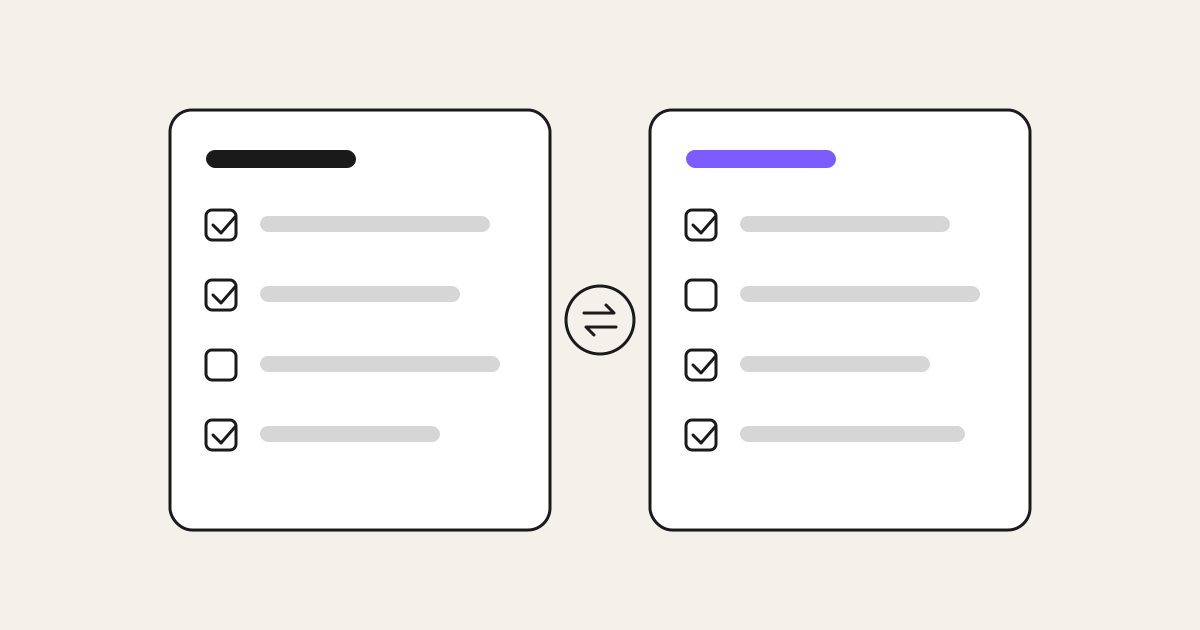
A table for comparing proposals
| Question | What to record |
|---|---|
| Objective | Priority service, market and definition of a qualified enquiry |
| Setup | Initial tasks and required access |
| Ongoing work | Recurring tasks and how priorities change |
| Responsibility | Tasks owned by the agency, your team and sales |
| Costs | Setup, monthly fee, media spend and additional costs |
| Measurement | Baseline, data source and decisions following a review |
| Handover | Access to accounts, data and materials after the engagement |
An empty field gives you a specific question to ask the agency. Comparing the same information across proposals makes your choice easier to explain.
If you need a partner in Latvia, get to know Juice Digital Agency. Bring your main business objective, the channels you currently use and the obstacles you want to address.