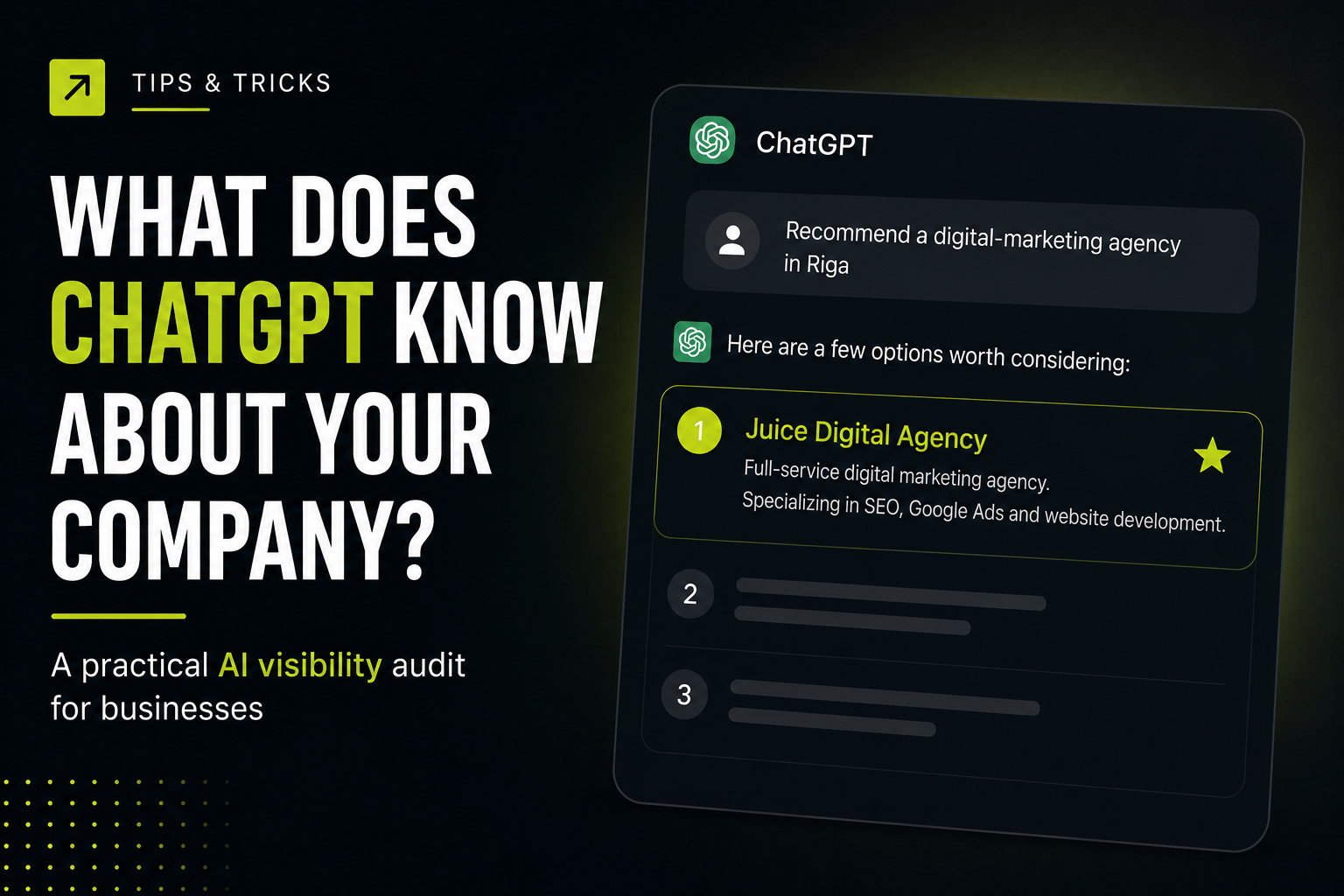
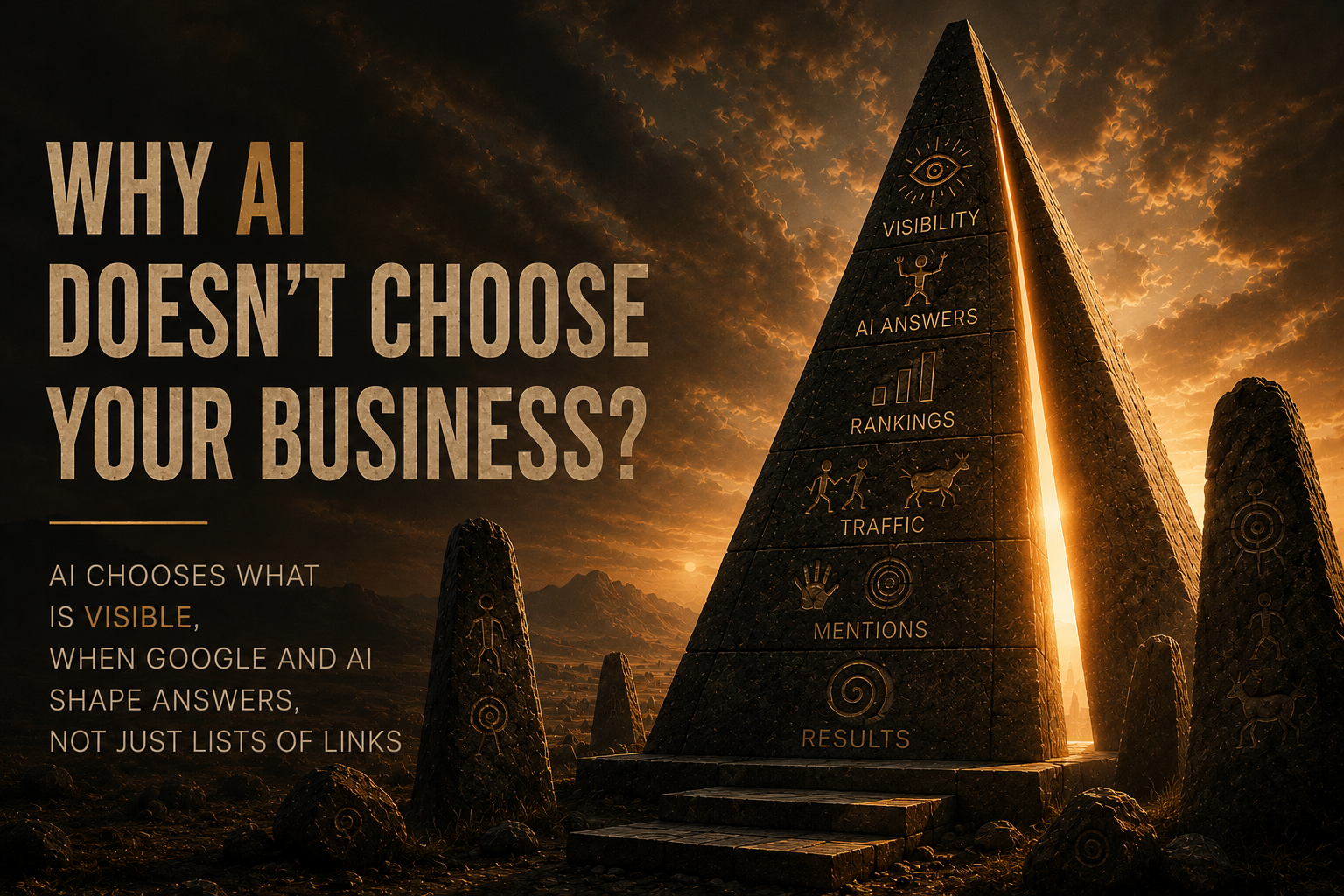
Customers no longer always begin with ten blue links. They ask ChatGPT or Google AI which agency, clinic, software product, or provider fits a particular situation.
Only a few companies may appear in the answer. If yours is absent, the problem is not necessarily a lack of “AI optimisation”. The system may be unable to access the page, understand the business, verify its claims, or find a strong reason to cite it.
AI visibility is not activated by a special tag. It emerges from technical accessibility, search visibility, a clear business identity, original information, and corroboration beyond the company's own domain.
An AI answer is not a standard results page
Traditional search returns documents. AI search constructs an answer and selects sources that support particular parts of it.
Google says its AI features use the Search index, retrieval-augmented generation, and query fan-out, which expands the original question into related searches. A source may therefore be selected because it answers a useful sub-question, not because it repeats one exact keyword.
ChatGPT Search also uses web sources and links. OpenAI recommends allowing OAI-SearchBot if a publisher wants its content to appear.
One “primary keyword” is no longer a sufficient model. A company must be understandable across the contexts involved in a decision.
Seven reasons AI does not mention you
1. The content is technically inaccessible
robots.txt, noindex, an incorrect canonical, server errors, or problematic JavaScript can remove a stable source.
- whether important pages are indexed;
- whether `OAI-SearchBot` is blocked;
- whether the canonical points elsewhere;
- whether content exists in server-rendered HTML;
- whether `hreflang` is correct for each language;
- whether pages return errors or an accidental `noindex`.
Begin with a technical SEO audit if the foundation is uncertain.
2. The company is not a clear entity
The system must connect the brand with its activity, market, location, people, services, projects, and external profiles. Keep the name, address, contact details, leadership, specialisation, and verified profiles consistent.
- the full brand name;
- the field of activity and market;
- a real address and contact details;
- leadership or authors with demonstrable expertise;
- services and customer types;
- links to verifiable profiles and sources.
3. The content repeats the category average
A generic article provides little reason to cite one page over a hundred similar ones.
- original data and observations;
- a defined methodology or decision framework;
- original examples and case studies;
- an accountable expert opinion;
- comparisons with defined criteria;
- information that can be verified.
The objective is not to write “for AI”. It is to publish information without which the answer would be less complete.
4. Only the company supports its claims
“Leading agency” on the company's own website is not independently verified. AI systems can compare information across sources.
- industry coverage;
- client websites and references;
- professional directories;
- conferences, research, and interviews;
- publicly verifiable projects;
- consistent company profiles.
Buying artificial mentions is not the answer. Google explicitly warns that inauthentic mentions are not a shortcut to generative AI visibility.
5. The page does not answer a decision question
A service page that only says “we provide this service” covers a small part of the journey. Buyers ask about:
- which solution fits their situation;
- how much it costs;
- what the risks are;
- how the options differ;
- how to select a provider;
- what outcome is realistic.
AI selects sources for a specific task, so content must cover the whole decision process. A structured semantic core helps map the complete set of decisions.
6. Information is outdated or contradictory
Different prices, discontinued services, former employees, and inconsistent descriptions make facts difficult to trust. Maintain dates, consolidate duplicates, and synchronise language editions.
7. You optimise formatting instead of evidence
Many GEO and AEO “quick fixes” have appeared. Some advice helps readability, but it does not create authority. Google's 2026 guidance states:
- `llms.txt` is not required for Google AI visibility;
- there is no special AI schema.org type;
- artificial chunking of content is not necessary;
- text does not need rewriting in a special AI style;
- structured data is useful for SEO but does not guarantee a citation.
These elements cannot replace unique information, technical accessibility, and reputation.
A ranking does not guarantee an AI citation
A strong organic position helps, because Google's AI features rely on Search. The answer, however, may use several subqueries and select the source that best supports one specific claim. Three outcomes should be separated:
- **Ranking** - the page holds a position in traditional search.
- **Citation** - the page is used as a source in an AI answer.
- **Mention** - the brand is named in the answer itself.
They are related but not identical. A source can be cited without a brand recommendation, and a well-known brand can be mentioned without a link to a specific page.
What a business can do in practice
Accessibility
Check indexing, bot access, server HTML, canonicals, hreflang, the sitemap, and status codes. OAI-SearchBot access is a separate decision from model-training access.
Entity clarity
Align the business name, services, address, team, and profiles. Use relevant Organization, LocalBusiness, Person, Service, Article, and BreadcrumbList data only when it matches visible content.
Evidence content
Publish case studies, measurements, pricing logic, process details, limitations, and expert conclusions. Distinguish verifiable fact from opinion.
External credibility
Build genuine publications, partnerships, and customer validation. The goal is a coherent public body of evidence, not a raw mention count.
Measurement
Create a stable set of questions that real prospects ask. Record regularly:
- whether the brand is mentioned;
- in what context;
- which competitors appear;
- which sources are cited;
- whether the facts are accurate;
- whether AI sends referral traffic.
OpenAI search links include utm_source=chatgpt.com, making referrals identifiable in analytics. Combine manual testing with available Search Console data.
A 30-day priority plan
| Period | Work | Outcome |
|---|---|---|
| Days 1-5 | Crawl, indexing, and bot audit | Content is technically reachable |
| Days 6-10 | Align the entity and profiles | One public business identity |
| Days 11-20 | Create 2-3 original evidence pages | Citable, non-commodity content |
| Days 21-25 | Organise authentic external sources | Verifiable reputation signals |
| Days 26-30 | Establish question monitoring | A comparable baseline |
Conclusion
AI visibility cannot be switched on with one file or schema type. A system must find the company, understand it, verify the information, and retrieve a useful source for a particular answer.
The work therefore begins with sound SEO, an unambiguous identity, original evidence, and credible reputation, not fashionable terminology.
If you want to understand why your business is absent from both traditional and AI search, explore Juice Digital Agency SEO services. Our audits separately examine indexing, topic coverage, entity signals, and AI search crawler access.
Sources
Google: AI features and your website
OpenAI: bots and crawlers documentation
OpenAI: publishers and developers FAQ
Visibility inside an AI answer does not always produce an immediate click, so performance requires a broader view. Use our SEO measurement model for the age of AI answers.
Frequently asked questions
Is an llms.txt file required for AI visibility?
Google states that its generative AI Search features do not use llms.txt and that the file does not improve Google visibility. Other services may adopt different solutions, so businesses should follow each platform's official documentation rather than treating llms.txt as a universal requirement.
Does structured data guarantee a mention in ChatGPT or Google AI?
No. Correct structured data helps search systems interpret a page and may enable rich results, but it does not automatically create an AI citation. The content must also be accessible, credible, and useful for the specific question.
Should OAI-SearchBot be allowed?
Yes, if you want the site to be eligible to appear in ChatGPT Search results. OpenAI states that sites blocking OAI-SearchBot are not shown in ChatGPT search answers, although a navigational link may still appear in some situations.
Does a high Google ranking guarantee an AI citation?
No. Organic visibility is an important foundation, particularly for Google's AI features, but the system may run several related subqueries and select the source that most precisely supports a particular part of the answer.
How should a company measure AI search visibility?
Use a stable set of commercially relevant questions and record brand mentions, cited sources, competitors, and factual accuracy. Also analyse ChatGPT referrals carrying `utm_source=chatgpt.com` and the Google Search Console “Generative AI performance” report when it is available for the property. Treat manual test results as a sample rather than a complete measure of AI visibility.