Why the old SEO measurement model is no longer enough
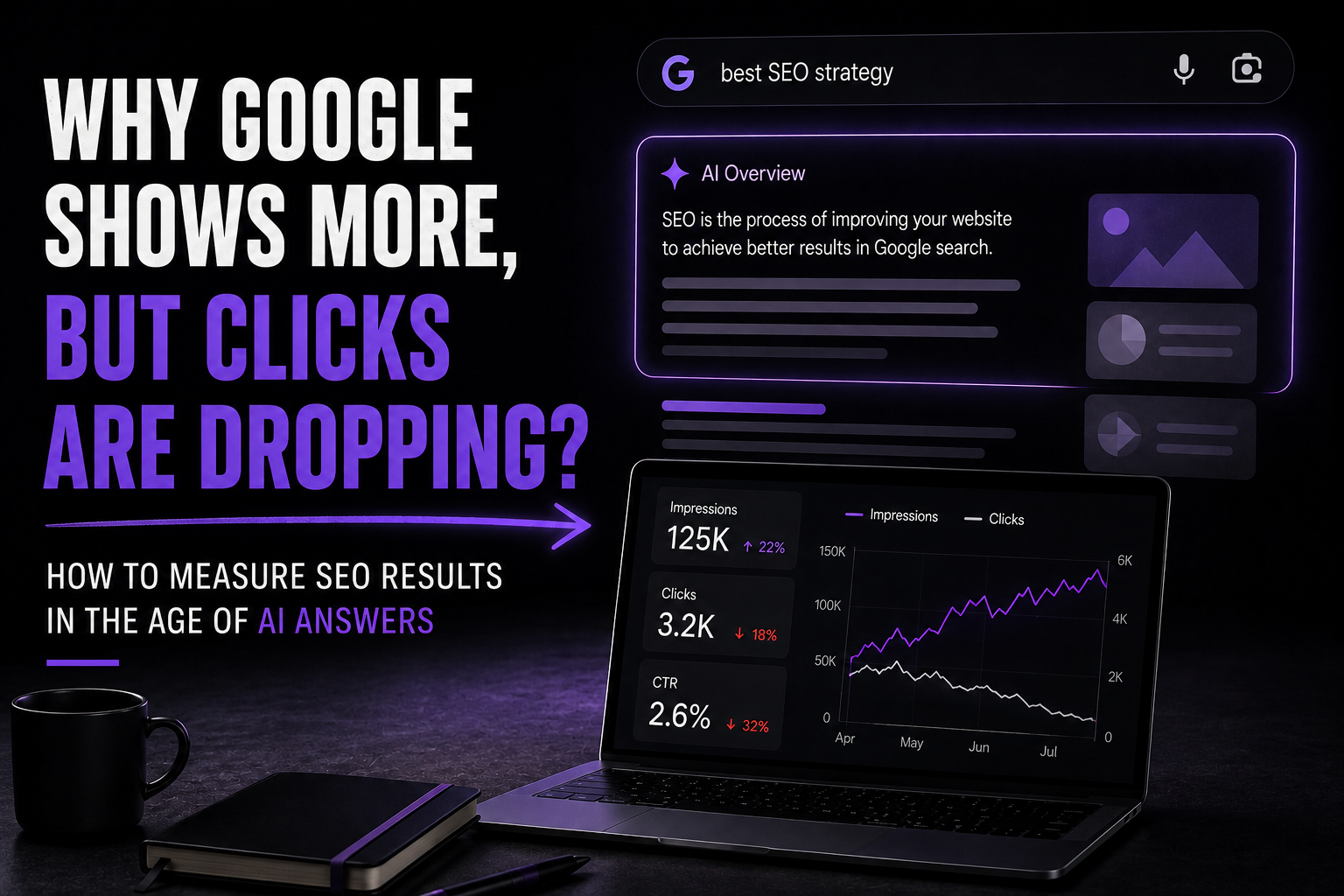
A business opens Google Search Console and finds a confusing pattern: impressions are increasing and average position has not deteriorated, yet clicks are flat or falling. The immediate conclusion is often that SEO has stopped working.
That conclusion may be premature.
Google results are no longer a simple list of ten blue links. A result page can contain AI-generated answers, featured snippets, knowledge panels, maps, images, videos, products and advertising. Some users obtain enough information without leaving Google. Others notice a brand during research and return later through a branded search or another channel.
Clicks still matter, but they no longer describe the full influence of organic visibility.
Google states that its established SEO fundamentals remain relevant to AI Overviews and AI Mode: pages must be crawlable and indexable, and the content should be genuinely useful. There is no separate technical “AI optimisation trick”. Google Search Central guidance on AI features.
What “more impressions but fewer clicks” can actually mean
This combination can appear for several very different reasons.
1. The page is appearing for a broader set of queries
Google may begin testing a page for new informational or adjacent searches. Impressions rise, although those users may not yet be ready to visit a service page.
This can be an early visibility signal rather than a failure.
2. The answer is available without a click
A definition, date, price or short instruction may be displayed directly in search. The user sees the source but does not open it.
In that case the source can gain exposure without receiving a recorded visit.
3. More elements compete for attention
Even at the same recorded position, a link may appear below an AI answer, ads, a map or video carousel. The same average-position number does not guarantee the same visual prominence.
4. The snippet is losing the click
If impressions and rankings are stable while CTR falls on one page, review the title, description, intent match and competitor offers.
5. The query and device mix has changed
Mobile and desktop results differ. Branded and non-branded searches also have very different CTR patterns. A site-wide average can hide the real change.
Lower CTR does not automatically mean worse SEO
CTR must be interpreted alongside position, intent, result format and business outcomes.
For example:
- informational impressions rise while clicks remain stable: topical visibility may be expanding;
- CTR falls while leads grow: the smaller audience may be better qualified;
- clicks rise without leads: the new traffic may lack commercial intent;
- position and impressions remain stable while one page loses CTR: inspect its snippet and live results first.
The measurement chain is:
demand → visibility → click → on-site behaviour → conversion → revenue.
A five-layer SEO measurement model
1. Demand
Determine whether interest in the topic is rising, falling or seasonal. Without this context, a market change can be mistaken for a website problem.
A structured semantic core separates commercial, informational, local and branded demand instead of treating all keywords as one group.
2. Visibility
In Search Console, analyse:
- impressions;
- average position;
- the number of queries a page appears for;
- visibility by country, device and page;
- branded and non-branded queries;
- commercial and informational clusters.
Google defines an impression as a situation in which a user could potentially see a link to the site; the precise counting method depends on the search-result type. Google’s definitions of clicks, impressions and position.
3. Click capture
At this layer, clicks and CTR matter - but not only at site level.
Compare CTR for:
- the same page before and after a change;
- comparable positions;
- one device category;
- branded and non-branded queries separately;
- queries with comparable intent.
Our guide to Google Search Console analysis provides a practical review sequence.
4. Behaviour after the click
Search Console explains the journey before the visit; GA4 explains what happens afterwards.
For organic landing pages, track:
- engaged sessions;
- average engagement time;
- paths to service or contact pages;
- CTA clicks;
- return visits;
- language and device.
Google recommends using both sources together for this reason. Official Search Console and Analytics guidance.
5. Leads and business outcomes
The primary question is not how many clicks arrived, but which valuable actions followed.
A minimum measurement set includes:
- `generate_lead` for a successfully submitted form;
- `book_call_click` for opening call booking;
- `phone_click` for clicking a phone number;
- organic landing pages that assisted the path to conversion;
- qualified leads and closed deals recorded in the CRM.
Connecting GA4 and Search Console makes it possible to analyse organic queries, landing-page engagement and key events in one analytics environment. Google Analytics integration instructions.
How to diagnose a decline in Search Console
1. Compare equal periods
Compare the last 28 days with the previous 28 days. For seasonal demand, also compare the same period year over year.
2. Locate where the difference appeared
Do not rely on the total graph. Review changes by:
- page;
- query;
- country;
- device;
- search appearance.
3. Separate branded and non-branded queries
Branded queries usually have a higher CTR. If their share falls, the overall CTR can drop without any ranking problem.
4. Group searches by intent
Evaluate separately:
- learning;
- provider selection;
- pricing and comparison;
- local intent;
- brand navigation.
5. Inspect the live result page
Search Console does not explain the visual layout of the result page. Check your most important queries in a private window, accounting for location and device: AI answers, ads, maps, video, new competitors and rewritten snippets.
If visibility falls alongside crawling or indexing issues, carry out a technical SEO audit instead of simply publishing more copy.
A practical monthly SEO dashboard
| Layer | KPI | What it explains |
|---|---|---|
| Demand | Impressions by topic cluster | Changes in interest and topical coverage |
| Visibility | Position and query count | Whether Google selects the site more often |
| Click | Clicks and CTR by intent | Whether the result earns a visit |
| Website | Engaged sessions and CTA paths | Whether the page satisfies the visitor |
| Conversion | generate_lead, book_call_click, phone_click | Whether organic search creates action |
| Quality | Qualified leads and deals | Whether SEO creates commercial value |
Review this table by landing page and topic cluster, not only as a site-wide average.
How to earn the click when Google already provides a short answer
The goal is not to hide the answer, but to give a reason to continue the research on your website.
Answer directly, then add depth
Do not hide the answer to manufacture a click. Give a concise response, then provide what the result page cannot replace: decision criteria, processes, risks, tables, examples and a useful next step.
Publish experience rather than a compilation
Original data, case studies, real constraints, expert judgement and practical examples are harder to replace with a generic AI summary.
Match the search intent
“SEO pricing”, “what is SEO?” and “SEO agency in Riga” require different page types. A mismatch can generate impressions without clicks or leads.
Improve the title and description
A strong snippet explains the specific value of the page instead of promising “everything you need to know”.
Offer a clear next step
An article should lead naturally to a related guide, service, audit or conversation. For the wider visibility topic, read our guide to AI SEO, GEO and AEO.
Common measurement mistakes
- evaluating only total traffic;
- comparing periods with different lengths or seasonality;
- mixing branded and non-branded searches;
- treating average position as an exact pixel location;
- assuming lower CTR proves a ranking loss;
- measuring form opens instead of successful submissions;
- treating every click as equally valuable;
- failing to connect Search Console, GA4 and CRM outcomes.
Conclusion
AI answers and richer search results do not make SEO irrelevant. They make click-only measurement inadequate.
When impressions rise but clicks do not, identify where the user journey changed: demand, the result page, the snippet, the website experience or the path to enquiry. Only then should the business change its content, technical implementation or offer.
Juice Digital Agency’s SEO services combine technical analysis, semantic research, content, Search Console, GA4 and commercial-conversion measurement. The objective is not an attractive traffic graph; it is understanding where organic visibility creates qualified demand.
Frequently asked questions
Does lower CTR mean rankings have fallen?
No. CTR can fall while position remains stable if an AI answer, advertising, maps, video or another search feature attracts attention. Review position, intent, device and the actual result layout together.
Do AI answers always reduce website traffic?
No. The impact varies by subject and query. A simple factual search may not require a visit, while comparison, provider-selection and purchase journeys still require sources and detailed information.
Which SEO metrics should be analysed together?
At minimum, impressions, positions, clicks and CTR from Search Console, engagement and key events from GA4, and qualified leads and deals from the CRM.
How should branded and non-branded searches be separated?
Create a query filter containing the company name, spelling variants and domain. Analyse this group separately because its intent and expected CTR differ substantially.
Does Search Console show all AI-answer performance data?
Google is gradually rolling out a dedicated generative-AI performance report to a subset of sites. Availability is not guaranteed, so the standard Performance report and page/query segmentation remain essential.
How can SEO-generated leads be measured?
GA4 should record successful form submissions, call bookings and phone clicks. Organic landing pages must then be connected with lead qualification and sales outcomes in the CRM.
How often should SEO results be reviewed?
Operational signals can be reviewed weekly, but strategic decisions are safer with complete 28-day periods and context about seasonality, website changes and major Google updates.