Introduction
A semantic core is one of the fundamental elements of an effective SEO strategy. However, many businesses only encounter the term after their website has already been launched and they begin asking why it receives little or no organic traffic from Google. In reality, keyword research and semantic mapping should begin before the website structure, design, or copy is finalised.
In simple terms, a semantic core is a structured collection of search queries that potential customers actually use when looking for your products, services, or information related to your industry. It helps determine which pages the website should contain, how services and categories should be organised, which topics should be covered in the blog, which search queries should be targeted by each page, how internal links should connect the content, and which search opportunities are commercially relevant to the business.
A semantic core is therefore much more than a spreadsheet of keywords. It is the foundation of the website architecture, content strategy, and wider SEO process.
A semantic core in simple terms
Imagine that a company provides website development services. Internally, the company may describe its work as "digital solution development", "corporate web platforms", or "custom web engineering". Potential clients, however, may use very different phrases in Google - for example, "website development", "website design and development", "business website", "SEO services", or "Google Ads cost".
A semantic core reveals this difference. A single service may be associated with dozens or even hundreds of search queries. These queries can differ by wording, search volume, competition, commercial value, and user intent. For example, "what is SEO?" and "SEO agency in Riga" belong to the same broader topic, but the users behind them want different things. The first user is looking for information. The second is probably evaluating service providers. A well-structured semantic core separates these search intents and helps create the most appropriate page for each one.
What does a semantic core include?
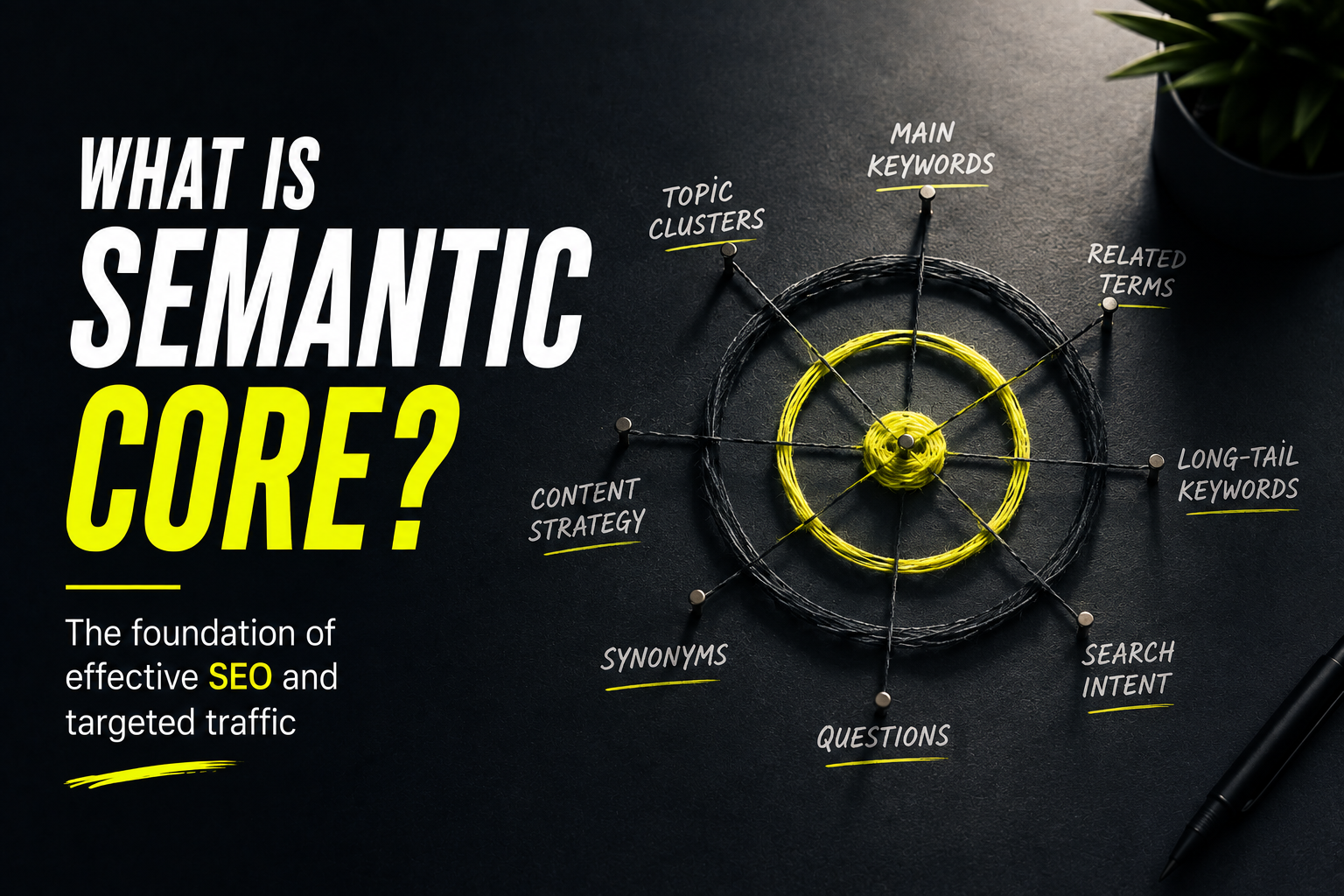
A semantic core typically contains primary keywords, synonyms and alternative wording, long-tail search queries, pricing-related searches, frequently searched questions, location-based queries, service and product categories, informational and commercial terms, estimated search volume and competition, and a clear mapping of each keyword group to a relevant page. The result should not be an unstructured export from an SEO tool. It should be a practical strategy document that supports decisions about the website and its content.
Why should a semantic core be created before website development?
One of the most common mistakes is to build the website first and attempt to "add SEO" afterwards. Once the site is launched, the business may discover that important service pages are missing, several different services have been combined on one page, the menu does not reflect how customers search, multiple pages target the same queries, the copy uses internal industry language rather than customer language, and the completed website structure needs to be rebuilt.
The more effective process is the opposite. First, the business analyses search demand and builds its semantic core. The website structure, categories, service pages, and content are then planned around that evidence. This does not mean that every keyword requires its own page - keywords with the same topic and search intent are generally grouped and targeted by a single comprehensive page.
How is a semantic core created?
1. Collecting seed keywords
The process begins with the main phrases that describe the company's products, services, and areas of expertise. For a digital agency, the initial topics might include SEO, Google Ads, website development, social media marketing, brand identity and graphic design. These seed terms provide the starting point for deeper keyword research.
2. Expanding the keyword list
The initial terms are then expanded to identify synonyms, alternative wording, related topics, frequently searched questions, longer and more specific queries, location-based terms and keywords used by competing websites. Tools such as Google Keyword Planner, Google Search Console, Ahrefs and Semrush can support this process. It is rarely advisable to rely on a single tool - search-volume estimates and keyword coverage can differ significantly between platforms.
3. Analysing search volume and competition
Each keyword is assessed according to factors such as estimated monthly searches, ranking competition, relevance to the company's services, commercial potential, the current Google results and the realistic opportunity to achieve strong rankings. A high search volume does not automatically make a keyword valuable - a more specific search query may attract fewer searches but have a much higher probability of generating a qualified lead.
4. Identifying search intent
Search intent describes what the user expects to find. Most search queries can be grouped into informational intent (the user wants to learn something), commercial investigation (comparing options or providers), transactional intent (ready to buy, request a quote, or make contact) and navigational intent (looking for a particular brand or website). Understanding intent helps determine whether a keyword should be targeted with a service page, category, comparison, guide, article, or another content format.
A search-intent map matters even more now that some questions are asked not in Google but in ChatGPT or Google AI. When the semantic core covers the full decision path - from informational questions to comparisons and pricing queries - it also supports the company's visibility in ChatGPT and Google AI, not only its classic search results.
5. Clustering keywords
The keywords are then organised into thematic groups. An SEO cluster, for example, might include SEO pricing, SEO services, SEO audits, technical SEO, Google indexing, keyword research, Google Search Console and how long SEO takes to produce results. Each cluster may become a service page, a blog article, or a section within a larger resource. The key is to avoid creating multiple pages that address the same search intent - otherwise keyword cannibalisation can occur.
6. Setting priorities
Not every keyword cluster needs to be developed at the same time. Priorities can be based on commercial value, search demand, competition, the company's strategic services, the existing authority of the website, potential influence on sales and the resources required to create competitive content. Prioritisation is also closely tied to budgeting - see our guide on SEO pricing in Latvia in 2026 for more detail. In most cases, the best starting point is a topic that matters commercially, has confirmed demand, and offers a realistic opportunity to achieve visible Google rankings.
7. Mapping keywords to pages
Finally, each keyword cluster is assigned to an existing or planned page. This process is often referred to as keyword mapping. It makes it possible to see which page is responsible for each topic, where new content needs to be created, which existing pages require improvement, where keyword overlap exists and which internal links should be added.
How does a semantic core shape website structure?
A semantic core allows the website to be structured around real search behaviour rather than internal assumptions. For example, keyword research may show that users separately search for logo design, graphic design, brand identity and packaging design. This may indicate that each service needs a dedicated page or, at minimum, a clearly separated content section. This makes it easier for Google to understand the subject of each page and easier for users to find the exact service they need. The semantic core can also influence the main navigation, service hierarchy, category structure, blog topic clusters, URL structure, internal linking and page headings.
If the pages already exist, it is easier to check intent distribution with a content audit template and decision matrix.
How does a semantic core support blog strategy?
Without keyword research, a company blog often becomes a collection of unrelated articles. The team publishes topics that appear interesting internally, without knowing whether users are searching for them, what the underlying search intent is, which commercial service the article should support, and how the article contributes to the wider website.
A semantic core enables the creation of structured topic clusters. For example, a main SEO service page can be supported by articles covering SEO pricing, technical SEO audits, Google indexing, Google Search Console and other related topics. These pages can be connected through internal links, helping Google understand that the website covers the topic in depth.
What does a business lose without a semantic core?
Without a well-developed semantic core, a business may create pages that almost nobody searches for, fail to create pages for valuable commercial searches, publish content without confirmed demand, make its own pages compete against each other, target too many unrelated topics on one page, use terminology that customers do not understand, lose organic traffic to competitors and pay to rebuild the website structure later. When analysing websites for companies in Latvia, we often find that a significant share of potential organic demand remains untapped simply because the website was organised according to internal business logic rather than actual customer search behaviour.
Common mistakes when building a semantic core
Focusing only on high-volume keywords - the most popular keywords usually attract the strongest competition, and a new or less authoritative website may gain visibility faster by targeting more specific and relevant queries. Ignoring search intent - two similar keywords can represent different user goals, and if a commercial keyword is targeted only with an informational article, the page may not match the Google results or the user's expectations. Creating a separate page for every keyword - this can produce many weak, similar pages that compete against one another. Combining too many topics on one page - the opposite mistake is attempting to optimise a single page for every service the business provides. Ignoring long-tail queries - longer and more specific searches often have lower volume, but they may be much more likely to generate a conversion. Not checking whether pages are indexed at all - for the reasons Google may exclude your pages, read Why isn't my website on Google?. Failing to update the semantic core - search behaviour, competitors, services and Google results change over time, so the semantic core should be reviewed and expanded regularly.
Keyword cannibalisation: what to check before merging pages
Two pages appearing for the same query do not, by themselves, prove harmful keyword cannibalisation. A service page and a practical guide may serve different needs. First identify what the searcher wants and which page answers that need best. Check language versions separately: similar content in different languages is not a reason to redirect every version to one page.
In the Google Search Console report, filter by exact query, country and device, then review the pages. Compare equal periods with complete data. Does the visible URL change? Is the intended page losing clicks and impressions? Does the pattern persist across several weeks? One day's fluctuation or two URLs in a table is not sufficient grounds to delete a page.
If the pages serve different purposes, keep both and clarify their content and links to each other. If they genuinely duplicate one intent, assess their content, links and enquiries before planning a merge and an appropriate redirect. Use canonical signals for duplicate or very similar documents, not as a universal fix for different topics. For help with priorities and implementation, explore our SEO services.
Does a semantic core guarantee high Google rankings?
No. A semantic core alone cannot guarantee strong rankings. It provides the foundation for a technically reliable website, a clear site architecture, useful and comprehensive content, a logical internal-linking system, external authority and brand recognition, and regular performance analysis. However, without a semantic core, the remaining SEO work is often performed without a clear strategic direction.
Frequently asked questions
Is a semantic core a one-time project?
The initial semantic core is normally created at the beginning of an SEO or website project, but it should be reviewed periodically. This is especially important when the company introduces new services, enters new markets, or expands the website.
Does a small business need a semantic core?
Yes. A smaller company may need a less extensive semantic core, but even a business offering only a few services should understand the terminology its potential customers actually use in Google.
What is the difference between a semantic core and a keyword list?
A keyword list is simply a collection of search phrases. A semantic core is a structured document in which keywords have been analysed, grouped by topic and search intent, prioritised, and assigned to specific pages.
Can a semantic core be created for an existing website?
Yes. For an existing website, it can identify missing topics, untapped searches, competing pages, and opportunities to improve the current structure and content.
Conclusion
A semantic core is not simply a list of keywords. It is the foundation of the entire SEO strategy, from website architecture and service pages to blog content and internal linking. A well-developed semantic core helps a business understand what potential customers are actually searching for, which pages the website needs, and which topics deserve further investment. The earlier this analysis is completed, the lower the risk of having to rebuild the website, lose valuable organic traffic, or create pages that compete against each other.
*To understand which terms your potential customers use and whether your website fully covers the available search demand, our SEO team carries out semantic-core research at the beginning of every project. For more information about the technical analysis of a website, read our guide: What is a technical SEO audit?*
Search behaviour is changing and more questions are asked through AI assistants, so topic planning also affects visibility in ChatGPT and Google AI.