
A redesign is usually intended to modernise the brand, improve navigation, adopt better technology and generate more enquiries.
Yet the company is not changing an empty layout. Search engines know its pages, other sites link to specific URLs, campaigns use landing pages and customers follow established journeys.
A redesign migrates four assets at once: search equity, information architecture, conversion systems and measurement continuity.
If only the visual layer is managed, the new site can look better and earn less.
Why traffic falls
Google does not penalise a site because it dislikes the new design. Losses occur when the redesign removes the signals through which the old site was understood.
- valuable URLs disappear without equivalent redirects;
- unrelated pages all redirect to the homepage;
- useful content becomes a few slogans;
- headings and internal links change;
- staging noindex reaches production;
- canonical or hreflang is wrong;
- content is absent from server HTML;
- sitemap contains redirected or non-canonical URLs;
- structured data no longer matches the visible content;
- mobile navigation hides essential sections;
- forms and analytics stop recording leads.
The real question is not whether rankings will fluctuate, but whether the new system preserves and clearly hands over the meaning of every valuable page.
Inventory before design
A safe migration starts in data, not in Figma. Before approving the new structure, export crawlable URLs, sitemaps, Search Console pages and queries, GA4 landing pages and conversions, backlinks, campaign destinations, structured data, assets and language mappings.
| URL role | Decision |
|---|---|
| Retains purpose and value | Keep the URL |
| Has an equivalent successor | 301 to that page |
| Merges into another resource | 301 to the consolidated page |
| Obsolete with no replacement | 404 or 410 |
| Useful to users but not Search | Deliberate index/noindex decision |
A page should not be deleted simply because it is absent from the navigation. It may attract valuable demand.
Keep URLs unless change creates real value
When topic, language and role remain the same, the existing URL is usually safest. A prettier slug rarely offsets redirect risk, temporary reprocessing and broken analytics continuity.
Build the redirect map
- server-side permanent 301/308;
- one final destination per valuable old URL;
- the destination matches the previous search intent;
- no chains A → B → C;
- no loops;
- internal links point directly to final URLs;
- languages remain aligned;
- parameter and campaign URLs are tested separately.
Redirecting everything to the homepage does not preserve relevance and may be treated as a soft 404. An honest 404 is better than a misleading destination, although valuable pages normally deserve a successor.
Preserve meaning, not merely old wording
Record search intent, answered questions, original facts and tables, heading structure, internal links, authorship, FAQ/schema and conversion elements. A deeper methodology is described in What is a technical SEO audit.
Copy may be improved and consolidated. A substantial service page should not become a headline and three icons without evidence. If a design cannot present the information customers need, the design - not "too much SEO text" - is the problem.
Avoid one uncontrollable experiment
Changing the domain, CMS, URL structure, architecture, copy, design, consent platform and analytics simultaneously makes diagnosis almost impossible.
Where possible, phase the project: migrate technology while retaining URLs and content, then introduce structural changes, and handle a domain change as a separate controlled event.
Measure conversion alongside SEO
Before launch, preserve organic landing-page conversion, form starts and completions, calls, bookings, purchases, lead quality, device differences and abandonment points. Stable traffic with a 30% lower form conversion rate is not a successful redesign.
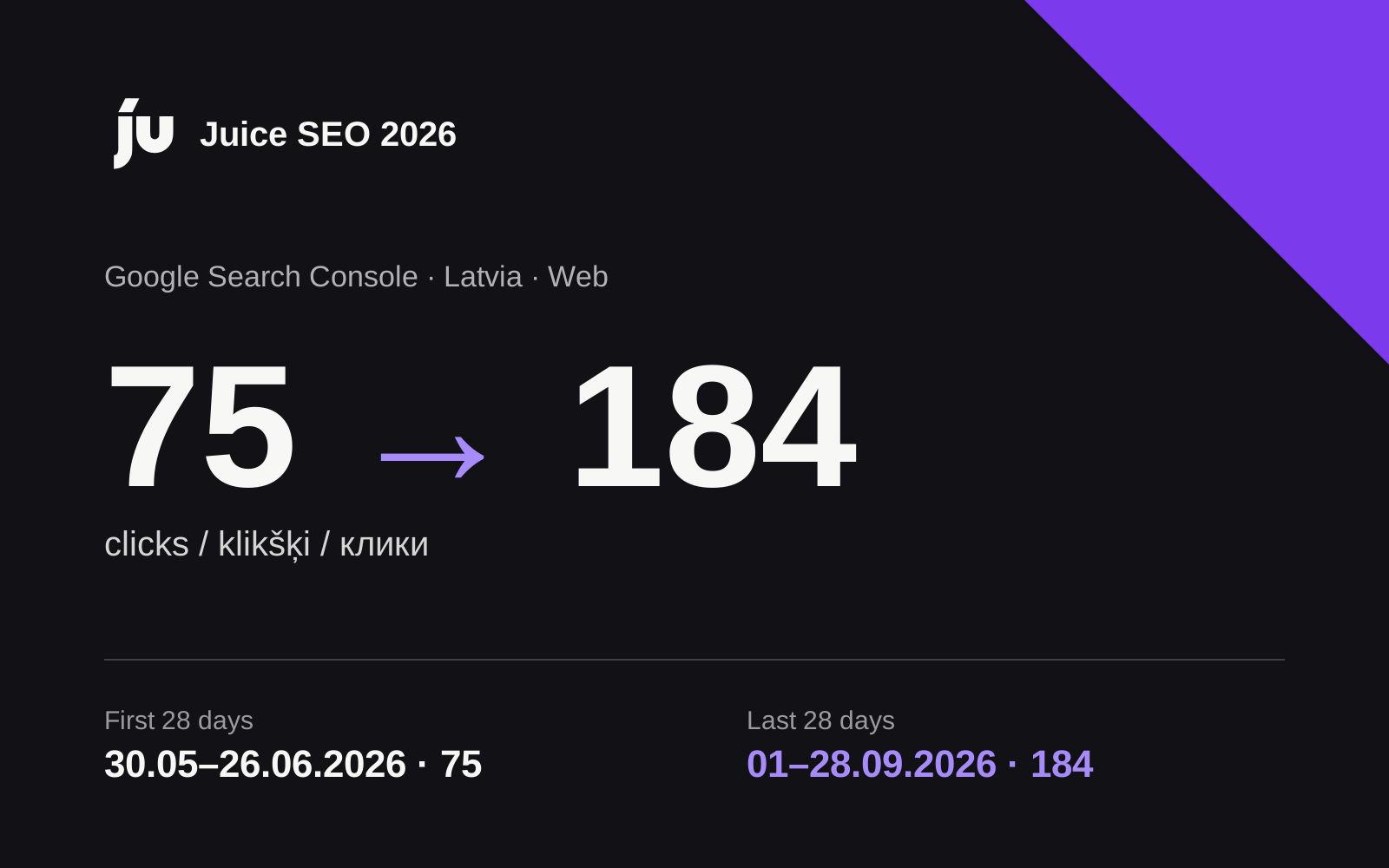
In the VC4 redesign project, architecture followed patient tasks: finding a service, specialist and booking route. The outcome was not only a new interface but growth in organic traffic and online appointments.
Multilingual migration
LV/RU/EN sites require complete, aligned maps. Validate reciprocal hreflang, self-canonical, direct switching to the equivalent page, localised metadata/schema and the absence of language-changing redirects.
Staging acceptance test
- planned pages return 200;
- no accidental noindex in production;
- canonical, robots, sitemap and hreflang are correct;
- titles, H1 and content are localised;
- structured data matches visible content;
- visible FAQ and FAQPage match word-for-word;
- no broken internal links;
- every old URL passes its map test;
- forms, CRM, consent and analytics events work.
Launch protocol
- create a recoverable backup;
- launch while all responsible teams are available;
- activate redirects at server level;
- crawl old and new URL sets;
- inspect live robots, sitemap, canonical and hreflang;
- submit real test forms, bookings or purchases;
- validate CRM and analytics;
- submit the sitemap in Search Console;
- run URL Inspection on the highest-priority URLs.
Do not launch on a Friday evening just because traffic is low. Low traffic does not help if an error goes unnoticed the entire weekend.
The first 30 days
During week one, check 5xx, 404, soft 404, noindex, redirect errors, key-page indexing, forms and campaign URLs daily.
Each week, compare page and query groups, index transition, Core Web Vitals, conversion by device and external links.
Do not remove permanent redirects after several weeks. Old links and bookmarks may remain for years.
Normal fluctuation or incident?
- loss is concentrated around redirect errors;
- important pages leave the index;
- Google selects the wrong canonical;
- 5xx errors increase;
- the new site is not being crawled;
- one language loses visibility disproportionately;
- traffic remains but conversions stop being recorded;
- old URLs return 404 despite having valid equivalents.
Do not respond by changing ten more things. Isolate the affected URL group and cause first.
Conclusion
A strong redesign does not destroy accumulated value. It inventories, transfers and improves it. The sequence is baseline → page decisions → redirect map → UX/content → staging QA → controlled launch → 30-day monitoring.
SEO must participate before architecture is approved. If the audit starts a day before launch, the most expensive decisions have already been made.
Juice Digital Agency can combine migration, UX, development and SEO through its website development service. Our guide to website development in Latvia in 2026 explains the wider planning process. If your B2B site attracts traffic but does not generate qualified pipeline, start with Why your B2B website doesn't generate leads.
Sources
Google site moves: developers.google.com/search/docs/crawling-indexing/site-move-with-url-changes
Google 301 redirects: developers.google.com/search/docs/crawling-indexing/301-redirects
Google mobile-first indexing: developers.google.com/search/docs/crawling-indexing/mobile/mobile-sites-mobile-first-indexing
Google - do I need SEO: developers.google.com/search/docs/fundamentals/do-i-need-seo
Frequently asked questions
Do Google rankings always fall temporarily after a redesign?
No. Some fluctuation is possible, particularly when URLs, domains or large amounts of content change, but a major decline is not an unavoidable cost of redesign. Retaining valuable URLs and content, implementing accurate redirects and monitoring errors quickly can substantially reduce the risk.
Is it better to keep old URLs during a redesign?
Yes, when the topic and function of the page remain substantially the same. Keeping the URL reduces migration risk and preserves backlink and analytics continuity. Change it only when architecture or consolidation creates a justified long-term benefit.
How long should 301 redirects remain active?
Permanent redirects should remain in place long-term, not merely for several weeks. Old links, bookmarks and search signals may exist for years, so removing redirects can recreate errors and lost value.
Should every deleted page redirect to the homepage?
No. An old URL should redirect to the closest relevant equivalent. If none exists and the content is no longer needed, a correct 404 or 410 is better than a misleading redirect to an unrelated homepage.
When should an SEO specialist join a redesign project?
Before the new architecture, URLs and content are approved. If SEO review begins immediately before publication, most risky decisions are already embedded in design and development and are more expensive to correct.