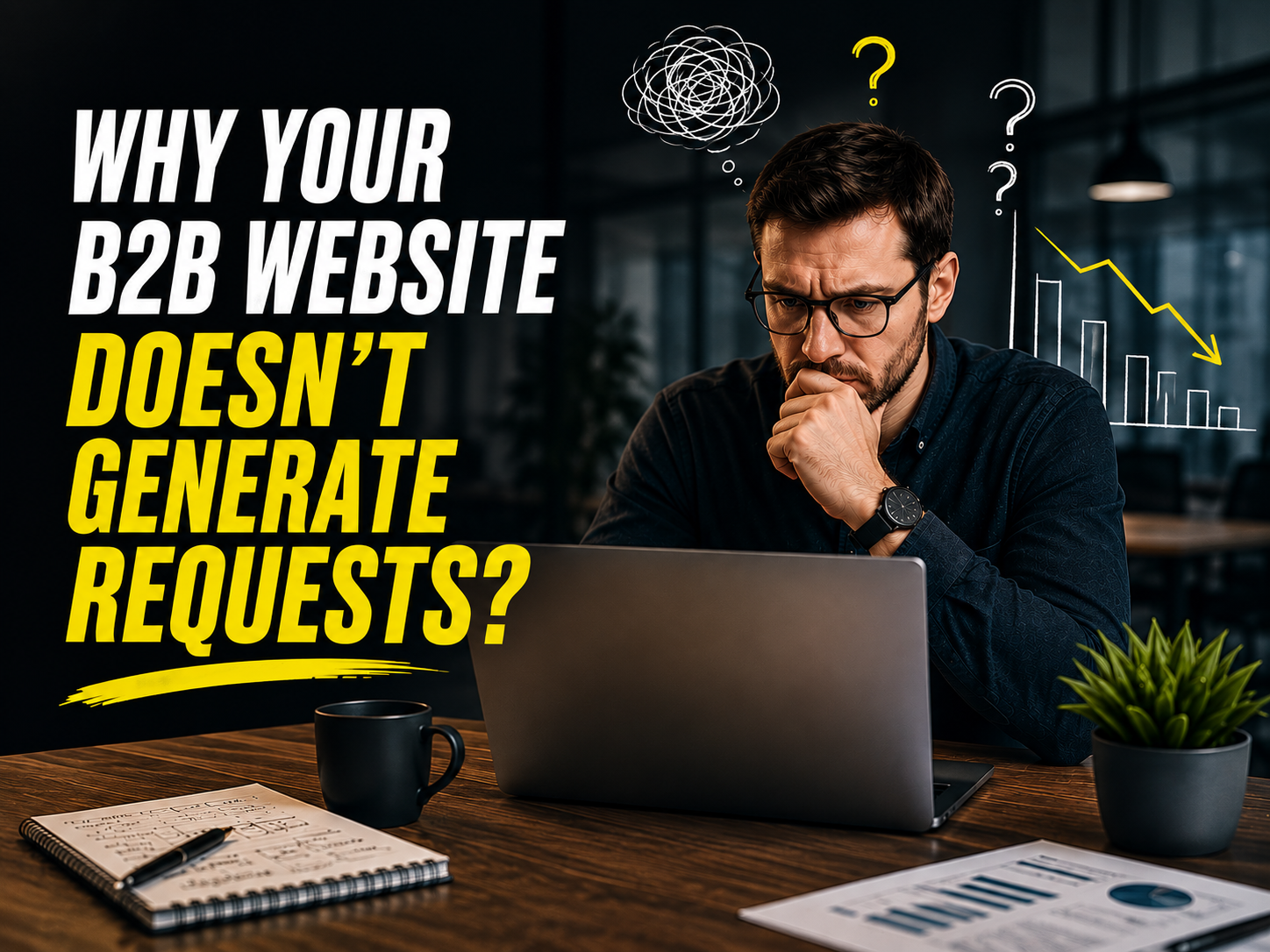
Modern animation, premium photography and a "Contact us" button do not guarantee demand. In a complex B2B purchase, people rarely avoid a form because its colour is wrong. They avoid it because the site has not clarified the offer, validated the claims or reduced professional risk.
The website serves a group: users assess practicality, leaders assess outcomes, IT assesses integration and security, finance assesses cost, and procurement assesses compliance.
Gartner's 2026 survey found that 67% of B2B buyers preferred a rep-free experience and 45% used AI during a recent purchase. Forrester reports that buying groups keep growing and procurement influence increases. Sales enters later, so the site must do the work before that.
The Juice Digital Agency model: Clarity → Evidence → Risk → Route → Measurement
Conversion is not an element. It is a sequence.
1. Clarity - does the buyer understand the offer?
Visitors should quickly understand the audience, costly problem, concrete offer, difference and next step. "Innovative solutions for sustainable growth" explains none of these.
Clarity is not primitive copy. It is a precise choice: which audience, which problem and which outcome the company is willing to name without corporate fog.
2. Evidence - can the buyer verify the promise?
B2B sites often rely on unproven claims: personalised approach, high quality, experienced team, modern technology, reliable partner. These words gain value only alongside evidence.
| Claim | Evidence |
|---|---|
| We have logistics experience | Project, brief, team and outcome |
| The platform reduces manual work | Before/after process or measurable time saved |
| We work in enterprise environments | Security, integrations, SLA and rollout model |
| We deliver business impact | Defined metric, period and baseline |
| Clients trust us | Attributed testimonial with name, role and company |
A strong case study is not an image gallery. It answers the buyer's question: has this provider solved a sufficiently similar situation?
3. Risk - does the site reduce decision risk?
In a B2B decision the buyer risks more than company money - they risk timelines, team hours, system stability and professional reputation. The site must answer uncomfortable questions: how long implementation takes, what the client must supply, what is excluded, how pricing is built, how data migrates, what the limits are, what happens after launch, how security and compliance are handled.
Honest boundaries often create more trust than another superlative.
4. Route - does each role have a reasonable next step?
Not every visitor is ready to "book a demo". One is building a shortlist, another is preparing budget, a third is checking integrations. Provide paths of different depth: sector cases, comparisons, budget ranges, technical documentation, a brief, a qualification call or a trial.
A bare "Contact us" CTA pushes all the work onto the buyer. A strong CTA names the outcome: "Get a migration risk assessment" is more informative than "Submit".
5. Measurement - are you measuring deals, not just forms?
If the site is optimised for form-fill volume, it produces more unfit leads and more sales load. Measure qualified lead rate, enquiries by service and segment, CRM opportunities, pipeline value, close rate, sales cycle, loss reasons, assisted conversions and the pages consumed by the buying group behind closed deals. A form is only an intermediate event between interest and revenue.
One persona is not a B2B audience
Forrester reports an average of 13 people involved in a B2B purchase. Not every one visits the site, but its material gets forwarded, quoted in slides and used inside internal discussions. Content must be forwardable - understandable to someone who never heard the first sales conversation.
- For business leaders - outcome, delivery risk, cost logic, time to value.
- For users - workflow, use cases, interface, support.
- For IT and security - architecture, integrations, data handling, access, uptime, incident process.
- For finance and procurement - commercial model, contract logic, company data, reference clients, supplier stability.
How polished design can reduce conversion
- Invented terminology hides the category.
- Animation replaces hierarchy - the user waits for text to appear.
- Portfolios display aesthetics without outcomes.
- Mobile removes comparisons and evidence.
- The experience is optimised for awards rather than decisions.
Hiding pricing does not always create more leads
Exact pricing is not always possible for B2B, but total secrecy manufactures unnecessary uncertainty. Publish a starting budget, typical range, cost drivers, project examples, implementation and maintenance breakdowns and situations where the solution is not economically justified. The goal is not to force everyone into a form only to learn budget does not match - it is to bring more suitable companies into the conversation.
Forms: less friction is not the only goal
Three fields raise submissions but weaken qualification. Twenty mandatory fields drive away a good buyer still building a shortlist. Forms must match the stage: early interest - low friction and a useful resource; project enquiry - enough data for a qualified reply; enterprise - space to attach a brief or NDA request; demo - role, company and use case. After submission, tell the buyer what happens next, who will contact them and how quickly.
In the AI era the site sells before the visit
Some buyers first ask ChatGPT, Google AI or another system which vendors are relevant. AI can use service pages, case studies, external profiles and articles to build a shortlist. Vague positioning and unsupported claims damage both human conversion and machine interpretation. See Why Don't ChatGPT and Google AI Mention Your Company?.
B2B website diagnostic: 15 questions
- Is it clear within five seconds what we sell and to whom?
- Is the problem named alongside its business cost?
- Does every meaningful claim have evidence?
- Do case studies show decisions and outcomes?
- Does the buyer understand the implementation process?
- Is pricing logic visible?
- Are limitations explained honestly?
- Can each buying-group role find its own information?
- Does the site help build an internal justification?
- Is there a step between interest and demo?
- Does the form match the buyer's readiness?
- Do mobile pages preserve evidence and CTAs?
- Does sales know which pages a lead consumed?
- Is analytics connected to a CRM outcome?
- Can AI systems find and describe the company correctly?
If several answers are "no", the problem is not one button - the system needs to be rebuilt. A useful companion read: Why visitors leave your website.
A 90-day sequence
Days 1-30: diagnose
- Interview sales and 5-8 existing clients.
- Analyse lost-deal reasons.
- Map the buying group.
- Audit analytics and CRM.
- Run a content and competitor audit.
Days 31-60: rebuild the evidence system
- Sharpen positioning.
- Design a case study format.
- Publish pricing and implementation logic.
- Build pages for the key scenarios.
- Redesign CTAs and forms.
Days 61-90: test against pipeline
- Compare qualified lead rate.
- Review form completion and quality.
- Analyse opportunities and revenue.
- Test the most important hypotheses.
- Share page-consumption signals with sales.
Conclusion
Polished B2B design is necessary but not sufficient. A site generates qualified leads when it helps a buying group understand the offer, verify claims, reduce risk, choose an appropriate next step and justify the decision internally. That is why conversion must be designed as Clarity → Evidence → Risk → Route → Measurement, not as button optimisation.
If your B2B site attracts traffic but does not create qualified pipeline, the Juice Digital Agency website development and UI/UX design teams can audit the buyer journey, content, evidence and analytics. For a full rebuild, follow our safe redesign and SEO migration protocol.
Sources
Gartner 2026 sales survey (67% of B2B buyers prefer a rep-free experience): gartner.com/en/newsroom/press-releases/2026-03-09-gartner-sales-survey-finds-67-percent-of-b2b-buyers-prefer-a-rep-free-experience
Forrester 2026, The State of Business Buying: forrester.com/press-newsroom/forrester-2026-the-state-of-business-buying/
Forrester on buying groups: forrester.com/blogs/the-verdict-is-in-its-buying-groups-for-the-win/