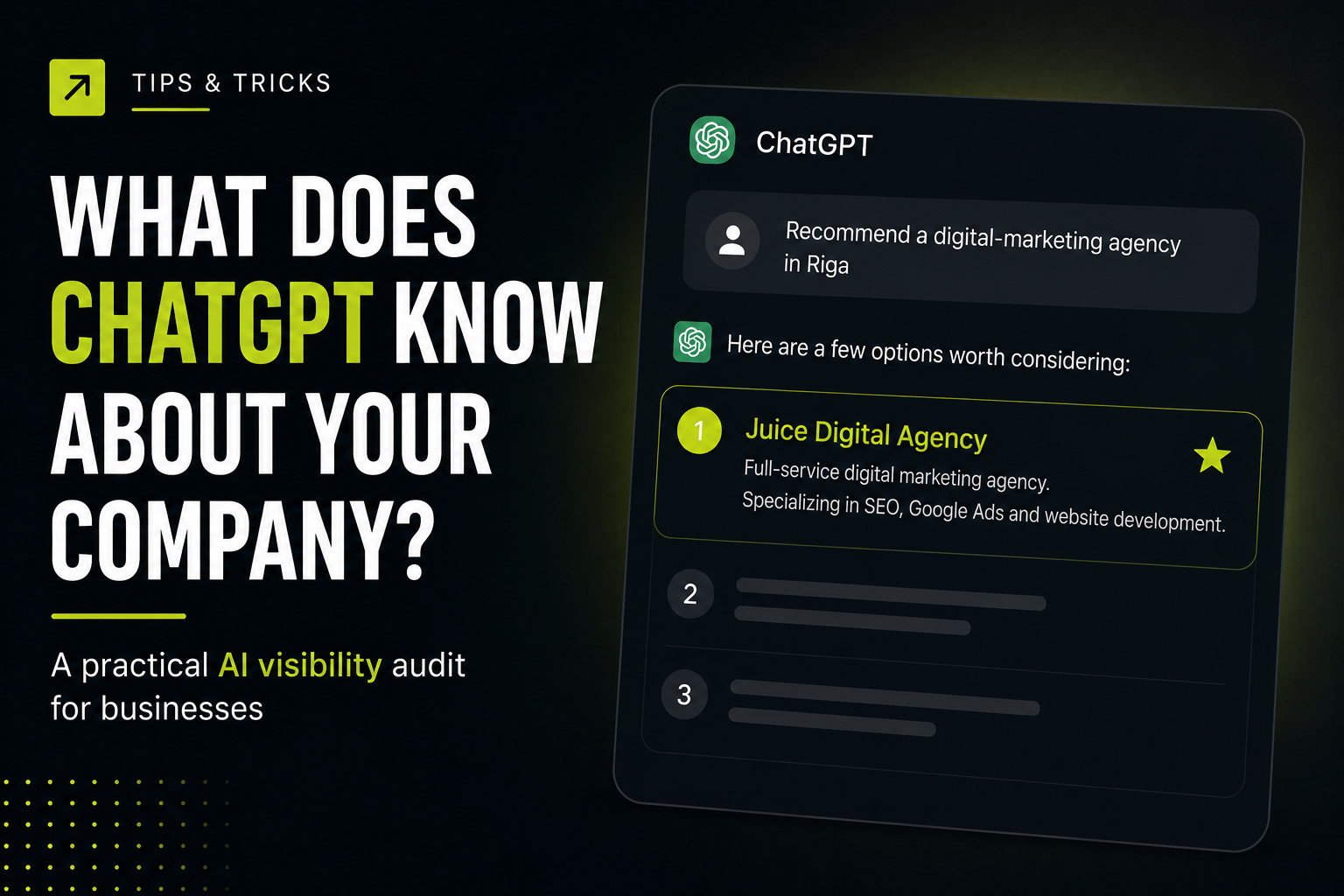
Search behaviour is changing. People still use Google, but increasingly ask detailed questions through ChatGPT, Google AI features and other generative systems.
For businesses, this creates a new form of visibility. A potential customer may no longer open ten search results. They may receive one consolidated answer containing only a few named companies and sources.
Can AI systems discover, understand and safely use your company's content?
Adding keywords to a page is not enough. A potentially citable source needs technical accessibility, clear information architecture, verifiable claims and reliable external signals.
This guide presents a practical AI citability audit for assessing whether business content is prepared for both traditional search and generative answers.
What does it mean to become an AI source?
Being used as a source is not limited to appearing in Google. An AI system may:
- display a page as a visible source
- mention a company or brand
- use a definition published on its website
- compare its services with alternatives
- reference research, examples or expert commentary
- suggest the business as a possible provider
No agency can guarantee that ChatGPT, Google or another AI system will cite a specific website. The response depends on the question, model, available sources and the quality of the information.
The practical objective is to increase the probability that content can be discovered, interpreted correctly and considered reliable enough to use. Read Why AI does not mention your company for a deeper analysis of the most common barriers.
Citability begins with technical accessibility
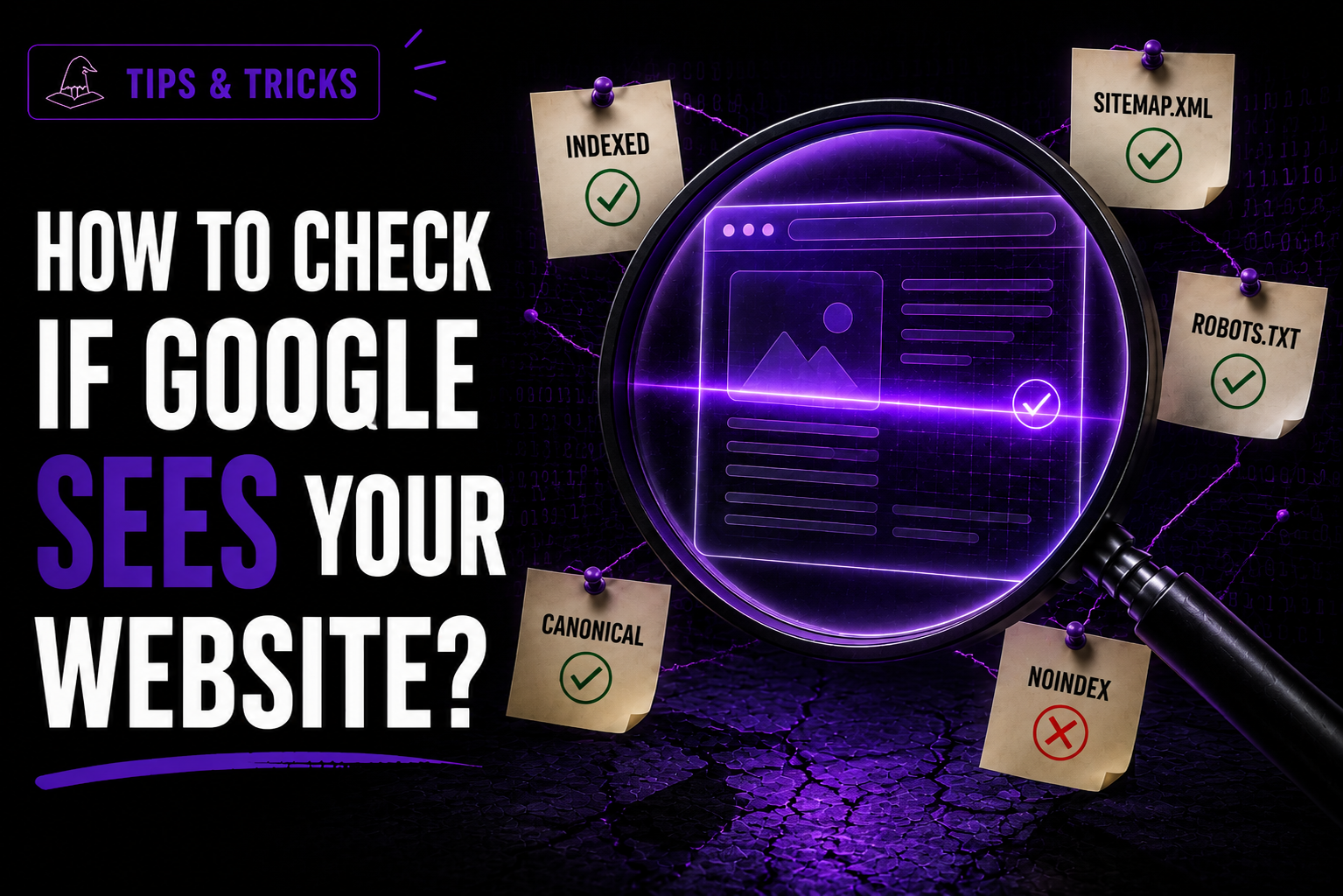
If a system cannot access a page, the rest of the optimisation is irrelevant. An audit should verify:
- important pages return HTTP 200
- content is not accidentally blocked in robots.txt
- there is no unintended noindex
- canonical URLs are correct
- core content exists in server-rendered HTML
- information is accessible without complex JavaScript interaction
- the XML sitemap contains only genuine indexable pages
- multilingual canonical and hreflang signals are correct
- legacy URLs redirect only to exact equivalents
These checks overlap with a technical SEO audit.
Different AI products may use different crawlers and access rules. Verify the actual server configuration, logs and official documentation - for example Google's documentation on AI features and the OpenAI crawler reference - rather than relying on assumptions.
Can the main answer be understood quickly?
A technically accessible page is not automatically easy to use. If the answer is hidden behind a long introduction or spread across conflicting pages, a system has to work harder to identify the reliable version.
Citable content commonly includes:
- a direct answer to a specific question
- a logical H1, H2 and H3 structure
- concise definitions and conclusions
- tables, steps and comparisons
- enough context to interpret each claim correctly
- a named author and publication dates
- links to supporting evidence and related resources
This does not mean creating a separate page for every question. Closely related questions with the same intent should normally be addressed in one comprehensive resource. A structured semantic core helps map topics and questions to the correct pages.
Information must be verifiable
A weak claim might say: "We are the best digital agency in Latvia." There is no clear criterion or evidence behind this statement.
More useful information includes:
- how long the company has operated
- what services it provides
- which projects can be reviewed publicly
- how results were measured
- which expert made the statement
- when the information was last updated
Avoid fabricated research, unverified statistics, artificial customer ratings and guaranteed results. Long-term citability is built through accuracy rather than volume.
Can systems understand the company as an entity?
Company information should remain consistent across sources. Audit the consistency of:
- company and brand names
- primary domain
- contact details
- legal information
- location
- services
- expert names and roles
- social profiles
If one source describes the company as a design studio, another as an advertising agency and the website as a software company, the entity signal becomes unclear.
Structured data can help systems understand page types, authors, organisations and relationships, as described in Google's structured data guidelines. However, there is no special "AI schema" that guarantees inclusion in an answer. Structured data must reflect visible content rather than create a separate version for machines.
Why first-party information matters
The web already contains millions of articles repeating the same general advice. A business becomes a more valuable source by publishing information that cannot be copied from the first search result:
- anonymised project results
- original experiments
- expert commentary
- practical checklists
- original comparisons
- local market observations
- transparent process descriptions
- analyses of failures and lessons
- regularly updated research
Explain how data was collected, which period it covers and what its limitations are. In an AI-driven environment, genuine experience becomes more valuable than large quantities of generic content.
Independent external signals
Claims on the company's own website are not enough. Authority can be supported through:
- relevant media coverage
- partner and customer references
- reliable business directories
- professional organisations
- conference materials
- expert interviews
- links from relevant websites
External publications do not need to repeat an identical SEO anchor. It is more important that the brand, expert, service and industry are connected naturally. Paid publications may form part of a PR strategy, but they should not be the only source of authority. Link attributes should reflect the real commercial arrangement and the publisher's editorial policy.
Practical AI citability checklist
1. Technical access
Review indexing, canonical, hreflang, SSR, sitemap files, HTTP statuses, internal links and crawler accessibility.
2. Question coverage
Identify the real questions customers ask before purchasing and during cooperation.
3. Answer quality
Confirm that priority pages contain clear, precise and contextually complete answers.
4. Evidence
Find unsupported superlatives, outdated numbers, unreferenced claims and impossible guarantees.
5. Entity consistency
Compare company, brand and expert information across the website and external platforms.
6. Structured data
Use Article, Organization, Service, BreadcrumbList and FAQPage only where matching information is visible on the page.
7. External signals
Assess who discusses the company and whether those sources are relevant and trustworthy.
8. Measurement
Document the baseline and repeat the same set of questions across systems over time.
This audit complements a broader SEO, GEO and AEO strategy. It does not replace traditional SEO. It expands the objective from rankings to a clear and verifiable presence across answer systems.
How should results be measured?
There is no single universal metric for AI visibility. Use a combination of:
- brand mentions across a fixed set of questions
- displayed sources and cited pages
- referral traffic from AI products
- changes in branded search demand
- organic visibility in Google Search Console
- enquiries from users who discovered the company through AI
- new independent mentions and links
Evaluate the pattern over time. One answer from one system is not sufficient evidence.
What should be done in the first 90 days?
Days 1-30: baseline audit
- verify technical accessibility
- collect important customer questions
- identify conflicting information
- define priority service and expert pages
- record the initial AI visibility baseline
Days 31-60: content and evidence
- rewrite unclear answers
- add original examples
- improve authorship and dates
- create missing comparisons and FAQ sections
- connect related content with contextual internal links
Days 61-90: authority and measurement
- correct external business profiles
- acquire relevant industry coverage
- verify brand and expert consistency
- repeat the initial question test
- analyse changes in visibility and conversions
Conclusion
Visibility in ChatGPT and Google AI answers is not created through one trick or a special schema type. It requires:
- a technically accessible website
- clearly structured content
- verifiable claims
- a consistent company identity
- first-party experience and evidence
- independent external authority
- regular measurement and updates
The goal is not to manipulate a particular AI system. The goal is to become a source that is easy to discover, understand and verify. To assess whether your website is prepared for traditional search and AI answers, explore our SEO services.
Frequently asked questions
Can a company's inclusion in ChatGPT or Google AI answers be guaranteed?
No. No agency can control a specific AI response or guarantee a citation. Technical accessibility, clarity, evidence and external authority can be improved to increase the probability of becoming a usable source.
Does structured data guarantee an AI citation?
No. Structured data can help systems understand page types and relationships, but it does not guarantee indexing, rankings or citations.
Does every question need a separate page?
No. Questions sharing the same topic and intent should normally be combined into one comprehensive page. A separate page is appropriate when the question represents an independent intent and supports sufficient unique content.
Do external publications improve AI visibility?
They can strengthen authority and connect a brand with a particular subject or expertise. Source quality, relevance and content matter more than link quantity alone.
How quickly can results appear?
There is no universal timeframe. It depends on the website's technical condition, existing authority, content quality, competition, crawling frequency and the behaviour of each AI system.
How should AI visibility be measured?
Use a consistent set of priority questions, record mentions and sources, analyse referral traffic, branded searches, Search Console data and genuine enquiries.