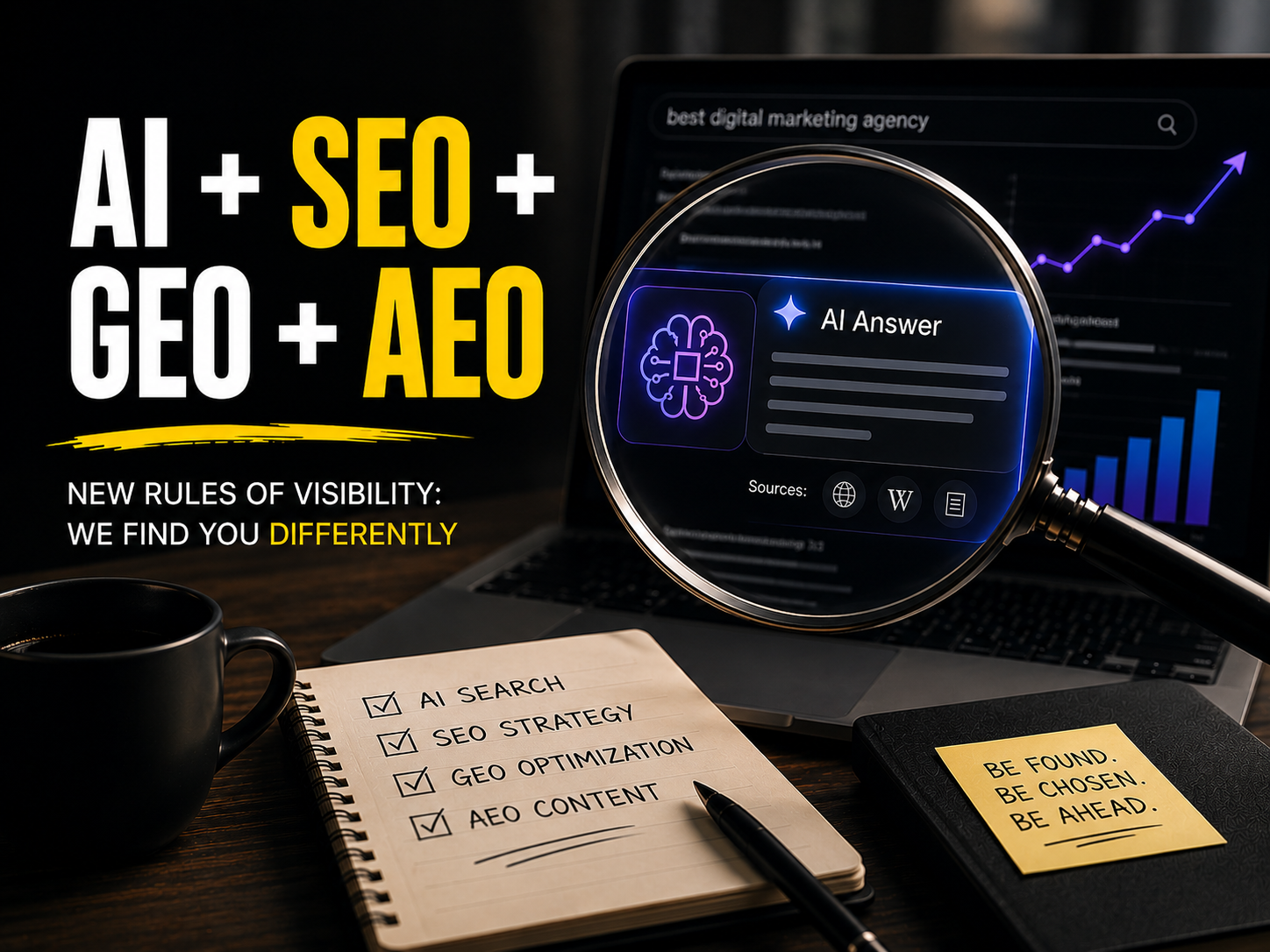
Search marketing has acquired a new alphabet: AI SEO, AEO, GEO, LLMO and AIO. Businesses are promised visibility in ChatGPT, Google AI Overviews, Gemini and Perplexity, sometimes as if conventional SEO has become obsolete.
Search is changing. Users increasingly receive a composed answer, making citation and brand mention important alongside ranking and clicks.
Yet a new format has not replaced the foundations of the web. Google's 2026 guidance describes AEO and GEO as terms used for AI-search visibility while stating that, from Google's perspective, optimising for generative search is still SEO.
The professional question is therefore not "is SEO dead?" but "which existing activities remain valuable, what should be added and how should results be measured?".
Definitions
SEO helps a search engine find, index, understand and rank a page. AEO focuses on becoming a direct-answer source and predates generative AI through featured snippets, knowledge panels and voice assistants. GEO addresses generated responses more specifically. AI SEO is a broad market label without one official technical standard.
| Term | Primary objective | Typical outcome |
|---|---|---|
| SEO | Visibility in search results | Ranking and click |
| AEO | Become a direct-answer source | Answer extract or citation |
| GEO | Appear in generated answers | Citation and brand mention |
| AI SEO | Overall AI-influenced search visibility | Rankings, citations, mentions and conversions |
These are not three independent infrastructures. They share a foundation while emphasising different outcomes.
Why SEO remains foundational
Google's AI features use its Search index and core ranking systems. A page must be indexed and eligible for a snippet. ChatGPT Search also needs an accessible web source; OpenAI recommends allowing OAI-SearchBot.
Without technical SEO, there is no reliable crawling, indexing, canonicalisation, language targeting or site architecture. GEO cannot rescue a page a system cannot retrieve. Start with a technical SEO audit.
What genuinely changes
Google describes query fan-out: a complex question may be expanded into several related searches. A page does not always compete for one exact phrase - it can become a source for a useful sub-question. The system needs not merely a document "about" a topic but a specific supporting claim, method or comparison.
AI can name a brand without producing an immediate click, so demand and reputation impact must be assessed alongside sessions. The system needs to know what the company is, which market it serves, what it offers, who represents its expertise and which independent sources confirm it.
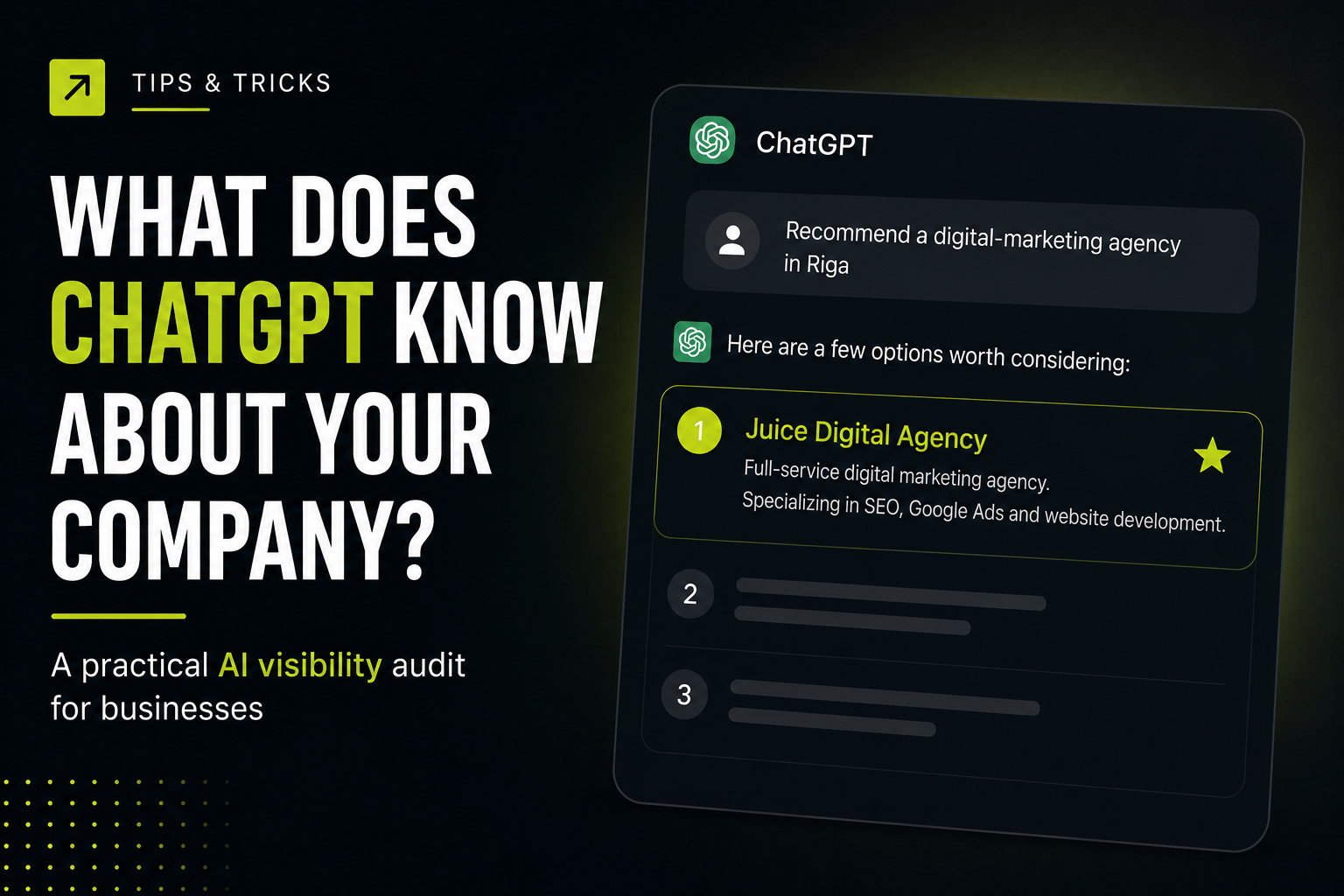
The related article Why don't ChatGPT and Google AI mention your company? explains the failure points in detail.
Work with genuine value
1. Platform-specific technical access
Audit Googlebot, OAI-SearchBot and other required crawlers separately. Do not confuse ChatGPT Search access with permission to use content for model training.
2. Information gain, not volume
Generic summaries are easy to reproduce. First-party data, experiments, case studies, calculations, selection criteria, justified conclusions and honest limitations add citable value.
3. The complete decision journey
Build a connected cluster covering the problem, alternatives, price, risks, criteria, implementation and measurement. A semantic core provides the map.
4. Verifiable authors and entities
Expert names, roles, experience, projects, business details, services and external profiles should form a consistent public record.
5. Consistent business entity
The company name, address, services, people, social profiles and external directories must present a single unambiguous public picture.
6. Authentic external reputation
Client references, industry publications, professional directories and real projects provide stronger corroboration than manufactured mentions.
7. Multiple evidence formats
Depending on the question, AI search may use text, images, video, products or local business data. An original chart or demonstration can be more valuable than another long generic article.
Tactics that do not guarantee results
- `llms.txt` - Google does not use it for its AI Search features.
- "AI schema" - no special type guarantees citation.
- Artificial chunking - clarity helps, but there is no required block length.
- Hundreds of generated FAQs - scaled content without value may violate spam policies.
- Guaranteed "number one in ChatGPT" - answers vary with wording, context, location, time and retrieved sources.
How to evaluate an AI SEO provider
Ask:
- Which platforms and crawlers will be audited?
- How are ranking, citation and mention separated?
- How is the baseline question set created?
- How is answer variability controlled?
- Which original evidence will be produced?
- How does the work extend SEO instead of merely renaming it?
- How will visibility connect to demand and revenue?
If the entire offer consists of llms.txt, schema and automatically generated FAQs, it is packaging rather than strategy.
Measurement
| KPI | What it shows | Limitation |
|---|---|---|
| Citation rate | Frequency of domain use as a source | Citation is not recommendation |
| Mention rate | Frequency of brand naming | Context may be neutral or negative |
| Share of answer | Visibility against defined competitors | Depends on the question set |
| Factual accuracy | Correctness of business information | Requires human review |
| AI referral traffic | Clicks from AI platforms | Misses zero-click influence |
| Assisted conversions | Influence on enquiries | Requires sound attribution |
Fix the questions, language, market, date and repetition method. A favourable screenshot is not a measurement system.
Conclusion
AEO and GEO describe genuine changes, but they do not replace SEO. Technical access, useful content, authority and entity clarity remain the foundation.
The units of success expand: a company must not only rank but become a verifiable source and recognisable entity inside an answer.
A professional strategy begins not with a new acronym but with a question: what unique, verifiable information can our company contribute that competitors cannot reproduce just as easily?
To assess your current visibility, explore Juice Digital Agency SEO services. A practical metric system - citation rate, mention rate, share of answer - is detailed in a separate article How to Measure Brand Visibility in ChatGPT and Google AI.
To check how prepared your content is for such answers, start with a practical AI citability audit.
Frequently asked questions
Will GEO replace traditional SEO?
No. Google's AI features use the Search index and core ranking systems, so crawling, indexing, architecture, content and authority remain necessary. GEO extends SEO by addressing citations, brand mentions and visibility inside generated answers.
What is the difference between AEO and GEO?
AEO focuses on content being used in direct answers, including featured snippets and voice search. GEO more often refers to answers generated by generative systems. In practice, much of the work and measurement overlaps.
Does AI SEO require special schema?
No. There is no special schema.org type that guarantees an AI citation. Existing structured-data types help describe visible information, but they must be accurate and cannot replace strong content or reputation.
Can anyone guarantee first place in ChatGPT answers?
No. Answers vary with wording, context, location, time and retrieved sources. A professional service can improve accessibility, evidence and relative visibility, but cannot guarantee a permanent first position.
What is the most important AI SEO outcome?
It depends on the business objective. Citation share, brand mentions, competitor visibility, factual accuracy, referral traffic and assisted enquiries should be considered together. One metric cannot represent the complete result.
How to track these outcomes in practice with Google Search Console and GA4 is described step by step in How to measure brand visibility in AI search.
Sources
Google generative AI optimisation guide: developers.google.com/search/docs/fundamentals/ai-optimization-guide
Google third-party SEO guidance: developers.google.com/search/docs/fundamentals/third-party-seo
OpenAI crawler documentation: developers.openai.com/api/docs/bots
OpenAI publisher FAQ: help.openai.com/en/articles/12627856-publishers-and-developers-faq
AI systems are moving from generating answers to completing multi-step tasks. Read our analysis of AI agents as the emerging interface between customers and businesses.