The short answer
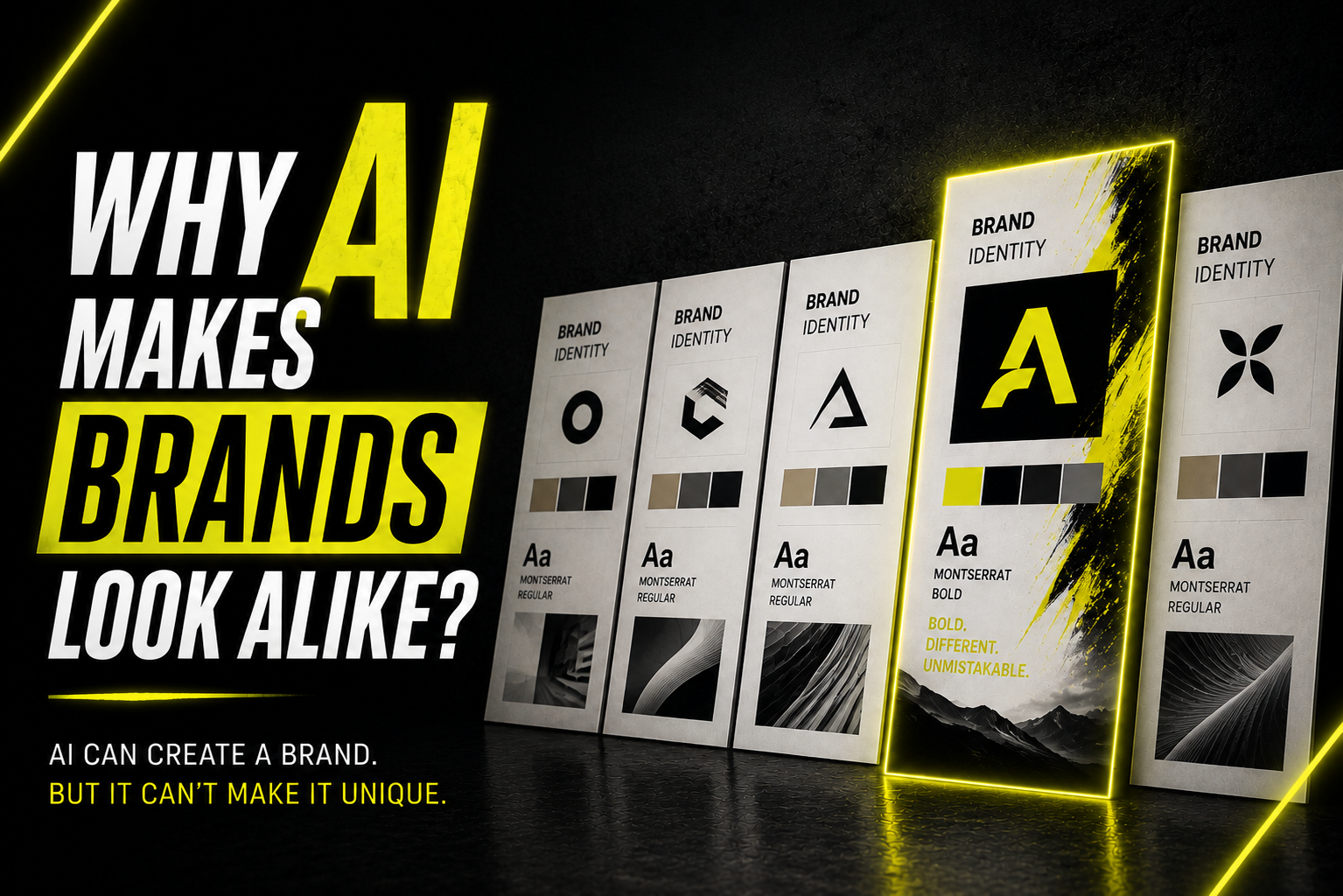
AI does not automatically make brands identical. Sameness emerges when companies use the same models, similar prompts and shared visual references without defining which brand elements are non-negotiable.
Ask for "a modern premium campaign for a technology company" and the model is likely to produce the most probable category answer: a dark background, neon gradient, polished 3D object, neutral sans serif and a person looking at a screen. It may be well executed, but dozens of competitors could use it.
The problem is not merely an insufficiently detailed prompt. Companies often cannot answer:
- Which elements make people recognise our brand?
- Which may AI change, and which must remain intact?
- Who decides whether generated work strengthens or dilutes brand memory?
AI can accelerate production. Recognition still comes from strategically selected and consistently repeated brand assets.
Why does generative content converge?
1. Models produce probable rather than company-specific answers
With a generic task, a model moves towards the category average. It predicts the most probable answer for the requested category.
As a result:
- fintech becomes dark blue with light trails;
- sustainability becomes green with leaves and a planet;
- premium becomes beige and minimal with a thin serif;
- SaaS becomes purple with floating 3D shapes;
- healthcare becomes white and pale blue with a smiling person.
These codes communicate the category quickly but rarely distinguish one company from another.
2. Businesses write the same briefs
Modern, innovative, premium, trustworthy and friendly are not distinctive positions. Almost every company uses the same language.
When a prompt contains only a category and universal adjectives, the model has no specific material from which to build recognition.
3. Style is mistaken for identity
An editorial treatment, "make it like Apple" or a reference to a famous filmmaker may produce an attractive image. A borrowed style, however, is not a brand identity.
Style is a flexible execution layer. Identity is a system of assets and principles that remains recognisable across styles, formats and campaigns.
4. Platform templates flatten difference
Website builders, Canva, presentation generators and social tools offer the same grids, effects and font pairings to millions of users.
When a template is not transformed with proprietary assets, the platform's design language becomes stronger than the brand's.
5. Volume replaces selection
Teams can generate hundreds of versions, but this does not guarantee better decisions. If the KPI is speed and output volume alone, AI multiplies average content.
The brand appears active in the short term while building few distinctive memories over time.
6. AI is disconnected from the actual brand system
The brand book is a PDF, logos sit in another folder, and each employee writes prompts independently. The tool does not know:
- the approved logo version;
- priority colours;
- compositions the brand avoids;
- its signature photography style;
- words the brand never uses;
- the assets that have already built recognition.
Every generation effectively begins from scratch.
Recognition is not the same as attractive design
An attractive image can capture attention without necessarily building brand memory.
Distinctive brand assets can trigger a particular brand without its name. They may include:
- a colour combination;
- shape or silhouette;
- symbol;
- distinctive typography;
- character;
- packaging structure;
- graphic principle;
- photography style;
- tone or recurring phrase;
- sound, melody or motion;
- a characteristic way of demonstrating the product.
The Ehrenberg-Bass Institute evaluates these assets using:
- **fame** - how widely the asset is recognised;
- **uniqueness** - how exclusively it is associated with one brand rather than the category or a competitor.
Originality in a designer's eyes is not enough. The asset must be used consistently until it becomes established in buyer memory.
The no-logo recognition test
Take ten recent advertisements, social posts or presentation slides:
- remove the logo and company name;
- remove the product if its name is visible;
- show the material to people familiar with the category;
- ask which company it might belong to.
If the answer is "any bank, property company or technology business", the company may have a logo without having a strong recognition system.
Repeat the test with AI-generated materials. If only the logo and colour connect the content to the brand, AI has not extended the brand language. It has attached a branded label to generic content.
How do you build an identity that AI cannot dilute?
1. Define the immutable core
Select three to five elements that should be visible or felt in almost every communication:
- a characteristic colour ratio;
- proprietary composition;
- a specific way of photographing people or products;
- a unique graphic shape;
- a recognisable headline rhythm;
- a characteristic motion principle.
Do not make everything mandatory. An overloaded system becomes unusable.
2. Organise assets into three layers
| Layer | Role | Rule for AI |
|---|---|---|
| Immutable assets | Build recognition | Never redraw or replace |
| Flexible principles | Layouts, subjects and formats | Vary within defined boundaries |
| Campaign layer | Seasonal ideas and channel experiments | Explore freely within an approved brief |
This gives teams creative freedom without sacrificing the core.
3. Create an AI reference pack
A link to the brand book is insufficient. Teams and tools need:
- approved logo files;
- exact colour values;
- typefaces and licences;
- 10-20 correct examples;
- 5-10 attractive but off-brand examples;
- photography and illustration guidance;
- accepted and prohibited terminology;
- core messages;
- channel and layout templates;
- a list of content AI must not generate.
Negative examples clarify the difference between "good-looking" and "right for our brand".
4. Write a brand brief, not just an image prompt
Weak prompt: "Create a modern premium visual for a Latvian fintech company."
Stronger brief: "Create a LinkedIn campaign visual for a B2B financial-infrastructure brand. The audience is banking product leaders in the Baltics. The tone should feel precise, calm and competent rather than futuristic. Preserve the brand's 70/20/10 colour ratio, use its diagonal data line as the primary distinctive asset and leave the left third for the headline. Avoid neon, humanoid robots, coins, city skylines and unrelated 3D spheres. The result must extend the existing campaign system."
A useful AI brief covers:
- business objective;
- audience;
- channel and format;
- intended response;
- mandatory brand assets;
- flexible components;
- prohibited category clichés;
- technical requirements;
- approval criteria.
5. Separate generation from final assembly
Models can reproduce logos, text, packaging and precise graphics incorrectly. A safer workflow is:
- AI generates the setting, background, photograph or concept element;
- a designer selects and corrects the output;
- original logos, typography, graphics and copy are added in design software;
- the final file is reviewed and exported for the channel.
AI does not need to create every final pixel.
6. Establish human review gates
Every public AI asset needs a named human owner. Review should ask more than whether it looks good:
- Is the brand recognisable without its logo?
- Are at least two distinctive assets present?
- Does it avoid category clichés and competitor resemblance?
- Are people, products, locations and text represented accurately?
- Could it mislead the audience about the product or company?
- Are rights and licences clear?
- Was confidential information excluded from prompts?
- Is disclosure or provenance information required?
- Does it meet channel specifications?
- Who accepts responsibility for publication?
In companies with several products or business lines, this discipline should sit on top of brand architecture: which offers share an identity, which have their own, and who approves AI-generated work in each case.
7. Preserve provenance
Companies should record:
- the tool and model used;
- company assets supplied to it;
- the creator and approver;
- whether real people, places or events are represented;
- post-generation edits;
- the location of source and final files.
Content Credentials, based on the C2PA standard, can attach machine-readable information about a media asset's provenance and editing history. It does not solve every copyright or deception risk, but it provides a practical transparency layer.
Most of the EU AI Act applies from 2 August 2026. Article 50 introduces transparency requirements for certain synthetic and manipulated content, including deepfakes. The exact obligation depends on the content and context, so sensitive campaigns require legal review.
Where is AI useful, and where is human judgement essential?
AI is well suited to:
- idea and scenario variations;
- moodboards and early exploration;
- adapting an approved concept;
- backgrounds, textures and supporting elements;
- draft localisation;
- internal visualisation;
- retouching and technical variants;
- copy options within an approved voice.
It should not operate without human accountability for:
- positioning;
- a final logo;
- sensitive representations of people or events;
- health, financial or legal claims;
- crisis communication;
- simulation of real product functionality;
- content requiring documentary accuracy.
The useful distinction is not AI versus human. It is where AI creates speed and where context, judgement and accountability are essential.
How can recognition be measured?
Clicks alone do not reveal whether content is building brand memory. Use:
- no-logo recognition tests;
- fame and uniqueness measurement for each asset;
- quarterly audits of 30-50 assets across channels;
- the share of materials using mandatory assets;
- error and off-brand rates;
- time from brief to approval;
- revision rounds after the first generation;
- confusion with competitors.
AI should reduce total production time, not just the time to a first draft. Five minutes of generation followed by three hours of repair is not an efficient workflow.
A 30-day implementation plan
Week 1: audit
Collect three months of content, identify AI-generated work, map recurring clichés and run the no-logo test.
Week 2: asset system
Choose three to five immutable assets, define flexible and campaign layers, collect positive and negative examples and organise source files.
Week 3: workflow
Create the reference pack, channel-specific prompt templates, data rules and publication checklist.
Week 4: pilot
Run one campaign through the system, measure production time, revisions and recognition, then update the rules.
Begin with one repeatable workflow rather than trying to standardise the entire company in one day.
Frequently asked questions
Does AI-generated design always look generic?
No. AI can produce strong and surprising work. Sameness usually results from generic briefs, common references and a lack of proprietary distinctive assets.
Are brand colours enough?
No. Recognition also requires principles for composition, typography, imagery, language, motion and other assets.
Can AI create a company logo?
It can assist with early exploration, but the final mark requires professional development, technical refinement and checks for distinctiveness and rights. A generated symbol should not automatically be treated as unique or protectable.
Who owns AI brand consistency?
A brand or marketing lead usually manages the system, but every public asset should also have a named approver.
Does the brand book need to be replaced?
Not necessarily. It can be extended with an asset hierarchy, AI reference pack, prompt principles, prohibited uses, provenance records and human-review workflow.
Conclusion
AI has made competent execution available to almost everyone. Attractive design alone is therefore becoming a weaker competitive advantage.
The winners will not be the companies that generate the most. They will be the companies that know what must not be lost: distinctive assets, positioning, judgement and trust.
A strong identity in the AI era is not a static PDF. It is a governed system with a clear core, boundaries for flexibility, reliable inputs, human review and regular measurement.
If the current identity no longer reflects the direction of the business, use our rebranding decision framework to determine what to retain and what to change.
If your company's content is polished but increasingly resembles its competitors, Juice Digital Agency can audit the identity and build a recognisable logo and branding system designed for consistent AI-assisted production.
AI systems are moving from generating answers to completing multi-step tasks. Read our analysis of AI agents as the emerging interface between customers and businesses.