Until recently, people completed most of the digital customer journey themselves. They entered a query, opened several websites, compared offers, contacted businesses and made a decision.
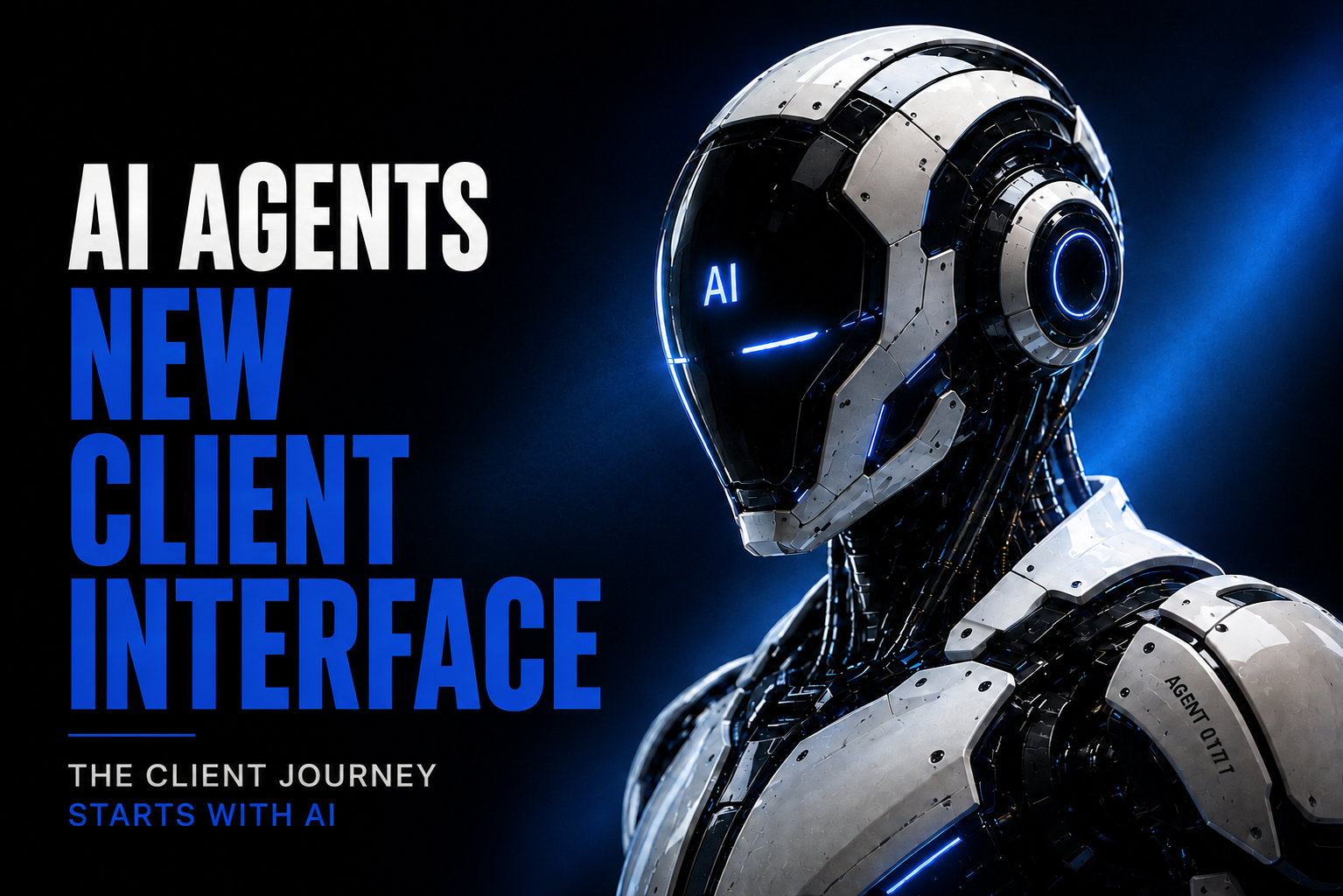
A new intermediary is now appearing between customers and companies: the AI agent.
Unlike a conventional chatbot, an AI agent does not merely answer a question. It can collect information from multiple sources, compare providers, clarify conditions, create an action plan and, in some scenarios, assist with a purchase or another conversion.
OpenAI is already developing purchasing within ChatGPT through the Agentic Commerce Protocol. Google is building the Universal Commerce Protocol and Universal Cart, connecting product discovery and transactions across Search, Gemini, YouTube and other Google environments.
The central question is therefore changing. Businesses previously asked: can the customer find our website? They must now ask another question: can an AI system understand our business, compare our offer accurately and guide the customer towards an appropriate action?
What is an AI agent?
An AI agent is a system capable of completing a multi-step task instead of only generating an answer. A user might ask it to:
- find an appropriate digital marketing agency in Latvia;
- compare several website-development proposals;
- estimate a realistic pricing range;
- check whether a product is available;
- prepare questions for a potential supplier;
- book a consultation;
- assist with completing a purchase.
Google is already testing scenarios in which AI calls local businesses on a user's behalf to ask about pricing, availability and other conditions - Google's explanation of agentic calling.
These capabilities are not yet available in every market or industry. The direction, however, is clear: AI is moving from providing information to performing actions.
Why is the AI agent becoming a new customer interface?
In the traditional digital model, the website was the primary interface. In the emerging model, the first interaction with a business may happen inside an AI environment:
- the user describes a goal;
- the AI collects and structures information;
- the system selects appropriate providers;
- the user receives a comparison or recommendation;
- only then does the user visit the selected website.
This does not make the website less important. It makes the website the primary verifiable source of truth about the business. If the information is unclear, contradictory or technically difficult to process, an AI system may:
- exclude the company from a comparison;
- describe the service incorrectly;
- choose a competitor with a clearer offer;
- fail to determine pricing, geography or conditions;
- direct the user to an outdated page;
- fail to identify a safe next action.
What does an AI agent need to understand about a business?
To recommend a company, the system needs concrete facts:
- who provides the service;
- what the offer includes;
- who the offer is intended for;
- where the company operates;
- how pricing and cooperation work;
- what evidence supports the company's expertise;
- whether the information is current;
- how the user can contact the business or take action.
Abstract statements about building innovative solutions for the future provide much less value than precise information about the service, process, audience, limitations and measurement.
Seven signs that a business is ready for AI agents
1. Business information is consistent
The company name, services, contact information, address and operating markets should be described consistently across the website, Google Business Profile, social platforms and other trusted sources. Contradictory facts reduce confidence in the answer.
2. The website has a clear technical structure
Important content should not be hidden exclusively inside interactive components or depend entirely on client-side JavaScript. The website needs:
- stable, indexable URLs;
- correct canonical and hreflang implementation;
- a logical heading hierarchy;
- server-rendered primary content;
- structured data;
- meaningful internal links;
- accurate HTTP status codes.
A technical SEO audit helps identify problems in these areas.
3. The offer is described precisely
An AI system should be able to determine:
- what the service includes;
- who it is suitable for;
- what is excluded;
- how the engagement works;
- what information is required initially;
- how performance is measured;
- what the next step is.
A company does not need to disclose every commercial detail. It does need to explain its offer clearly enough to be understood and compared.
4. Claims are supported by verifiable evidence
"Industry-leading" is not evidence. More useful signals include:
- detailed case studies;
- specific team experience;
- author and expert profiles;
- a transparent methodology;
- reviews with meaningful context;
- verifiable company information;
- regularly updated professional content.
Authority in AI-mediated discovery is built through a consistent body of evidence, not a single optimised page.
5. The website provides a clear path to action
Both the customer and the AI agent should understand what happens next: submit an enquiry, book a consultation, request a proposal, choose a service, download a document or purchase a product. Forms, buttons and booking links must work predictably, and analytics must be able to record whether the action was completed.
6. Data is kept current
An outdated price, unavailable product or discontinued service reduces trust. For ecommerce businesses, product feeds, Merchant Center data, availability and structured product attributes are becoming increasingly important. B2B businesses must regularly review service pages, team information, contact details and case studies.
7. The business measures actions, not only traffic
Visits from AI platforms may appear as referrals from ChatGPT, Gemini, Perplexity or other services, but part of their influence will remain difficult to identify. Businesses should therefore track:
- successful form submissions;
- telephone and email clicks;
- consultation bookings;
- qualified enquiries;
- sales outcomes;
- the landing pages that began the journey.
Without conversion tracking, the company may see visits but remain unable to evaluate their commercial value.
What do AI agents change across digital disciplines?
SEO
SEO is not disappearing. It is expanding to include the task of making a business understandable to AI systems. Technical accessibility, topical coverage, entity consistency, authority and precise content benefit both conventional search and AI-mediated discovery. Read our guide to AI SEO, GEO and AEO for a broader explanation of this transition.
Content marketing
Generic articles that repeat widely available information are becoming less valuable. Competitive content increasingly requires:
- original data;
- professional experience;
- practical examples;
- detailed comparisons;
- expert commentary;
- a distinctive point of view;
- regular updates.
Web development
A website is no longer only a visual presentation. It is becoming the company's information and action infrastructure. Professional website development must therefore account for information architecture, structured data, integrations, analytics and technical accessibility alongside design.
Branding
When brands use the same AI-generated language, imagery and positioning as their competitors, both people and systems find them harder to distinguish. Consistent positioning, recognisable language and demonstrable expertise therefore become more valuable. Read our analysis of why AI makes brands look alike.
Paid advertising
Advertising platforms will continue automating audience selection, creative combinations and budget allocation. Companies with reliable first-party data, correctly defined conversions and a clear offer will be better positioned to distinguish actual business results from platform optimisation metrics.
What can a company do within the next 30 days?
- Confirm that the primary product and service pages are indexable.
- Compare business facts across the website, Google profile and social platforms.
- Clarify what each service includes, who it serves and how engagement begins.
- Audit canonical tags, hreflang and structured data.
- Implement conversion tracking for forms, calls, email and bookings.
- Update outdated pricing, team information and case studies.
- Check how ChatGPT, Gemini and other systems currently describe the company.
- Document incorrect or missing facts.
- Add verifiable evidence of expertise.
- Assign responsibility for keeping digital information current.
Will websites become unnecessary?
No. AI agents require a reliable source from which to retrieve facts, verify an offer and direct users towards a safe action. The role of the website is changing: it is moving from a digital brochure to the information and transaction infrastructure of the business.
A company without a reliable website loses more than one marketing channel. It also loses control over how search engines, AI systems and potential customers interpret its offer.
Conclusion
AI agents are creating a new layer between businesses and customers. They do not eliminate SEO, websites or brands. They raise the standard required of the entire digital infrastructure. The advantage will belong to businesses whose offer is:
- technically accessible;
- precisely explained;
- consistent across sources;
- supported by evidence;
- connected to a clear action;
- regularly updated;
- measured through to a real business outcome.
To prepare your digital infrastructure not only for today's Google searches but also for AI-mediated customer journeys, explore Juice Digital Agency's website-development services.
The difference usually comes from context and editing rather than the tool - you can test that with 25 ChatGPT and Claude marketing tests.
In day-to-day SEO the data matters more than the tool, but the starting point still counts - see ChatGPT vs Claude for marketing.
Frequently asked questions
What is an AI agent in digital marketing?
An AI agent is a system that can do more than answer a question. It can complete a multi-step task by finding information, comparing options, selecting an appropriate solution and assisting with the next action.
Does AI-agent readiness replace SEO?
No. A technically reliable website, indexable content, authority and clear information architecture remain the foundation of SEO. AI-agent readiness extends that foundation with structured data, consistent business facts and understandable paths to action.
Is Schema.org structured data sufficient?
No. Structured data helps systems interpret a page, but it cannot replace useful content, technical accessibility, current information or evidence of expertise. The markup must also match the content visible to users.
Are AI agents relevant only to ecommerce?
No. Their development is particularly visible in ecommerce, but AI agents can also compare B2B services, agencies, software providers, local businesses and professional services.
Must a business publish its prices?
Not always. If the final price depends on the project, the company can explain the factors that determine cost, typical engagement models or a starting range. The important point is to explain how a proposal is prepared.
How can a business measure enquiries generated by AI agents?
Referral data should be combined with conversion tracking for forms, calls, email clicks and bookings. Because some AI influence cannot be identified automatically, the business can also ask customers how they discovered the company.