The short answer
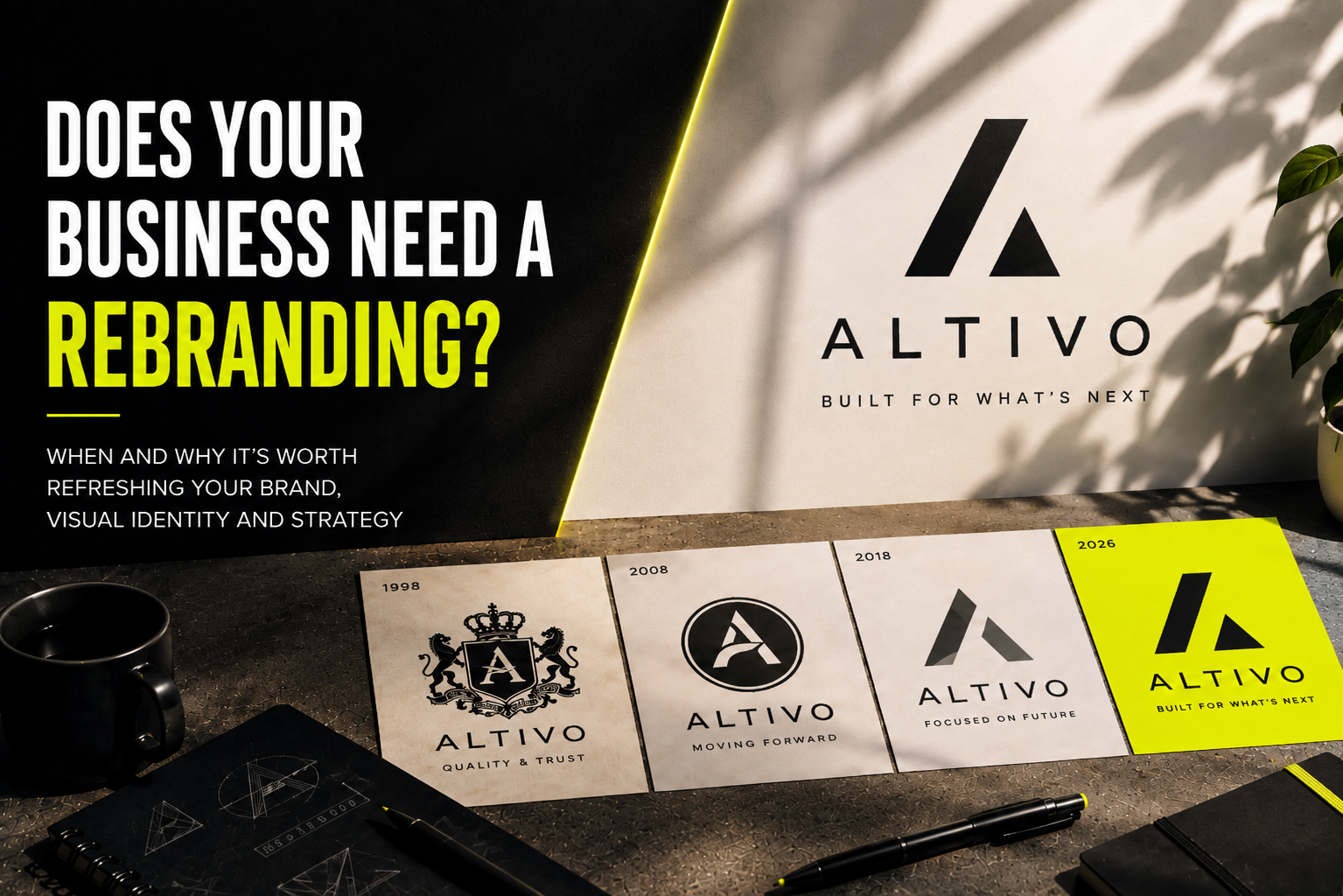
A company needs a rebrand not when leadership has grown tired of the logo, but when a strategic gap has opened between the actual business and its public identity.
Examples include:
- a major change in product, audience or market;
- positioning that no longer explains why customers should choose the company;
- incompatible identities after a merger;
- a brand that looks much smaller or less capable than the business;
- a visual and verbal system that fails in modern channels;
- a name or set of associations that restricts growth.
Not every problem requires a full rebrand. Better guidelines, a new website, clearer messaging or a visual refresh may be enough.
What has changed in the business that the current brand can no longer express accurately?
Rebranding cannot repair an unresolved business problem
If demand is weak, sales are broken or customer experience is poor, a new identity is not a cure.
A rebrand can clarify value, support entry into a new segment, organise a fragmented portfolio, improve professional perception and signal genuine change. It cannot replace product quality, fix service, guarantee sales or erase a reputational problem without behavioural change.
When the promise changes but the experience does not, disappointment can increase.
Four levels of change
| Level | What changes | When it fits |
|---|---|---|
| Brand repair | Files, rules, technical logo issues and inconsistency | The strategy is sound but implementation is chaotic |
| Visual refresh | Typography, colour ratios, layouts and logo refinements | The brand is recognised but execution is dated |
| Repositioning | Audience, value proposition, messaging and verbal identity | The business has changed but equity can be retained |
| Full rebrand | Positioning, name, identity and the complete rollout system | The model, market, structure or reputation context has changed |
The deeper the change, the greater the budget, implementation risk and potential loss of recognition.
Seven signs that change may be justified
1. The business has outgrown its original image
A company has grown from a local service into an international B2B operation, but still appears small or improvised.
Else Logistics faced this gap after 13 years of growth. Juice Digital Agency aligned its positioning, visual system, vehicles, multilingual website and advertising infrastructure with the company's actual scale. See the Else Logistics rebranding case.
2. The audience or market has changed
A brand built for Latvian consumers may not work for German enterprise buyers. Language, proof, sales cycles, trust signals and visual culture all change.
3. The offer no longer fits the name or structure
The company has added products, built a platform or become a group while the old identity still represents one narrow service. This requires a brand-architecture decision: masterbrand, sub-brands or separate brands.
4. Different channels look like different businesses
The website, social content, sales deck and physical environment have unrelated styles. The answer may be governance and templates rather than a full rebrand.
5. The identity fails technically
The logo is unreadable on mobile, there is no compact symbol, colours lack contrast, the typeface does not support required languages, or the system cannot handle motion and digital products. A refresh may solve this while retaining familiar assets.
6. A merger or structural change has occurred
After an acquisition, the company must decide which equity to retain and how to explain the new structure. Combining two logos mechanically rarely creates a sustainable architecture.
7. Old associations restrict the business
Reputation, legal conflict, geography or a narrow category association may justify deeper change. Behaviour and product must change first; the brand then makes the change visible.
When is a rebrand unnecessary?
- Leadership is bored with the design - employees see the brand daily, customers far less.
- A competitor has just rebranded - responding with a similar style makes the company less distinct.
- One campaign underperformed - the cause may be offer, media plan or landing page.
- The objective is merely to "look more modern" - that is not a strategic goal.
- There is no budget for rollout - an incomplete rebrand creates more inconsistency than before.
Audit equity before designing
Review customer and employee perceptions, competitors, existing materials and channels, branded search and mentions, recognition of distinctive assets, name associations, registered elements, domains and social profiles.
Assign each important asset a decision:
| Decision | When to use it |
|---|---|
| Preserve | Famous, unique and aligned with the strategy |
| Invest | Promising but used inconsistently |
| Migrate gradually | Recognised but needs adaptation |
| Remove | Misleading, technically weak or owned by category competitors |
Recognised does not automatically mean good. Personal dislike is also not sufficient reason to destroy an asset customers know.
How can recognition be preserved?
Define what remains unchanged
Before presenting the new system, identify the bridge: name, core colour, symbol, promise, phrase, product shape or familiar experience.
Choose evolution or revolution
An evolutionary refresh preserves memory structures. A revolutionary rebrand creates new meaning but requires a much larger communication investment. The greater the existing recognition, the stronger the evidence required for radical change.
Test perception rather than preference
Test which company people expect, which qualities the design communicates, whether it differs from competitors, whether existing customers see continuity and whether it performs in real applications.
Explain the reason
Customers should understand in one sentence what changed, why it matters, what stays the same and what improves for them. A launch statement focused only on a "dynamic new logo" makes the project feel decorative.
Plan the transition
- "new name, same team";
- temporary dual naming;
- redirects from the old domain;
- explanations in invoices and email;
- advance notice to clients and partners;
- controlled replacement of packaging and physical assets.
The rebranding process
- Business diagnosis: reason, objectives, risks and success criteria.
- Perception research: customers, sales insights, reputation and associations.
- Equity audit: what is recognised, unique and protectable.
- Strategy and architecture: positioning, audience, proposition, products and sub-brands.
- Verbal and visual identity: name, voice, logo, colour, typography, imagery and motion.
- Testing: perception, distinction, continuity, accessibility, technical and legal review.
- Implementation: guidelines, templates, website, product, sales, HR, media, physical assets.
- Launch and measurement: internal launch, migration, quality control and baseline comparison.
The rollout inventory teams often forget
- domains, redirects and email;
- Google Business Profile and directories;
- social profiles;
- CRM and email templates;
- contracts, invoices and presentations;
- recruitment and onboarding;
- product UI and app icons;
- advertising libraries;
- packaging, labels and instructions;
- signs, vehicles and uniforms;
- partner assets and press kits;
- archiving and access rights for old files.
A rebrand is not complete when the logo is approved. It is complete when the old identity no longer creates uncontrolled customer experiences.
How should results be measured?
Start measurement before design to establish a baseline. Brand metrics: unaided and aided awareness, principal associations, distinctive-asset fame and uniqueness, competitor confusion, consideration and preference. Business metrics: qualified enquiries, conversion, sales-cycle duration, value perception, revenue in new segments, recruitment. Operational metrics: production speed, revision rounds, off-brand rates, percentage of touchpoints migrated.
Revenue growth should not be credited automatically to identity design alone. In Juice Digital Agency's Antares Baltic project, the rebrand, new B2B website and Google Ads operated as one system; company revenue then grew by more than 60% in the first year. See the Antares Baltic case.
Common mistakes
- starting with a logo competition without a shared diagnosis;
- deleting every existing asset, leaving customers to feel the company has disappeared;
- selecting concepts by leadership taste;
- telling employees at the same time as customers;
- failing to budget for implementation;
- collecting no baseline measurements;
- treating launch day as the end of the project.
The leadership decision filter
Before proceeding, leadership should confirm:
- We can name the business change the current brand fails to express.
- We have evidence from customers, market or sales.
- We know which assets build recognition.
- We considered repair, refresh and repositioning.
- We can fund implementation, not only design.
- There is one decision owner.
- Success criteria are measurable.
- The product and experience can deliver the new promise.
Several "no" answers mean the company needs diagnosis before design.
Frequently asked questions
What is the difference between a refresh and a rebrand?
A refresh modernises execution while preserving the strategic foundation and recognisable assets. A rebrand changes deeper elements such as positioning, audience, messaging, identity and sometimes the name.
How often should a company rebrand?
There is no correct calendar interval. A full rebrand should be triggered by material business, market or reputation change rather than a desire to appear modern every few years.
Must the company name change?
No. Change it only when it restricts the business, creates unwanted associations, is unsuitable legally or internationally, or no longer fits the company structure.
How can SEO be protected during a name or domain change?
Prepare a complete URL map, 301 redirects, Search Console properties, canonicals, sitemaps, structured data, directory updates and monitoring. Do not simply switch off the old domain.
How long does a complete rebrand take?
Identity development may take several weeks, while strategy, testing, a website, materials and launch frequently require several months. Decisions and rollout scope drive the schedule as much as design.
Conclusion
A strong rebrand does not begin with a request for a more modern logo. It begins with evidence of a gap between the company the business has become and the way the market perceives it.
The objective is not to erase the past. It is to retain valuable equity, remove limitations and build a system for the next stage of growth.
If you are uncertain whether the company needs repair, refresh, repositioning or a full rebrand, Juice Digital Agency can begin with an audit and recommend the right logo and branding system.
When a rebrand involves a company with several products or business lines, it should define its brand architecture before developing the identity - which offers share a brand and which require independence.
Also read: Why does AI make brands look the same?.