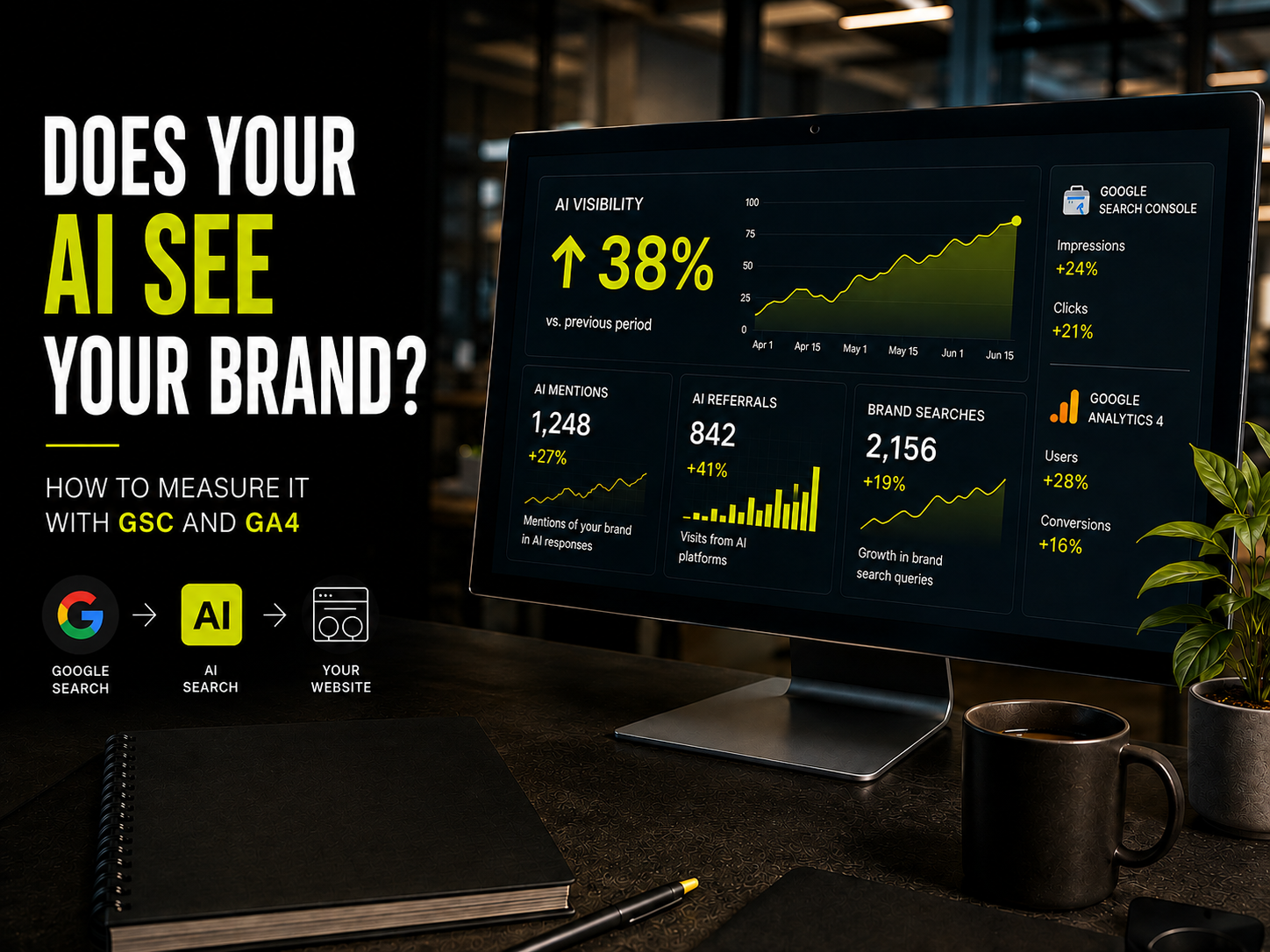
A growing share of search sessions now ends with an AI-generated answer rather than a click through to a website. For a business this raises a practical question: does the brand appear in those answers, and does it produce any measurable outcome?
This article is about measurement. The strategy itself - making a brand understandable and quotable for AI systems - is covered in our AI SEO, GEO and AEO guide. Here we focus on what can actually be read from Google Search Console and GA4.
Why AI visibility cannot be measured with a single number
Classic SEO follows a fairly clear chain: impression, position, click, conversion. In AI search that chain breaks in several places. A user can take the answer without clicking, return days later through a branded search, or arrive from an environment that passes no source information.
The objective is therefore not to find one perfect metric, but to build a set of signals that together show the trend and its effect on enquiries.
What Google Search Console shows about AI search
Search Console includes clicks and impressions from AI Overviews and AI Mode within the overall Web search type data. There is no dedicated filter for these formats, so the analysis relies on comparing trends rather than reading a ready-made AI report.
Which trends are worth checking
- rising impressions with falling CTR on informational queries - a typical sign of AI answer influence;
- branded query volume, which can grow when AI systems mention the brand;
- question-form queries where the page appears but clicks stay flat;
- position stability for individual pages compared with the previous period;
- new query groups that emerge after content is expanded.
The most useful view in practice is a comparison between two equal periods for the same query group. Absolute figures from a single month say very little on their own.
How GA4 helps identify AI-driven traffic
AI assistants mostly appear in GA4 as referral sources. The most common are chatgpt.com, perplexity.ai, copilot.microsoft.com and gemini.google.com. These can be combined into a single segment or custom channel group and reviewed as a distinct traffic channel.
What to set up in the GA4 account
- a segment or custom channel group containing AI assistant domains;
- an Explore report with sessions, engagement rate and conversions by source;
- conversion events that reflect a real business outcome, not just a page view;
- a list of the pages that most often receive AI referral sessions;
- a quality comparison between AI referral and organic search sessions.
In practice the volume of AI referral sessions is usually small, but their engagement and conversion rates are often above average because the user arrives with a formed intent.
What this data does not show
Neither Search Console nor GA4 shows how often a brand is mentioned in AI answers without a click. That part is measured separately through structured prompt testing, described in How to measure visibility in ChatGPT and Google AI.
If the brand does not appear in AI answers at all, the problem is usually accessibility, content or reputation rather than measurement. That scenario is covered in Why don't ChatGPT and Google AI mention your company.
A measurement framework: six indicators
- citation share - how often the brand appears in answers to a defined question set;
- factual accuracy - how correctly AI describes services, pricing and contact details;
- visibility against competitors - which companies are mentioned more often;
- AI referral sessions and their engagement in GA4;
- branded search trends in Search Console;
- qualified enquiries and conversions associated with those sources.
These six indicators form an adequate basis for a monthly report. Additional metrics are only valuable when they change decisions.
Monthly report structure
- Search Console: impressions, clicks, CTR and positions for key query groups versus the previous period;
- the ratio of branded to non-branded queries;
- GA4: AI referral sessions, engagement, conversions and main landing pages;
- prompt review results: citation share and factual errors;
- a comparison of competitor mentions;
- conclusions and three priorities for the next month.
Common measurement mistakes
- reviewing total traffic only and never analysing query groups;
- drawing conclusions from weekly data;
- treating every CTR decline as AI impact without ruling out seasonality and technical issues;
- leaving conversion tracking broken, which devalues every other figure;
- testing AI answers ad hoc without a fixed question list;
- ignoring factual errors that AI repeats about the company.
When the data looks contradictory, the technical side is usually the first place to look. What to check is described in What is a technical SEO audit.
Where to start this week
- check that GA4 conversion events match real enquiries;
- create an AI referral segment and record the current figures;
- save the last 6 months of Search Console data as a baseline;
- prepare 20-30 questions a client would realistically ask an AI assistant;
- run the first review and record where the brand appears and where it does not.
If the measurement system should be set up and maintained professionally, it can be included in the scope of our SEO services alongside content and technical work.
Frequently asked questions
Does Google Search Console report AI Overviews separately?
No. Clicks and impressions from AI Overviews and AI Mode are included in the overall Web search type data, and there is no separate filter. The impact is therefore assessed through trends - shifts in impressions, clicks, CTR and positions for specific query groups and pages.
How can traffic from ChatGPT and other AI tools be identified in GA4?
AI assistants usually appear in GA4 as referral sources such as chatgpt.com, perplexity.ai, copilot.microsoft.com or gemini.google.com. They can be grouped into a segment or a custom channel group and compared with organic search on sessions, engagement and conversions.
Is AI-driven traffic always visible in analytics?
No. Many AI answers are used without a click, some environments do not pass referrer data, and some users arrive later through a direct or branded search. Referral data therefore shows only part of the impact.
Which metrics indicate that AI search is affecting results?
Several signals should be read together: rising impressions with falling CTR on informational queries, changes in branded search volume, referral sessions from AI tools, the engagement and conversions of those sessions, and citation share for industry-relevant questions.
How often should an AI visibility report be produced?
In practice a monthly report with a deeper quarterly review is sufficient. Weekly AI search data fluctuates too much to support strategic decisions.
Can AI visibility be measured without paid tools?
Yes. Google Search Console, GA4 and a structured manual prompt review are enough to build a solid baseline measurement system. Paid tools mainly automate citation tracking and save time rather than provide fundamentally different data.
Where should a company start if no measurement system exists yet?
Start by fixing conversion tracking in GA4, creating an AI referral segment, recording current Search Console figures as a baseline, and preparing a list of 20-30 industry-relevant questions for regular review.
If impressions are rising while clicks or CTR appear contradictory, see our guide to measuring SEO in the age of AI answers.