Google Ads Search campaigns are becoming increasingly automated. Keywords, ad copy, landing pages and audience signals are no longer managed exclusively through manual decisions. Google's machine-learning systems now influence a growing part of campaign delivery.
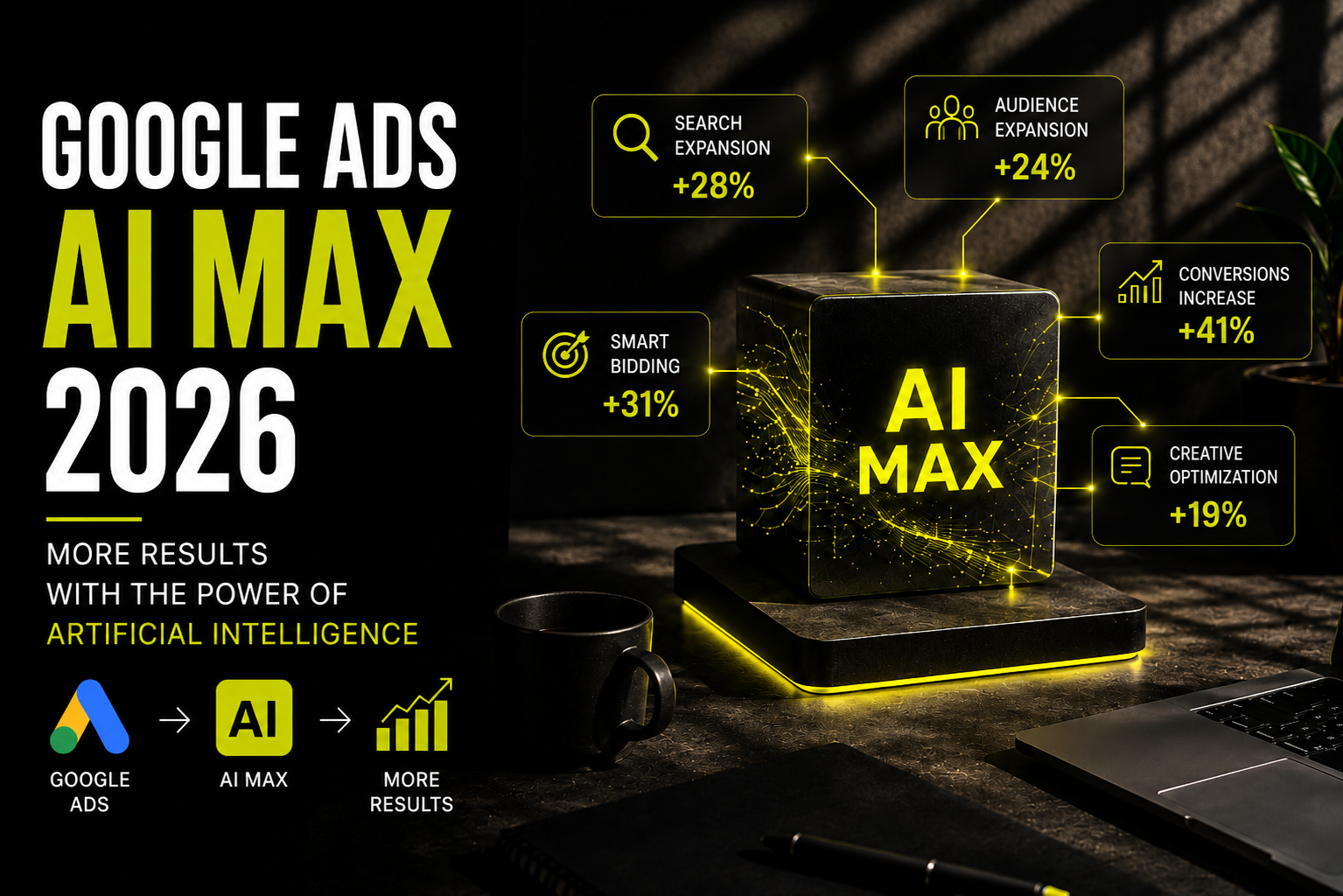
One of the most important developments in 2026 is the expansion of AI Max for Search and the gradual transition of several existing automation features into a more unified system.
This does not mean that businesses should simply enable AI Max and expect an improvement.
The more decisions an algorithm makes, the more important conversion quality, account structure, landing pages, first-party data and clearly defined business objectives become.
This guide explains:
- what AI Max actually is;
- what changes in 2026 and 2027;
- which campaign decisions it can automate;
- which controls advertisers retain;
- how to assess account readiness;
- how to test it without exposing the entire budget.
What is Google Ads AI Max?
AI Max is not a separate Google Ads campaign type.
It is a suite of features for Search campaigns that helps Google interpret a wider range of queries, adapt advertising messages and select a more relevant landing page.
Its main components include:
Search term matching
The system can identify relevant searches beyond a strictly defined keyword list.
It uses existing keywords, ads, landing-page content and other account signals to understand which searches may be relevant to the business.
Text customisation
Google can adapt or create individual advertising elements using the landing page, existing assets and the user's search query.
Final URL expansion
The system may send a user to a different page from the URL originally selected by the advertiser if it considers another page more relevant.
This is where both the opportunity and the main risk of AI Max appear.
A broader interpretation of demand can uncover valuable searches. In a poorly prepared account, however, it can also increase irrelevant queries, inaccurate messages and unsuitable landing-page selections.
What changes in 2026 and 2027?
Google has announced different timelines for different campaign features.
From September 2026, campaigns using Automatically Created Assets or campaign-level broad match will begin moving to the corresponding AI Max capabilities.
The automatic transition of Dynamic Search Ads is scheduled to begin in February 2027.
These dates should not be confused.
Businesses should audit their accounts before an automatic transition begins, rather than waiting for campaign results to change.
Google provides upgrade tools intended to move existing settings and data into standard ad groups. A technical migration, however, does not prove that the new campaign logic matches the company's commercial objectives.
Does AI Max replace keywords?
No. Keywords and the existing Search campaign structure remain part of the current model.
Their role is changing.
Previously, keyword lists largely defined the boundaries within which an ad could appear. AI Max uses a broader set of signals and can find searches that are not explicitly listed.
This makes several activities particularly important:
- search-term analysis;
- negative-keyword management;
- separation of services, products and markets;
- clear landing-page architecture;
- reliable first-party data;
- accurate conversion measurement.
For more context on campaign structure and the local market, read our guide to Google Ads in Latvia in 2026.
The biggest risk is not AI - it is the wrong objective
AI Max optimises according to the signals it receives.
If a form start, short call, page view or another low-value action is configured as the primary conversion, the system may become very efficient at generating more of that action.
A higher conversion count in Google Ads does not necessarily mean more qualified customers.
Before expanding automation, verify:
- which actions are configured as primary conversions;
- whether one action is counted more than once;
- whether a lead is recorded only after successful submission;
- whether qualified and unqualified enquiries are separated;
- whether CRM outcomes are returned to the advertising platform;
- whether the account has enough reliable data.
If the campaign already attracts traffic without delivering meaningful enquiries, first determine why Google Ads is not producing results.
Final URL expansion: opportunity and risk
Final URL expansion can be useful for websites with many well-structured service, product or category pages.
It can only work well if Google understands the website correctly.
Problems may appear when the site contains:
- outdated service pages;
- pages competing for the same subject;
- similar content across several URLs;
- weak category pages;
- incorrect canonical tags;
- mixed language versions;
- pages not designed for advertising traffic;
- different offers without a clear hierarchy.
Before enabling Final URL expansion, check whether the website is ready for paid advertising.
URL exclusions should also be created for pages that must not receive paid traffic.
What control does the advertiser retain?
AI Max does not necessarily remove advertiser control.
Depending on account and feature availability, advertisers can use:
- brand inclusions and exclusions;
- location controls;
- URL exclusions;
- negative keywords;
- text guidelines;
- restrictions on unwanted terms or concepts;
- mandatory legal or informational text;
- experiments before full implementation.
Google expanded text guidelines in 2026, enabling advertisers to describe terms or ideas that should not appear in generated content.
Availability may vary by account, language, market and rollout stage. A feature announced by Google should not automatically be treated as available in every Latvian advertising account.
What should be checked before enabling AI Max?
1. Conversion measurement
Confirm that Google Ads is optimising towards a genuine business outcome rather than the easiest available action.
2. Campaign structure
Different services, markets and objectives should be separated logically.
3. Search-term quality
Establish a baseline and record the share of irrelevant terms before starting the experiment.
4. Landing pages
Every important subject should have a relevant page with a clear offer and conversion path.
5. Brand controls
Define which brands, competitors, statements and terms the system may or may not use.
6. Budget and data volume
There is no universal budget that guarantees strong AI Max performance.
A lower volume of data may require a longer testing period and more cautious interpretation.
7. Measurement plan
Before launch, define:
- the primary KPI;
- supporting quality metrics;
- unacceptable outcomes;
- test-stopping conditions;
- the date on which the decision will be made.
How to test AI Max safely
The safest approach is not to enable every feature across every campaign immediately.
Select a controlled campaign
Begin with a campaign that has enough historical data and a clearly defined outcome.
Preserve the baseline
Record:
- spend;
- conversions;
- conversion value;
- qualified leads;
- search-term quality;
- landing-page distribution.
Use an experiment
Where available, use a Google Ads experiment to compare AI Max with the existing configuration.
Measure business quality
Do not evaluate only the platform conversion count. Compare:
- lead quality;
- genuine sales opportunities;
- revenue;
- rejected-enquiry rate;
- alignment between the brand, queries and generated messages.
Do not judge the result after a few days
The appropriate test duration depends on conversion frequency, data volume and the sales cycle.
Google has published aggregated internal data indicating that, within a particular selection of non-retail campaigns, using the full AI Max suite was associated with an average 7% increase in conversions or conversion value at a comparable CPA or ROAS.
This is not a guaranteed result for an individual company. Performance depends on data quality, campaign structure, competition, the offer and measurement accuracy.
When should implementation be postponed?
Businesses should delay broader automation when:
- conversion tracking is unreliable;
- lead quality cannot be identified;
- suitable landing pages are missing;
- the campaign regularly attracts irrelevant searches;
- legal or brand requirements have not been documented;
- the budget does not allow a controlled experiment;
- nobody will review search terms, URLs and generated messages.
AI Max cannot replace a coherent strategy. It can scale both a well-designed system and its mistakes.
AI Max, Performance Max or Meta Ads?
AI Max expands Search campaign capabilities. Performance Max operates across multiple Google channels, while Meta Ads relies more heavily on audiences, creative assets and demand generation.
The channel should be selected according to the customer journey and business objective.
Read our Google Ads versus Meta Ads comparison.
AI Max should not be evaluated separately from analytics, campaign management, landing pages and experimentation. For more information about budgets, read Google Ads pricing in Latvia.
Conclusion
AI Max is an important part of the development of Google Search advertising, but it is not an automatic route to a lower CPA or greater sales.
Better performance is possible when the system receives reliable data, appropriate restrictions, relevant landing pages and a correctly defined business objective.
Before switching, a business should answer three questions:
- Are we measuring a genuinely valuable result?
- Are the website and account structure ready for broader automation?
- Do we have an experiment capable of proving an improvement?
If you need an audit of the current account, conversion tracking and AI Max implementation risks, explore our Google Ads and Meta Ads services.
Frequently asked questions
Is AI Max a separate Google Ads campaign type?
No. AI Max is a suite of Search campaign features that expands query matching, adapts advertising content and may select a more relevant landing page.
Will AI Max replace keywords?
Keywords remain in the current model, but the system can use broader signals and identify searches beyond a precisely defined keyword list.
When does the transition to AI Max begin?
Updates for campaigns using Automatically Created Assets and campaign-level broad match begin in September 2026. The automatic Dynamic Search Ads transition begins in February 2027.
Can AI Max change the landing page?
Yes. When Final URL expansion is enabled, Google may select another website page that it considers more relevant to the search.
Can advertisers restrict AI-generated ad copy?
Google provides text guidelines, brand controls and other restrictions, although availability may vary by account, language and market.
Does AI Max guarantee more conversions?
No. Performance depends on measurement, data quality, campaign structure, landing pages, budget and market conditions. Platform averages are not a guarantee for an individual business.
Is AI Max suitable for a small advertising budget?
It depends on conversion frequency and data quality. A lower data volume may require a longer test and more cautious interpretation.
Can AI Max be enabled without an account audit?
Technically yes, but conversions, campaign structure, search terms, landing pages, URL exclusions and brand controls should be reviewed before switching.