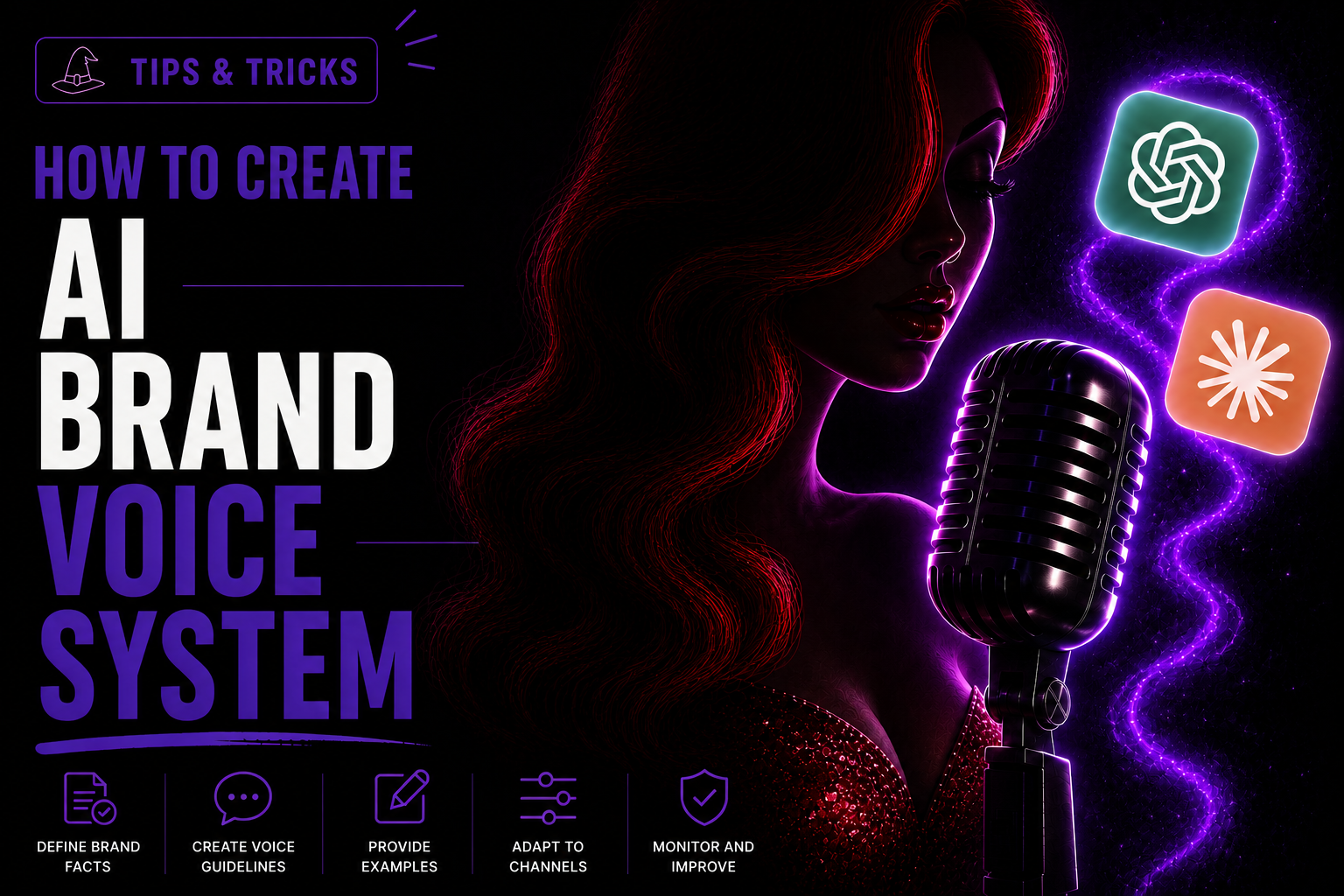
Most companies already use AI tools daily, yet the output often sounds the same: correct, smooth and completely unrecognisable. The problem is rarely the model. The problem is that the model is never given a system for writing as your brand.
This guide describes a practical system we will call a Brand Voice OS. It is not software and it is not a secret prompt. It is an editorial structure of seven layers, five templates and one quality matrix that works with ChatGPT, with Claude, and with whatever tool appears next year.
Model behaviour changes. Versions are updated, default styles shift, and what works well today may behave differently in six months. That is why the system is built around your facts, rules and review process rather than around one tool's current behaviour.
Why one "perfect prompt" does not solve brand consistency
A long prompt can improve one output. It does not solve the problem for ten people, six channels and three languages at once. Consistency is an organisational problem, not a wording problem.
- A prompt gets lost. It lives in one chat, with one person, without a version or an owner.
- A prompt holds no facts. When information is missing, the model fills the gap with average market language.
- A prompt holds no examples. Adjectives cannot describe rhythm, sentence length or the way an argument is built.
- A prompt holds no evaluation. Without criteria, quality becomes a matter of taste.
- A prompt does not learn. Without feedback, the same mistakes repeat every week.
What a brand voice actually consists of
A brand voice is not a list of adjectives, a set of favourite words, a "friendly but professional" tone, an instruction to "write like an expert", or a copy of another company's style. It is a decision system.
- What the brand believes and what it states publicly.
- Whom it addresses and what level of knowledge it assumes.
- How directly it communicates and how it explains complexity.
- Which claims it can support and which it must not make.
- Which words and structures it uses and which it deliberately avoids.
- How the voice shifts across channels without losing identity.
Five concepts that are often confused
| Concept | What it defines | How often it changes |
|---|---|---|
| Brand identity | What the company is and stands for | Rarely, on strategic change |
| Brand voice | The relatively stable way it expresses itself | Rarely, through controlled versions |
| Tone | Situational adjustment of the voice | Often, depending on context |
| Message | The specific information in one piece of content | In every piece |
| Format | The container: article, ad, page, email, proposal | In every task |
The seven layers of a Brand Voice OS
The system has seven layers. Each layer solves one problem, and the absence of each produces a predictable failure.
| Layer | Purpose | Required input | Typical failure when missing |
|---|---|---|---|
| 1. Brand evidence | Give the model verified source material | Product, audience, positioning, proof | The model invents facts and generalises |
| 2. Voice specification | Turn style into executable rules | Scales, vocabulary, prohibitions | Every writer interprets the style differently |
| 3. Examples and anti-examples | Teach patterns words cannot describe | Approved and rejected texts | Text is formally correct but foreign |
| 4. Channel adapters | Fit the voice to the channel | Channel goals and constraints | An ad reads like an article |
| 5. Task brief | Define the specific job | Objective, sources, format, limits | The model assumes context that does not exist |
| 6. Quality assurance | Make evaluation repeatable | Criteria and threshold | Quality becomes a matter of taste |
| 7. Feedback and version control | Accumulate improvements | Change log, owner | The same mistakes repeat |
Step 1: build a brand evidence base
A model cannot know your pricing policy, the objections your sales team hears, or which results you are allowed to publish. If that information is missing, it is replaced by the industry average. This is exactly why AI copy sounds like a competitor's copy.
COMPANY
- Company name:
- Product or service:
- Main market:
- Business model:
- Price position:
- Main commercial objective:

AUDIENCE
- Primary audience:
- Audience level of knowledge:
- Main problem:
- Main objections:
- What the audience has already tried:
- What creates trust:
- What creates resistance:

POSITIONING
- Why the company exists:
- What it believes:
- What makes its approach different:
- What it refuses to do:
- Which claims can be supported:
- Which claims must not be made:

CUSTOMER LANGUAGE
- Phrases customers actually use:
- Questions customers ask:
- Terms customers understand:
- Internal terminology customers do not use:

EVIDENCE
- Verified facts:
- Case studies:
- Original data:
- Expert experience:
- Approved customer quotations:
- Sources that may be referenced:

RULE: leave empty fields empty. The model is not allowed to fill
them with assumptions.
This intake is not filled in by one person. The fastest route is short interviews with the founder, the sales team and customer support. Support usually supplies the most accurate customer language because they see the real wording. If positioning is not settled yet, start with brand and logo work rather than with prompts.
Step 2: convert brand evidence into operational writing rules
"Sound premium" is not an instruction. It cannot be executed and it cannot be checked. An operational rule looks different: average sentence length under 18 words, every claim followed by a reason, zero superlatives without evidence.
Brand personality:
Audience relationship:
Level of formality:
Sentence rhythm:
Preferred sentence length:
Technical depth:
Emotional intensity:
Humour:
Use of first and second person:
Preferred vocabulary:
Forbidden vocabulary:
Preferred proof:
Acceptable calls to action:
Unacceptable claims:
Formatting rules:
Language-specific rules:

SCALES
Formality: 1-5
Directness: 1-5
Technical depth: 1-5
Emotional intensity: 1-5
Humour: 0-3
Commercial pressure: 1-5
Scales are useful for two reasons. First, they can be passed to the model numerically and repeated in every task. Second, they let an editor say precisely "directness 4, not 2" instead of "something feels off".
Step 3: add examples and anti-examples
Examples teach what abstract descriptions cannot: rhythm, transitions, the order of an argument, how quickly the main point arrives. The minimum set is three approved short examples, two approved long examples and three anti-examples with explanations.
EXAMPLE:
[approved text]
WHY IT FITS:
- ...
- ...
- ...

ANTI-EXAMPLE:
[text that does not fit]
WHY IT FAILS:
- ...
- ...
- ...

CORRECTION RULE:
[what the model should do differently]
A common mistake is filling the system with old published texts simply because they exist. If the content predates a positioning change or was written without an editorial standard, it will teach the model exactly the habits you want to remove. Examples must be selected, not collected.
Step 4: create channel-specific voice adapters
One brand should not sound identical in every channel. The core voice stays stable while directness, length, amount of evidence and CTA intensity change.
| Channel | Reader state | Primary objective | Tone adjustment | Recommended structure | What to avoid |
|---|---|---|---|---|---|
| Website service page | Comparing options | Clear promise and next step | Directness 4, commercial pressure 3 | Problem, solution, process, proof, CTA | Generic promises without support |
| SEO blog article | Looking for an answer | Answer faster than competitors | Directness 4, commercial pressure 1 | Answer first, details after | Empty introductory paragraphs |
| Google Ads | Active need | Match the query | Directness 5, minimum length | Need, benefit, action | Metaphors and wordplay |
| Meta advertisement | Passive attention | Stop and interest | Emotion 3, directness 4 | Hook, context, one benefit | Jargon and long constructions |
| LinkedIn post | Professional context | Competence without selling | Formality 3, humour 1 | Observation, argument, conclusion | Corporate emptiness |
| Personal correspondence | One clear step | Formality 2, directness 4 | Context, value, single CTA | Several objectives in one email | |
| Sales proposal | Assessing risk | Reduce uncertainty | Technical depth 4 | Task, approach, scope, timeline | Unsupported guarantees |
| Customer-support reply | Problem right now | Resolve and reassure | Emotion 2, directness 5 | Acknowledge, resolve, timeline | Defensive tone |
Step 5: use a structured task brief
The brief is where evidence, voice and channel meet. The key rule: source material and constraints must sit inside the task rather than rely on an earlier conversation. Chat context is dropped, compressed and reinterpreted, while what is written into the task stays fixed and verifiable.
ROLE
You are writing as [brand/company], not as a generic copywriter.

OBJECTIVE
The business objective of this content is:
[objective]

AUDIENCE
The reader is: [audience]
The reader already knows: [knowledge]
The reader needs to understand or do: [outcome]

SOURCE MATERIAL
Use only the following verified information:
[source material]

BRAND VOICE
Follow Brand Voice OS version: [version]

CHANNEL
[channel]

FORMAT
[format, length, required sections]

CLAIMS AND LIMITATIONS
Allowed claims: [claims]
Claims that must not be made: [limitations]

OUTPUT RULES
- Do not invent facts, quotations, statistics or case studies.
- Mark missing information as [INFORMATION REQUIRED].
- Prefer specific explanations to generic marketing language.
- Remove repetition and empty introductory phrases.
- Explain why each recommendation matters.
- Follow the required language version and terminology.

QUALITY CHECK
Before returning the final version, evaluate the draft using the
supplied QA matrix and revise any criterion scoring below 2.
Step 6: evaluate every output using the same scorecard
As long as quality is a matter of taste, the team argues about wording instead of improving the system. Eight criteria with three levels make evaluation repeatable. The maximum is 16 points.
| Criterion | 0 - unacceptable | 1 - requires revision | 2 - ready to publish |
|---|---|---|---|
| 1. Factual accuracy | Contains an unsupported or invented fact | Facts correct but partly unverifiable | Every fact traceable to a source |
| 2. Brand-voice consistency | The text could belong to anyone | Recognisable but with foreign phrasing | Matches the voice spec and examples |
| 3. Audience relevance | Speaks to the wrong reader | Partly on target, partly generic | Knowledge level and objections addressed |
| 4. Clarity | The point has to be searched for | Understandable on second reading | Main point clear immediately |
| 5. Specificity | Only general statements | Partly concrete, partly decorative | Concrete steps, conditions, examples |
| 6. Channel fit | Format does not suit the channel | Format fits, length or CTA does not | Structure and length fit the channel |
| 7. Commercial integrity | A promise that cannot be kept | Borderline phrasing | Promise matches real capability |
| 8. Originality and usefulness | Restates the obvious | Useful but already known | Gives the reader something usable |
Publication rule
- Total score at least 13 out of 16.
- Factual accuracy may not score 0.
- Commercial integrity may not score 0.
- Any unsupported fact blocks publication regardless of the total score.
Total score:
Critical factual issue:
Unsupported claim:
Voice inconsistency:
Generic passage:
Missing evidence:
Required correction:
Publication decision: approve / revise / reject
Step 7: introduce feedback and version control
A system that never changes becomes outdated. A system that changes chaotically becomes unmanageable. The answer is a simple version format and a change log.
Brand Voice OS v1.0
Date:
Owner:
Languages:
Approved channels:
Main changes:
Known limitations:
Next review date:
- Minor wording changes are v1.1.
- Structural changes are v2.0.
- Rejected rules stay in the change log with the reason.
- Every approved example states its language and channel.
- LV, RU and EN may need separate language rules even when positioning is shared.
How to use ChatGPT and Claude in the same workflow
There is no universal answer about which tool is better. Model versions are updated and behaviour shifts. The practical approach: prepare one Brand Voice OS, give both models the same material, and compare the outputs with your own matrix. A detailed comparison protocol is described in ChatGPT vs Claude for marketing.
- 1.Prepare one shared Brand Voice OS.
- 2.Give both models the same source material and brief.
- 3.Ask Model A to produce the first draft.
- 4.Ask Model B to audit the draft using the eight-criterion matrix.
- 5.Return the audit to Model A for revision.
- 6.A human verifies facts, positioning and commercial implications.
- 7.Record the accepted changes in the Brand Voice OS.
Three workflow variants
| Variant | When to use | Steps |
|---|---|---|
| Fast | Low-risk content, internal material | One model drafts, a human reviews |
| Quality | Public content, service pages | One model drafts, the second critiques, a human approves |
| High-risk | Medical, financial, legal claims | One model structures, the second checks, a subject-matter expert verifies every claim |
Important: different model versions may behave differently, so test representative tasks instead of relying on reputation. A model that performs well on long analytical documents is not automatically best for ads or social posts. The same principle is covered in our AI prompt library for marketing.
A complete reusable Brand Voice OS template
This is one document you can keep in the team knowledge base and attach to every task. It combines all seven layers.
BRAND VOICE OS v1.0

1. BRAND EVIDENCE
[Template A completed]

2. VOICE SPECIFICATION
[Template B completed, with scales]

3. EXAMPLES AND ANTI-EXAMPLES
[3 short + 2 long approved, 3 anti-examples with reasons]

4. CHANNEL ADAPTERS
[Channel: objective, tone, structure, constraints]

5. TASK BRIEF
[Template E as a repeatable form]

6. QUALITY MATRIX
[8 criteria, threshold 13/16, blocking rules]

7. GOVERNANCE
[Owner, version, change log, review date]
A practical example: copy before and after the system
The example uses a fictional B2B software company. It is not a Juice Digital Agency client and all inputs are hypothetical.
Original text
"Our innovative solution helps companies take their business to
the next level, optimise processes and achieve outstanding results."
- The language is interchangeable: it fits any company's site.
- The audience is undefined.
- No specific problem is named.
- The outcome is claimed without support.
- There is no evidence.
- It is unclear what the reader should do next.
Labelled fictional inputs
- Audience: logistics teams.
- Problem: manual status updates.
- Verified capability: combines shipment updates in one workspace.
- Limitation: do not claim guaranteed savings.
- Tone: direct, calm, technical.
Logistics teams usually collect shipment statuses from emails,
carrier portals and chat messages. In our tool those updates sit in
one workspace, so checking a status does not require visiting each
carrier separately.
We can show how this works on your routes in a short demo.
For most logistics teams the problem is not the status data.
The problem is that the data sits in five different places.
We bring shipment updates into one workspace.
That does not fix carrier delays, but it removes the time spent
finding out where a shipment currently is.
Shipment statuses in one workspace.
No carrier portal hopping.
Book a demo.
- The rule "name the specific problem" replaced "next level" with manual status hunting.
- The rule "verified capabilities only" removed the promise of outstanding results.
- The savings limitation prevented invented numbers from appearing.
- The channel adapter changed length and CTA while keeping the same voice.
Common implementation mistakes
| Mistake | Why it happens | Business risk | Practical correction |
|---|---|---|---|
| One enormous prompt for everything | Feels faster than building a system | Non-repeatable output and dependence on one person | Split into layers and store outside the chat |
| Adjectives only | Brand guidelines are often written that way | Everyone interprets the style differently | Add scales and rules |
| No examples | Selecting examples takes time | Text is formally correct but foreign | Three short and two long approved examples |
| Examples without explanation | It seems self-evident | The model copies the surface, not the logic | Add reasons to every example |
| The model invents facts | Inputs are incomplete | False public claims | Ban invention and require [INFORMATION REQUIRED] |
| Voice mixed with campaign tone | The campaign feels urgent now | The brand changes every quarter | Separate stable voice from situational tone |
| One structure for every channel | Copying is easier | Ads and emails stop working | Channel adapters |
| Approval without a source | The text sounds convincing | Reputational and legal risk | A source for every fact before approval |
| Changing prompts without versions | Edits happen in a hurry | Nobody knows what changed or why | Version numbers and a change log |
| Model output as the final decision | It saves time | Editorial accountability disappears | A human approves publication |
| Mechanical translation between languages | Fast and cheap | Unnatural language and lost recognition | Separate language rules for LV, RU and EN |
| Quality measured by taste | No criteria exist | Endless debate and inconsistency | The eight-criterion matrix |
Together these mistakes produce one visible effect: brands start to sound the same. Why this happens at market scale is covered in our article on why AI makes brands look alike.
What AI must never decide independently
- Legal or regulatory claims.
- Prices and commercial terms.
- Guarantees.
- Use of confidential client information.
- Whether a claim is sufficiently supported.
- Whether a customer quotation may be published.
- Crisis communication.
- Discriminatory or sensitive targeting.
- Final brand positioning.
- Publication approval in high-risk industries.
This article is not legal advice. If the content touches a regulated industry, consumer rights or personal data, involve the appropriate responsible specialist before publication.
A 30-day implementation plan
| Week | Focus | Work | Deliverable by end of week |
|---|---|---|---|
| 1 | Evidence | Collect source material, interview the founder, sales and support, capture customer language, remove unsupported assumptions | Template A completed with gaps marked |
| 2 | Voice system | Define voice dimensions, build examples and anti-examples, create channel adapters, prepare the master brief | Templates B, C, D and E ready |
| 3 | Testing | Select 10 representative tasks, test in ChatGPT and Claude, score the outputs, document recurring failures | Test log and an updated system |
| 4 | Governance | Assign an owner, introduce version numbers, define approval rules, create a change log | Brand Voice OS v1.0 with a monthly review date |
If the system also has to work in search and AI answers rather than only inside the editorial team, check how your content is cited. We covered this in our AI search and GEO guide.
Conclusion
Recognisable AI content comes from a system, not from a clever one-line prompt. The system must combine verified facts, executable rules, examples, evaluation and human accountability. ChatGPT and Claude are tools inside the workflow, not owners of the brand.
Start with one channel and ten tasks. Once the matrix shows a stable result, extend it to the remaining channels and languages. If you want the system implemented alongside a real content plan and named owners, see our content marketing service.
Frequently asked questions
Is one detailed prompt enough to maintain a consistent brand voice?
Usually not. A detailed prompt may improve one output, but consistency requires a system containing verified brand information, voice rules, examples, channel adaptations, quality criteria and a regular feedback process.
Can ChatGPT or Claude be given a company's previous content?
Previous content can be used as context and examples, but its quality, relevance and alignment with the current brand strategy should be reviewed first. Automatically reusing old content may reinforce outdated mistakes and an inconsistent style.
Which is better for brand content - ChatGPT or Claude?
There is no universal answer. Performance depends on the task, model version, language, context, examples and quality criteria. The safest approach is to test both tools on the same representative tasks and score their outputs using one evaluation framework.
How can a company prevent invented facts in AI-generated content?
The prompt should define the permitted sources, prohibit the invention of missing information and require the model to flag information gaps. A human must verify every fact, number, quotation and commercial claim before publication.
How often should a brand voice system be updated?
The system should be reviewed after significant changes to positioning, audiences, services or communication channels. A monthly quality review and several deeper audits each year are also useful for detecting drift.
Can the same brand-voice rules be used in every language?
Positioning and core principles may be shared, but Latvian, Russian and English need separate rules for vocabulary, rhythm, forms of address and terminology. Mechanical translation often produces unnatural content and weakens brand recognition.
Who is responsible for the quality of AI-generated brand content?
Responsibility should be clearly assigned. A process owner normally maintains the brand voice system, a writer or editor reviews language and structure, and a subject-matter expert approves factual and professional claims.